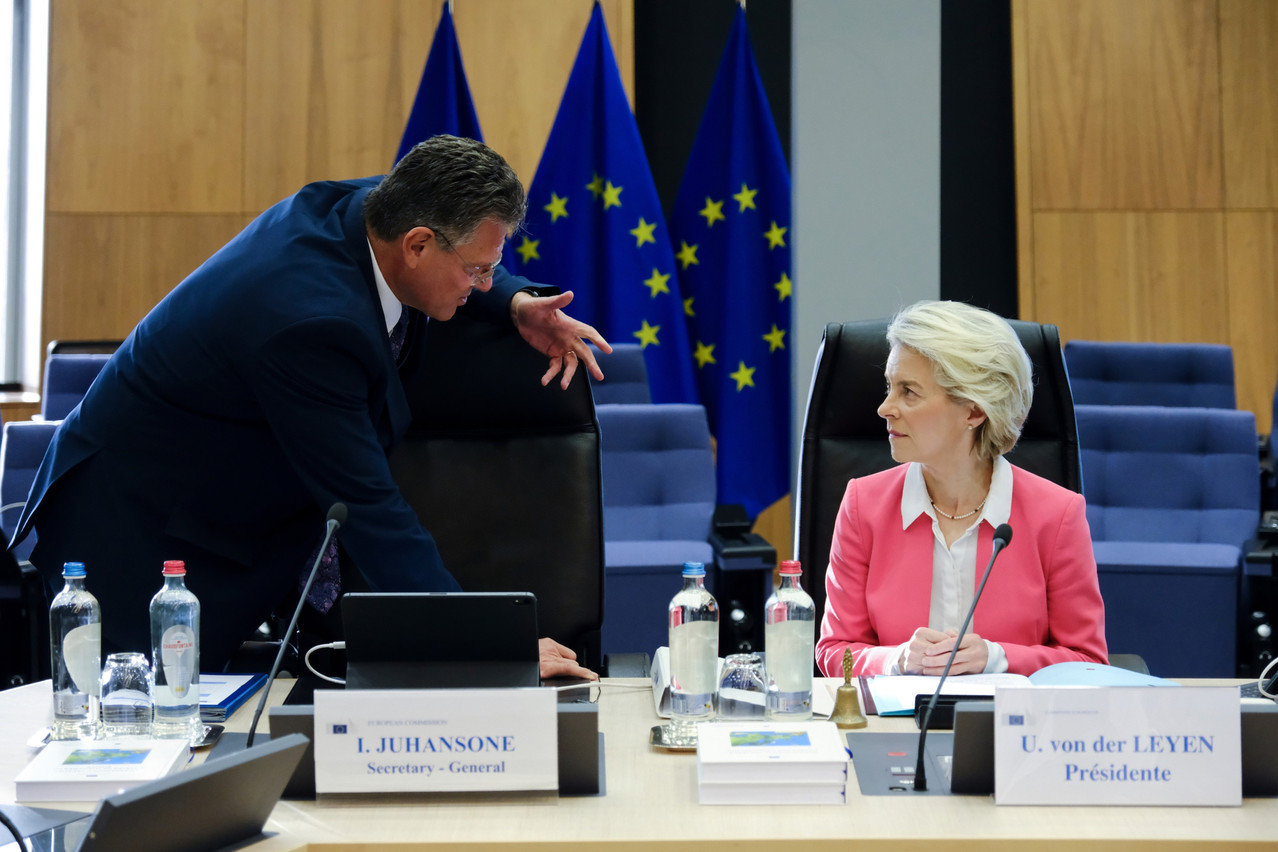
The European Commissioner for Trade and Economic Security confirmed before the weekend that the European executive would unveil "by mid-October a very strong trade protection measure". In an interview with Euractiv, Maroš Šefčovič pointed out that the European Union and the United States were facing "the same challenge, namely global overcapacity". According to him, "China is not the only target", with Brussels examining "all imports" to the European market.
Commission President Ursula von der Leyen had already announced to the European Parliament that the current safeguard clause, which expires in 2026, would be replaced by "a new long-term instrument". This clause, introduced in 2019 to curb massive imports, was strengthened in 2024 in the face of rising flows from China.
For the industry, the urgency is clear. At the Fédil's back-to-school BBQ, Valérie Massin, ArcelorMittal's new country manager for Luxembourg, pointed out that "Europe is now a depressed region for steel", where demand has fallen by 25% in five years. She pointed out that "the European industry is running at 60% of its capacity, far from the 80% threshold needed to cover its fixed costs", hence the "urgent" need to adopt new protection tools.
Massin also called for a genuine level playing field. "We need to move from the concept of free trade to that of fair trade", she explained, calling for the reform of safeguard measures to be supplemented by instruments such as the Carbon Border Adjustment Mechanism (CBAM) or the strict application of European chemical regulations to importers.
The stakes are also strategic. "We have lost 60m tonnes of our production capacity since 2008", admitted Šefčovič, adding that the EU is "the only region in the world where production is falling". Its share of global production has fallen from 9.4% to 6.9% since 2014, according to the World Steel Association. Brussels is also considering strengthening traceability to prevent circumvention and concluding a free trade agreement with India by the end of the year.
For steelmakers, what is at stake is the survival of thousands of jobs and the ability to invest in decarbonisation. "The key word is urgency", insisted Massin, at a time when plant closures are multiplying in Europe.
This article was originally published in French.