As the global steel industry prepares for 165m tonnes of additional capacity by 2027, the OECD is sounding the alarm. Its “Steel Outlook 2025” report points to a growing field of not-always-fair competition, caused in large part by massive subsidies in certain emerging economies, notably China.
The organisation predicts that production capacity will increase by 165m tonnes between 2025 and 2027, even though annual growth in demand will not exceed 0.7%. This unbalanced dynamic will lead to an estimated global overcapacity of 721m tonnes by 2027, well in excess of the combined production of all OECD countries.
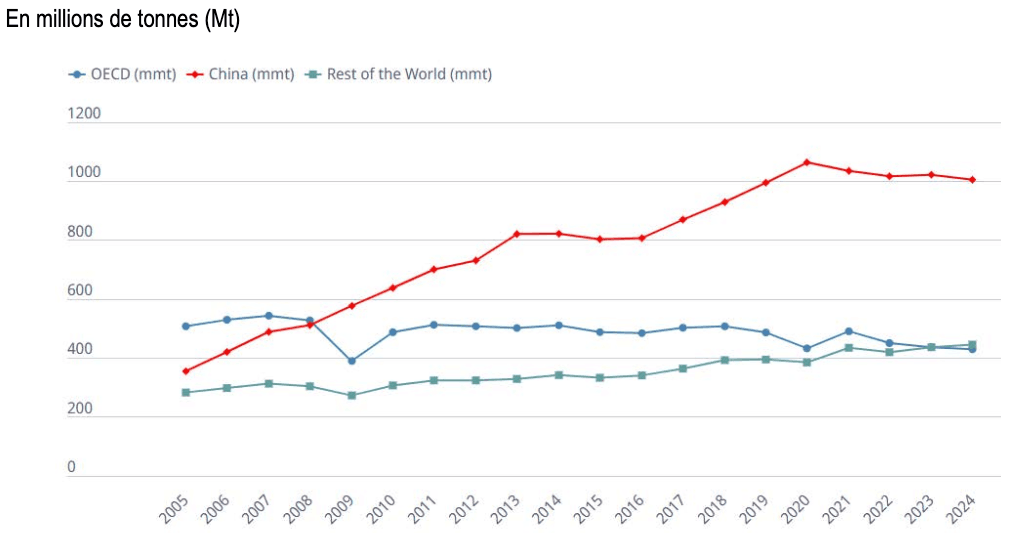
Steel production in OECD countries, China and the rest of the world. Graph: OECD
Europe is one of the main victims of this mismatch. Since 2020, steel imports into the European Union have risen by 13%, against a backdrop of contracting or stagnating domestic demand. European producers are suffering a double whammy: erosion of their market share and constant pressure on prices, fuelled by Asian steel sold at low cost.
China plays a central role in this instability. In 2024, its exports reached a record 118m tonnes, flooding world markets. These volumes are largely supported by public subsidies that distort competition. According to the OECD, the Chinese subsidy rate is ten times higher than that observed in OECD countries. It includes below-market loans, subsidised energy prices and massive tax incentives. The organisation points out that this aid keeps plants in operation that should have been closed and encourages investments that are only economically viable with state intervention.
This unfair competition is triggering a growing defensive reaction from market economies. In 2024, 19 governments launched 81 anti-dumping investigations into steel products, compared with just 16 the previous year. Almost 80% of these measures targeted Asian producers, with China alone accounting for a third of the cases. But these protection mechanisms are rapidly reaching their limits: exporters are circumventing the sanctions by processing their products or transiting them through third countries. The OECD estimates that 17.6% of world steel trade between 2013 and 2020 could be redirected or circumvented.
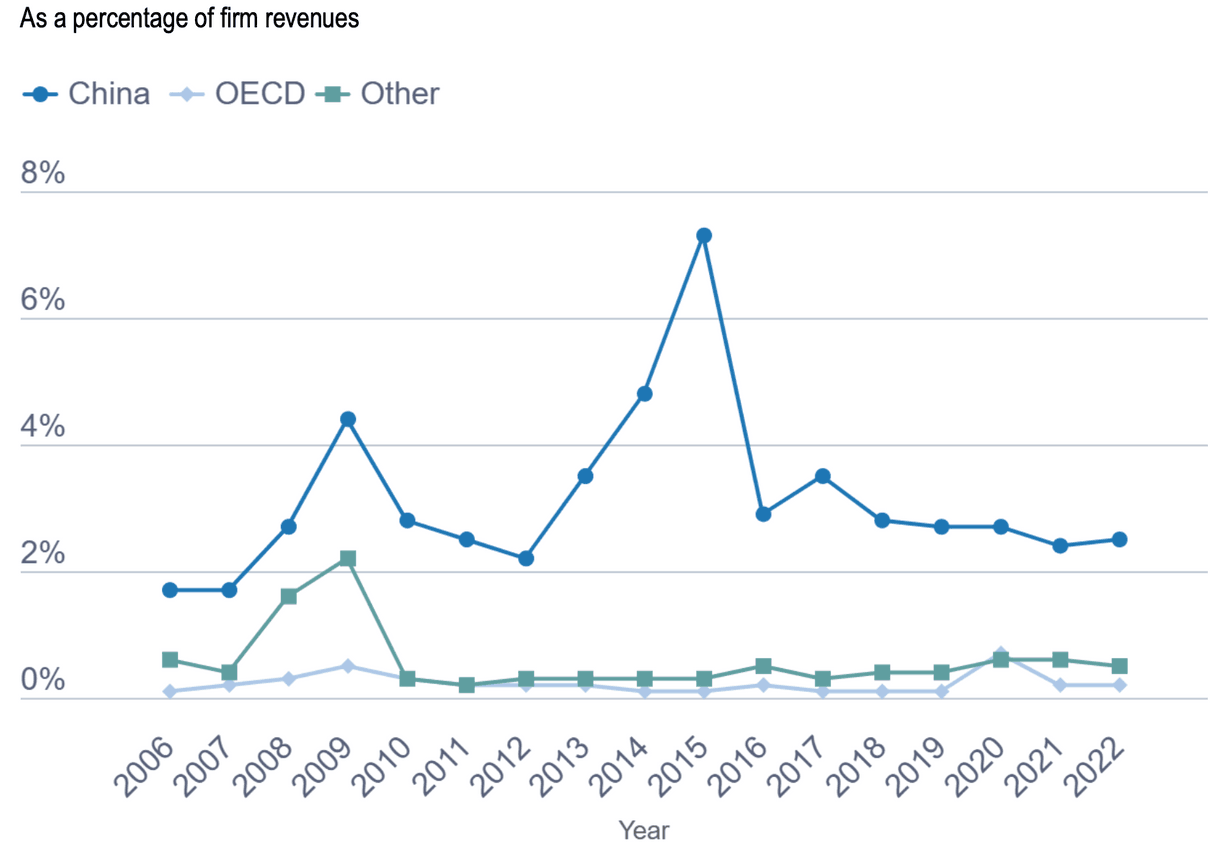
Steel subsidy rates in China, OECD countries and other countries. Graph: OECD
In this climate of latent trade war, Europe is struggling to defend its industry. The rate of utilisation of steelmaking capacity could fall back to 70%, a threshold that would seriously undermine the sector’s profitability. This limits the room for manoeuvre to invest in plant modernisation or the climate transition. Much of the new global capacity planned between now and 2027 will still be based on BF/BOF (blast furnace/oxygen furnace) technology, which emits a lot of CO2. Yet, according to the report, current overcapacities make it difficult to implement decarbonised solutions that are economically viable in the long term.
Finally, the report stresses that, without structural reforms in the countries behind the surpluses or greater international cooperation, the imbalances in the global steel market are likely to become entrenched. For European steelmakers, whose issues are simultaneously economic, industrial and environmental, the urgency is now political.
This article was originally published in French.