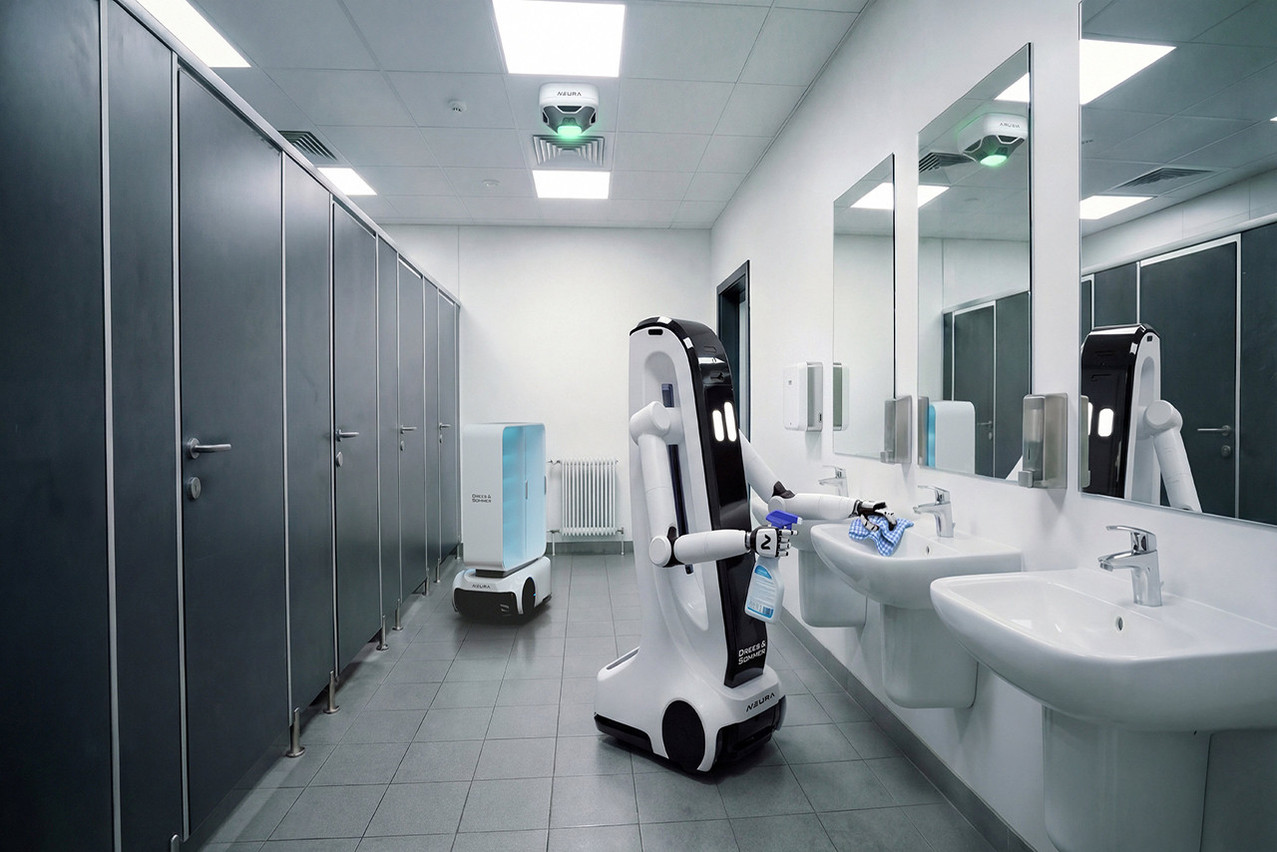
The cooperation reflects a new understanding of architecture and technology: buildings are becoming adaptive, processes increasingly automated, safer and more efficient, with robotics integration considered from the outset. “We are connecting the physical and the digital worlds, creating the conditions for robots to interact better with both their environment and humans,” says Dierk Mutschler, a member of the executive board at Drees & Sommer. “This opens up new possibilities for use in nursing and care facilities, production, office buildings and airports.”
Smart buildings need smart actors
“Robots will soon no longer be just tools, but accepted as intelligent companions in our buildings,” explains David Reger, CEO and founder of Neura Robotics. Founded in 2019 in Metzingen (Germany), the multi‑award‑winning company is pioneering cognitive robotics with a consistent one‑device approach across its entire portfolio, from industrial to household robots. “Our robots are networked, self‑learning and autonomous, supporting cleaning, servicing and maintenance where skilled labor is scarce. This significantly reduces workloads, saves time and enhances safety.”
Sanitary facilities were deliberately chosen as the starting point, as high usage, strict hygiene requirements and staff shortages make the need particularly acute. Cognitive robots can detect contamination, respond to situational demands, refill consumables and report technical anomalies before failures occur, improving reliability, cleanliness and safety.
The building as a digital nervous system
At the core of the collaboration is the concept of the Sensorized Environment. Light, motion, temperature, sound and other signals are captured and analyzed in real time to improve interaction between people, spaces and robots. This creates a digital nervous system that allows robots not only to operate within buildings, but to work with them.
“Our robots see, hear and feel, and make independent decisions,” says Reger. “Neura Robotics develops key technologies, including AI functionalities, in‑house and combines sensors and central components for physical AI in a single device—often described as a ‘smartphone with arms and legs’. Its Neuraverse platform aims to close the gap between people and technology and set new standards in physical AI, precision and safety.
Drees & Sommer contributes expertise in planning, sensor technology, digital twins and IT/OT networks. The partner‑managed consulting company supports real estate, infrastructure and industrial clients worldwide with sustainable, innovative and economically viable solutions. In Luxembourg, Drees & Sommer is represented in Luxembourg with over 130 employees. “We are no longer talking about building services alone, but about cognitive infrastructure,” says Veit Thurm, Partner at Drees & Sommer. “Buildings sense their environment, interpret situations and interact with robots securely, scalably and with increasing autonomy.”
For more information, contact info.luxembourg@dreso.com or visit dreso.lu.
A full version of this article is also available in French.