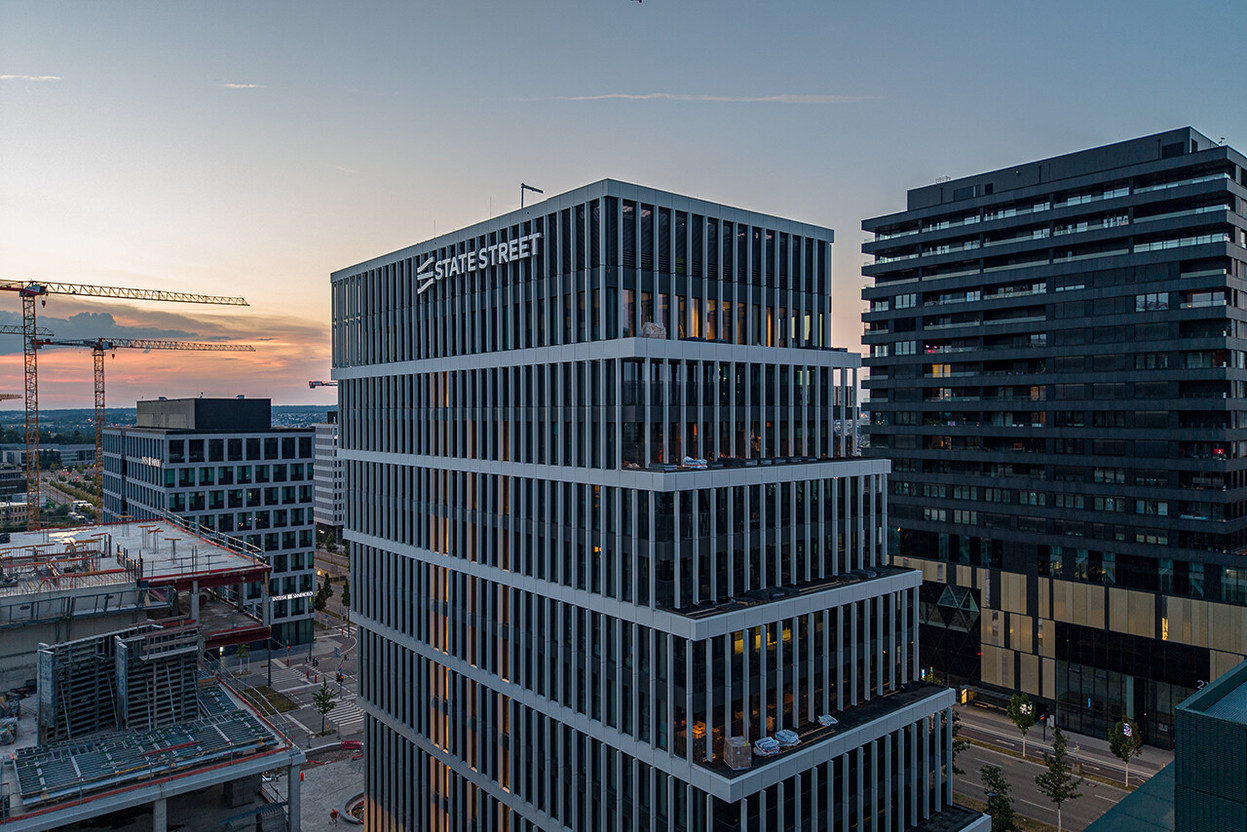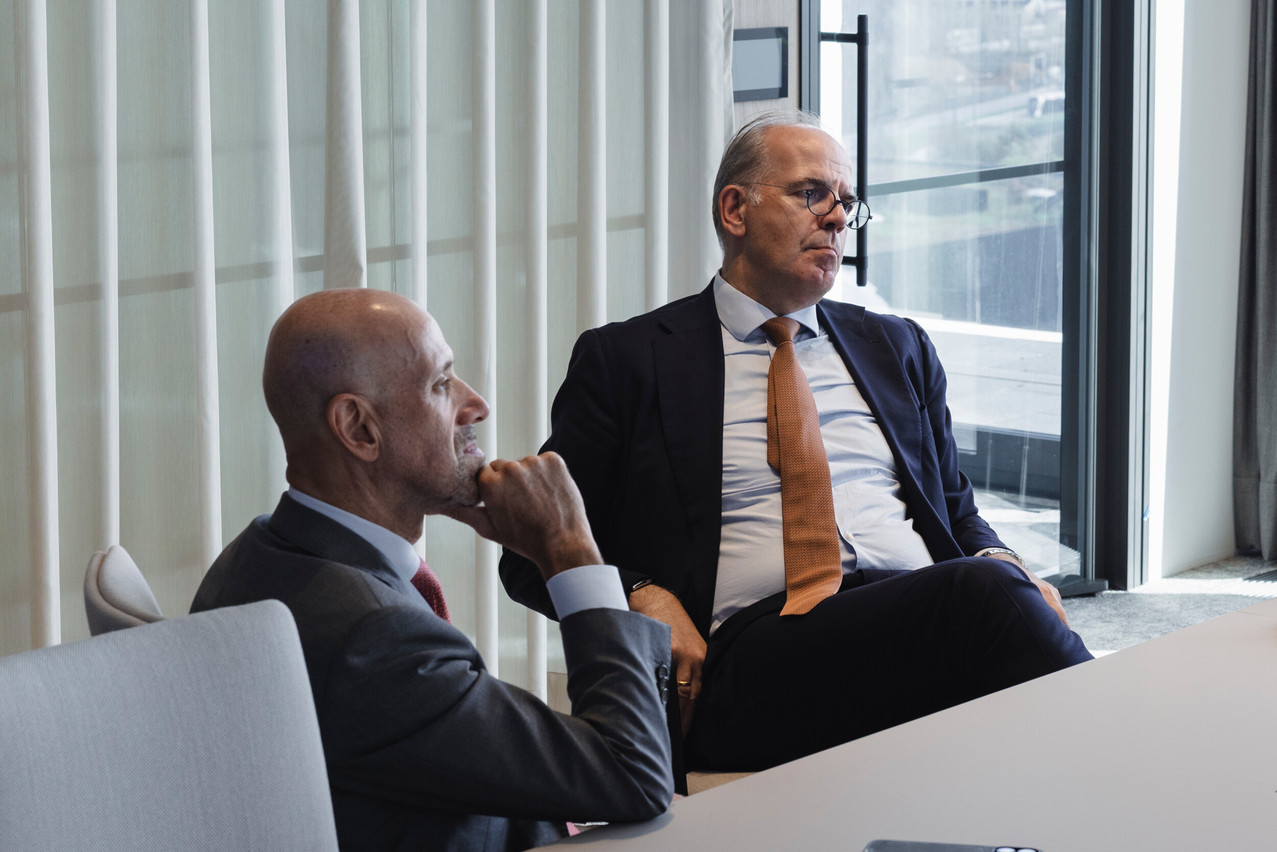
We are meeting today on the 11th floor of your new Cloche d’Or building, which you moved into this summer and where nearly 900 people work. Beyond the physical premises, what is the intention? What message do you want to send to the ecosystem? Is it that you are here to stay?
Joerg Ambrosius. – “I wouldn’t say that is the primary objective. On a global basis, we are looking to create the workspace of the future. To succeed in our business, especially given where it is heading, you must be able to attract, develop, and retain future talent. A competitive workspace is an essential element of that. We have been in Luxembourg for a long time – 36 years, since 1990 – and in all fairness, our previous facility was no longer suited to what comes next. We needed a very modern workplace.
Naturally, there is also a symbolic dimension. We made a deliberate decision to own this building because we are here for the long term. Over the past decades, Luxembourg has emerged globally as one of the most important investment hubs. We are in the fortunate position of being the market leader in supporting global investment managers who choose Luxembourg. We feel deeply integrated into this ecosystem and have actively helped build the Luxembourg brand abroad. When you look at our client base and the initiators of the funds we service, it represents the ‘who’s who’ of the European, US, and international investment industry.
Luxembourg has reinvented itself multiple times throughout our presence here, remaining extremely competitive. We intend to continue being the market leader while actively contributing to this ongoing evolution.
Luxembourg «ahead of many juridictions»
The Monterey Insight Luxembourg Intelligence Report 2026, published on 7 October, confirmed your leadership as of 31 December 2025: State Street ranks first in fund administration with $1,587.0bn, first in custody with $1,609.7bn, and second in transfer agency with $1,132.2bn. You mentioned that this building is designed for what comes next: what is that next major shift ahead for State Street?
J.A. – “We are seeing an unparalleled acceleration in technology deployment across the industry. Technology will be the defining factor. This obviously includes the deployment of AI, but doing that effectively requires the right talent. The way our industry operates will change substantially over the next five years. In several areas, Luxembourg is clearly paving the way. Take tokenization, for example: Luxembourg is ahead of many other jurisdictions in terms of regulatory framework, the local talent pool, and tangible support from key stakeholders who recognize the potential of this technological shift.
In private markets, your company often emphasizes that the next challenge is operating at scale. How can Luxembourg build its next competitive advantage in this area?
J.A. – “Luxembourg already possesses a competitive edge in alternative investments. If we look at broader industry trends, we have witnessed a clear bifurcation in asset allocation over the past decade: ETFs on one side, and alternatives on the other—real estate, private credit, private equity, and infrastructure. We expect continuous growth across both.
Because we have critical mass, we can co-create future solutions directly with our key clients, re-engineering processes end-to-end.

The crux of the matter is: how can the industry operate this business at scale?
J.A. – “This is where State Street brings critical mass. Luxembourg is at the forefront of our alternative asset administration in Europe. Historically, the industry hasn't established unified operating standards; every organization operates slightly differently, meaning scaling has traditionally required adding headcount. The business has now reached a maturity level where it is ripe for genuine technology deployment.
Because we have critical mass, we can co-create future solutions directly with our key clients, re-engineering processes end-to-end. That end-to-end perspective doesn't stop at State Street’s four walls; it extends into how our clients run their own operations. Everyone is pursuing two goals: operating at scale and simplifying processes.
Simplification brings two advantages: scalability and operational resilience. Resilience—especially cybersecurity—is top of mind for all our clients in an increasingly complex and hazardous world. Re-engineering processes end-to-end also leads clients to consolidate the number of strategic partners they work with, and we are an active driver of that market consolidation.
Riccardo Lamanna. – “To add to that, a crucial development in alternatives is democratization and distribution to retail investors. Handling liquid and illiquid assets within the same structures, alongside providing sophisticated investor services and reporting for a much broader investor base, demands massive investment. We are investing heavily to support semi-liquid funds, infrastructure funds, and Eltifs. Luxembourg is indisputably the prime European hub for both Eltifs and semi-liquid structures.
A vaste almount of data
Simplification is often complex to achieve. While everyone discusses AI, the underlying challenge is data: understanding it, leveraging it, and repackaging solutions for clients. How do you approach this?
J.A. - “You are spot on. The underlying AI models available today are highly advanced and, in many respects, interchangeable. The real differentiator is: do you understand your data? Can you govern it effectively, and can you apply AI to a dataset that you fully control to avoid hallucinations? Process re-engineering must be viewed through the lens of robust data governance. Once your data foundation is solid, you can deploy LLMs successfully and extract actionable intelligence.
At State Street, we sit on vast amounts of daily operational data as well as extensive historical data. In alternatives, everyone is searching for historical benchmark and risk metrics. Because we administer a representative sample of the global industry, we possess that intelligence. But data understanding and governance remain the indispensable foundation.
By the end of this year, we aim to go live with a tokenized money market fund in partnership with one of our clients.

Looking at tokenization beyond pilot announcements: which segment of the fund value chain will experience material transformation first?
R.L. – “By the end of this year, we aim to go live with a tokenized money market fund in partnership with one of our clients. This initiative connects directly to the blockchain via our digital asset platform, supported by a newly established digital transfer agency service. Unlike competitors who outsource segments of the chain, our offering covers the entire value chain on our own digital infrastructure.
The immediate transformation lies in execution speed: subscriptions, redemptions, minting, and burning of units become instantaneous. Crucially, tokenized units can then be pledged as collateral almost in real time, driving enormous market efficiency. It also enables 24/7 trading and real-time reconciliation.
Finally, it paves the way for trade atomization. Moving away from traditional registers toward central account keeping allows investors to trade in fractional, much smaller ticket sizes. We are replicating traditional operations on a digital platform today, with the next phase incorporating euro-denominated stablecoins, and potentially unbacked crypto assets further down the line. Throughout this, our priority is running traditional and digital fund administration seamlessly side by side.
Two paths, one reality for a long time
How do you practically manage both traditional and tokenized rails simultaneously?
R.L. – “Our digital asset platform runs in parallel with our traditional core architecture. They communicate, exchange data, and consolidate reporting for the client. From a registry perspective, we utilize the exact same application for both traditional and tokenized funds. A single fund can host both share classes simultaneously, using a sub-register architecture linked to the master register.
J.A. – “This is a clear case of end-to-end co-creation with a major client. Some assume tokenization will instantly disintermediate the value chain, but the reality is more nuanced. We will not have one single tokenized world operating at uniform speed under uniform rules. Global institutional managers will still need someone to connect these disparate systems. We see ourselves as the ‘plumbers’ of the financial architecture: ensuring liquidity and data flow seamlessly across different national and regional railway gauges. Operating across 31 countries gives us the footprint required to bridge these ecosystems. While tokenization is advancing in jurisdictions like the US—partly accelerated by legislative initiatives—it has not yet achieved mass scale. We do not anticipate an overnight ‘Big Bang’ where all traditional assets become tokens; both worlds will co-exist for a very long time.
Who will dictate the pace of transition between traditional and tokenized formats?
J.A. – “The institutional investors will decide based on the economic business case. Today, being a pioneer carries high setup costs. For plain-vanilla equity portfolios already trading efficiently, tokenization offers limited incremental value. Conversely, in asset classes like private credit—where settlement cycles can still take upwards of 20 days—or in money market funds where instant collateral movement is vital, the business case is compelling.
Regarding European financial oversight: proposals to centralize supervisory powers under ESMA are frequently debated. Would moving supervision away from Luxembourg weaken its competitive advantage, or strengthen the Single Market?
J.A. - “Regulatory compliance is our non-negotiable license to operate. Looking at the broader European picture, the fragmentation of rules across national borders remains a major structural disadvantage compared to the US or Apac. Achieving a genuine European Capital Markets Union is an absolute necessity if Europe wants to compete globally at scale. The true competitive threat to Luxembourg is not Paris; it is the major financial centers emerging across the Americas, the Middle East, and Asia. European integration should not be viewed as a threat to Luxembourg, but as a prerequisite for European relevance on the world stage.”