European companies Space Cargo Unlimited and Atmos Space Cargo are joining forces to usher in a new era in space logistics. The two companies have signed a mission order for a first integrated flight in 2026, combining Atmos’ Phoenix 2 return capsule and Space Cargo Unlimited’s BentoBox platform. The partnership marks the launch of a programme of seven autonomous manufacturing and research missions to low Earth orbit, designed to demonstrate the viability of a space station-independent operating model as the International Space Station (ISS) enters its final years.
The inaugural mission, planned on a SpaceX Falcon 9 rocket, will offer a fully commercial round-trip service for orbital logistics, a first in Europe. Atmos will provide capsule integration with the launcher, in-orbit operations control, telemetry, atmospheric re-entry and recovery near Santa Maria, Azores. Thanks to its inflatable heat shield that also acts as a supersonic parachute, the Phoenix 2 capsule reduces the cost and environmental footprint of returns to Earth.
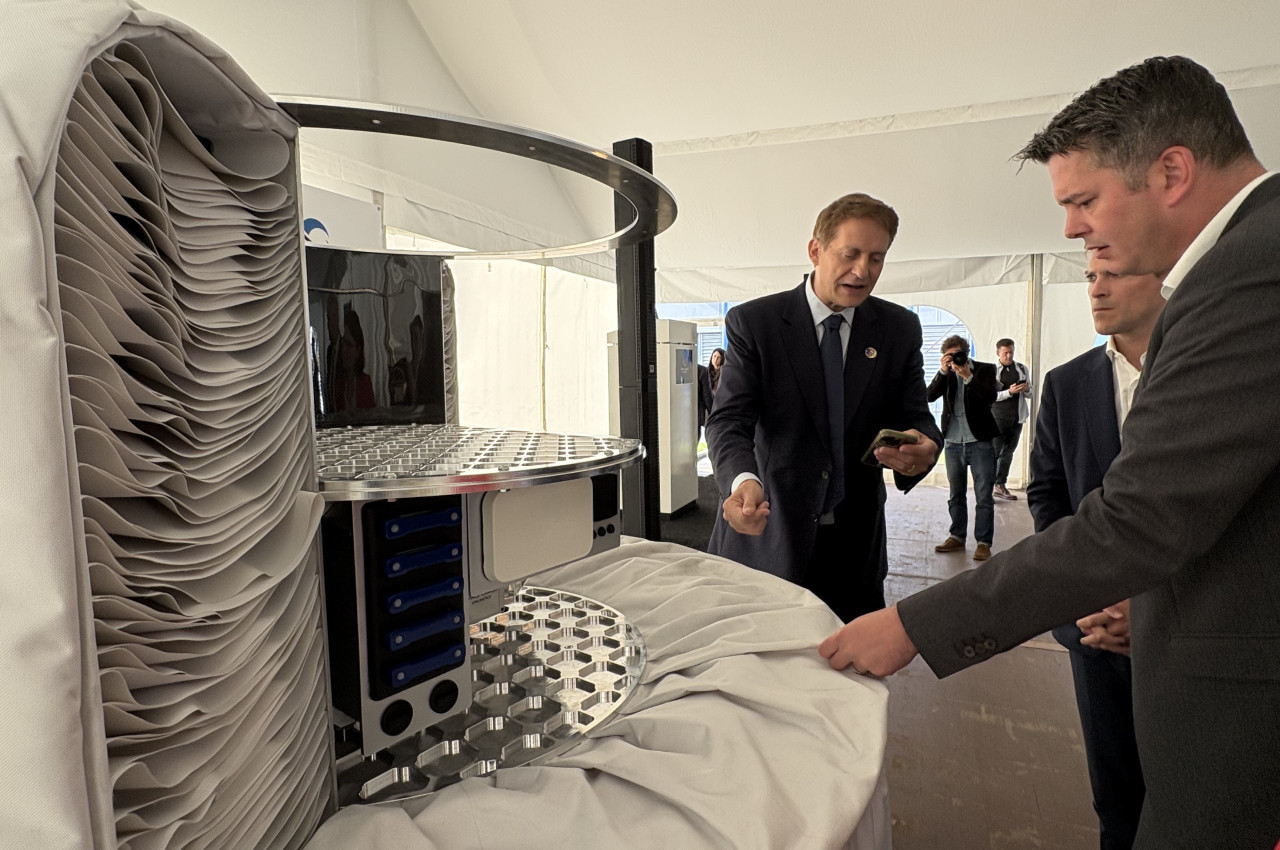
For its part, Space Cargo Unlimited will pilot customers’ payloads through BentoBox, an automated module managing energy, data and environmental conditions for microgravity experiments. Customers will be able to interact with their experiments in real time via the secure SpaceOS interface.
A successful first flight
This first flight comes against a backdrop of accelerating European investment in sovereign space infrastructure. Space Cargo Unlimited raised €27.5 million in a Series A round led by Expansion Ventures and Eurazeo, with support from the EIC, the EIB and Luxembourg Future Fund II. Atmos Space Cargo, meanwhile, has secured €13.1 million from the EIC Accelerator to further develop its technology, following the successful flight and return of its Phoenix 1 prototype in April.
For Nicolas Gaume, co-founder and CEO of Space Cargo Unlimited, this first mission “demonstrates not only our technology, but also our business model”. Most of the payload capacity has already been reserved. Sebastian Klaus, CEO of Atmos, sees this as a turning point for European space sovereignty: “Together, we are building the infrastructure that will make microgravity manufacturing as accessible as terrestrial production.”
Beyond the technological demonstration, the project aims to lay the foundations for an autonomous industrial space ecosystem in Europe. With the ISS due to come to an end by 2030, Space Cargo Unlimited and Atmos Space Cargo want to position the Old Continent as a major player in low-Earth orbit production and research, with a focus on innovation to serve the Earth.