In the presence of the Minister for the Economy, 
Gradel has forged a reputation for precision and reliability in a demanding sector. Its special machines have accompanied the birth of European nuclear power plants, before adapting to the challenges of decommissioning and recycling. At a time of renewed interest in nuclear energy, particularly in Germany, the Luxembourg company sees this renaissance as an opportunity for growth. “Nuclear power, combined with renewable energies, is part of the solution,” stresses its managing director, 
Gram [for Gradel Robotic Additive Manufacturing, editor’s note] makes sense for anything that flies.

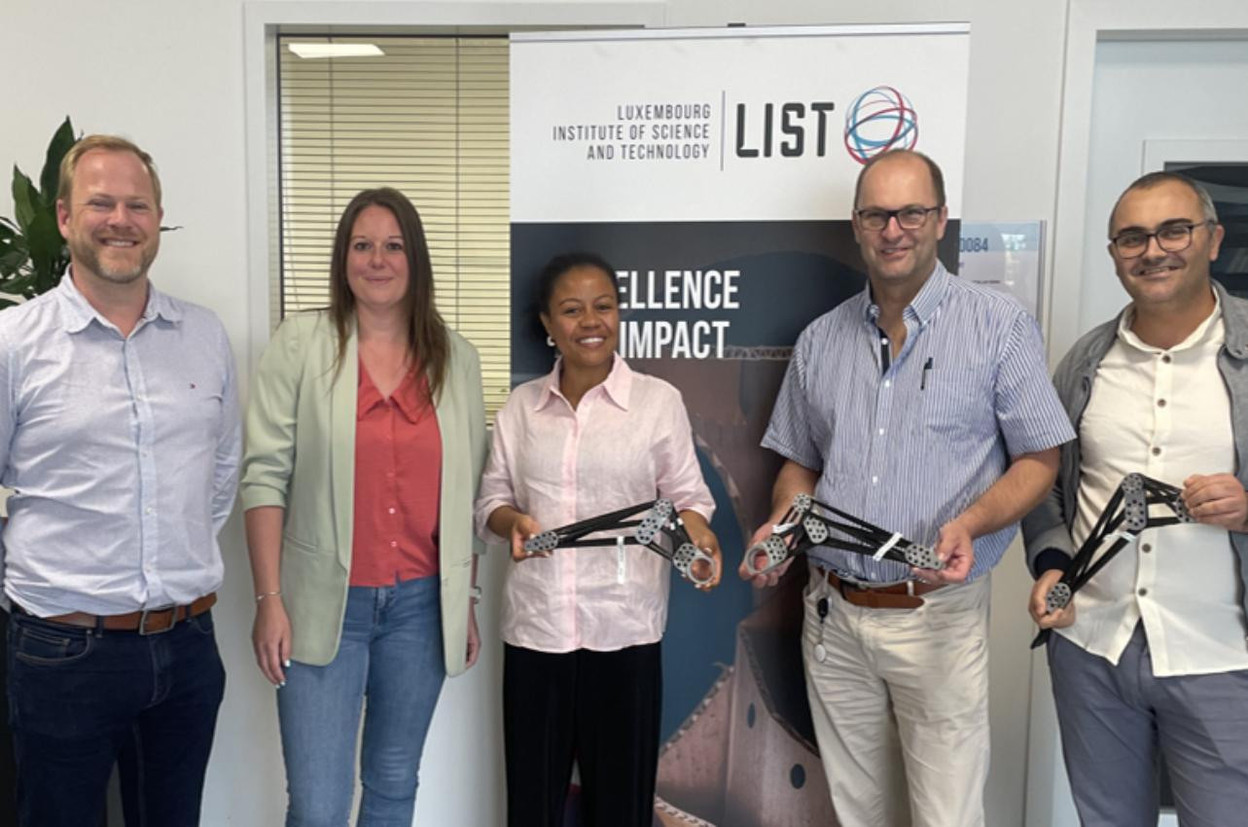
But it is in aerospace that the company has found new impetus. For the past ten years, it has been designing ground equipment capable of handling and testing satellites weighing several tonnes. In 2019, Gradel took a major step forward by developing a patented additive manufacturing technology called “Gram” for Gradel Robotic Additive Manufacturing. This endless fibre winding process can be used to create ultralight 3D structures for use in aeronautics, space or drones. “Gram makes sense for anything that flies,” sums up Claude Maack. The aim is to make it an industry standard by 2028.
A GPS-free drone
To speed up this transformation, Gradel has teamed up with Data Design Engineering (DDE), a pioneering company in artificial intelligence. DDE develops software capable of cutting design and robotic manufacturing costs by a factor of ten. Together, the two companies aim to produce structures for defence drones from 2026, with fully autonomous navigation systems.
During the celebrations on Monday afternoon, a GPS-less drone performed a flight demonstration, symbolising this alliance between engineering and software innovation.
Beyond technology, Gradel is pursuing a strategic shift: from a bespoke project model to an industrial products business. It now offers complete manufacturing cells, integrating Gram software, prototyping and component production. A shift that requires new resources: the company is currently in advanced discussions with strategic investors to strengthen its capabilities and support its growth.
From nuclear power stations to satellites
Financially, Gradel remains solid despite the heavy investment associated with its diversification. Its latest balance sheet shows total assets of €15.4 million for 2024, including almost €2 million in fixed assets, reflecting its growing technological strength. Although the financial year ended with a modest loss of 123,000 euros, this follows a profit of 266,000 euros the previous year, confirming the stability of a company in the midst of a major transformation.
60 years after its beginnings as a craftsman, Gradel readily describes itself as an experienced start-up. Its credo—precision, reliability, innovation and perseverance—remains unchanged. But its horizons have broadened, from nuclear power stations to satellite constellations. In an industrial world in search of meaning and performance, this SME demonstrates that, by combining mechanical skill and technological daring, it is possible to build a future that is both rooted on earth and turned towards the stars.