Marc Teusch has been fascinated with electronics since he was eight. He has spent the last 20 years of his life sharing this passion and knowhow working as a computer sciences teacher in Ettelbruck. Confronted with restrictions on time, resources and curricula posed by the school framework, Teusch established the first volunteer-led, not for profit hacker space in Luxembourg in 2008.
“A hacker space is a place where people can make and exchange ideas, talk about projects and profit from common infrastructure […] that’s expensive to buy for a single project,” Teusch explained in an interview with Delano this week.
“I wanted to bring that idea to school. I thought that learning in a non-formal environment was fantastic and encouraging.”

Marc Teusch is pictured giving a TEDx talk about makerspaces at Mudam in March 2013. Photo: Jessica Theis/archives
In 2012, Teusch pitched the makerspace model, an accessible place where young people learn new technology skills by working on a specific project and are mentored by volunteer professionals. Luxembourg’s education ministry ran with it and, in 2014, the first makerspaces were rolled out in schools across the country under the Bee Creative banner.
Today there are 32 makerspaces, involving around 200 teachers and attracting up to 3,000 students.
Among the projects developed in these hubs of activity, Teusch cites a remote-controlled hover board built out of a skateboard and wii controller. Another group worked on a cyclist’s coat with electronics sewn into the fabric to provide indicator lights for maximum visibility when turning. “The target is to make them aware that technology is worth taking a look at. It can be cool. You don’t have to be top at maths to be great at engineering,” Teusch says.
The initiative continues to grow
Teusch is one of four people who co-founded Make It, a not for profit which runs the annual Maker Faire, and the national robotics championships (both scheduled this year for 16-17 May in Rosport) and selects and trains a national team to compete in the robotics championships in Dubai.

Students are pictured at the Luxembourg Maker Faire. Photo: Make It/Pierre Weber
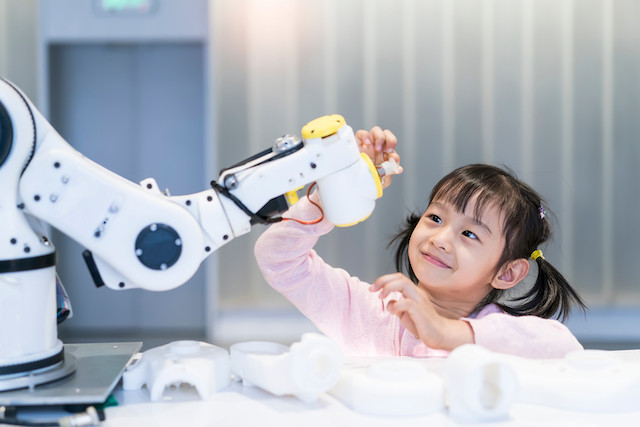
The organisation is also responsible for the Esch-sur-Alzette robotics makerspace. Open at fixed times on Thursday afternoons and at weekends, youngsters can access this and the other Make It space for €25 per year to work on a range of robotics projects using various robotic kits. Support and mentoring from volunteer staff is offered in several languages, including English.
The specialised makerspace aims to plug a gap in the public space and even in the school domain, where knowledge about and exposure to robotics remains limited. “We think this space will trigger a movement so that people will be more aware of what robotics actually is,” Teusch said.
During Saturday’s inauguration, which is open to kids and big kids, visitors can participate in up to six different workshops related to robotics. They can also be among the first to explore mobile makerspace the maker bus.
“We know that schools don’t have much budget, especially primary schools, for stuff like that,” Teusch said, explaining that excursions can get costly for primary schools with much of their budget going on transport and liability insurance. “That’s why we came up with this bus idea. If you can’t go to science, science comes to you.”
The Esch robotics makerspace open day takes place on Saturday 8 February, from 11am at the Centre National de Formation Professionnelle Continue, 22 rue Henri Koch, 4353 Esch-sur-Alzette