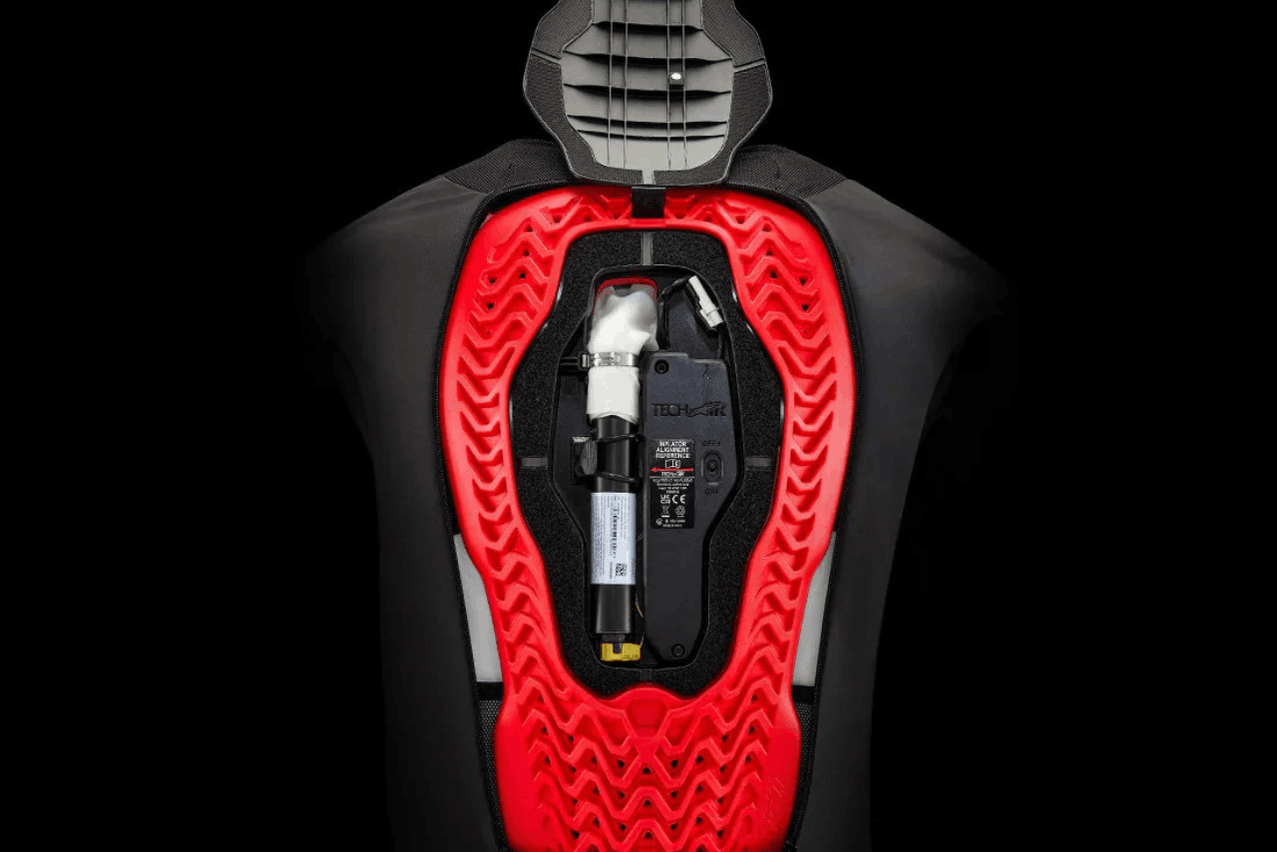
Technological innovation is redefining safety standards in the world of motorcycling. The motorcycle airbag is now establishing itself as an essential piece of equipment. Already regarded as the most effective form of protection after the helmet, it significantly reduces the risk of serious injury in the event of an accident, particularly when combined with protective elements featuring plasma technology.
“We are witnessing a genuine paradigm shift,” says Fabio Tinoco, managing director of XCrossroads. “Airbags are no longer the preserve of an elite few or the world of motor racing. They are becoming accessible and essential for all motorcyclists.”
The principle is simple and effective: whether worn as a standalone vest or integrated into a jacket, the airbag inflates in a matter of milliseconds in the event of a collision or a fall. It immediately protects vital areas – the neck, chest, back and abdomen – by absorbing the impact and minimising internal injuries.
Two technologies coexist today. Mechanical systems, connected to the motorbike by a cable, are triggered when the rider is thrown from the bike. Reliable and more affordable, they are a tried-and-tested solution. But the real breakthrough comes from electronic airbags.
“These models offer unrivalled accuracy and speed,” explains Matthieu Degrave, sales manager at XCrossroads. “Using sensors such as gyroscopes and accelerometers, they continuously analyse the rider’s movements and can detect both a fall and a head-on collision.”
Already mandatory in racing, these systems are gradually becoming the norm on the road. They meet a growing demand from motorcyclists keen to improve their safety without compromising on comfort.
Among the leading products on the market, Alpinestars’ Tech-Air® airbags – notably the Tech-Air® 3 and Tech-Air® 5 models – exemplify this development. Designed for everyday use, they combine a low-profile design, long battery life and optimal protection, with ultra-fast deployment without the need for a connection to the motorbike.
“What makes it so appealing is its simplicity,” adds Fabio Tinoco. “The airbag is worn just like a standard piece of clothing, operates independently and is suitable for all types of riding, whether cross, enduro or road.”
In Luxembourg, this equipment is available at XCrossroads, part of GRIDX, where motorcyclists can receive personalised advice.
“Our aim is clear: to make this equipment widely available,” concludes Matthieu Degrave. “The more widely it is adopted, the greater the reduction in the impact of accidents. Today, driving with an airbag is a responsible choice.”
As their adoption gains momentum, motorcycle airbags are emerging as a major development, set to become a safety standard.
A full version of this article is also available in French.