How did you end up working in applying informatics to cancer research?
Maryna Chepeleva. – “It was almost by accident. During my bachelor’s, I chose a topic for my first coursework related to cancer because it seemed like a very current and important issue. Over time, I got more involved in cancer research, and I really enjoyed the idea of applying my technology skills to real-world problems. That’s what motivated me.
The possibilities for innovation in oncology seem immense, thanks to technological advances. What solutions would you like to bring to the market for early cancer detection?
“I think the ultimate goal is to achieve truly personalised treatment. Right now, most treatments are generic, but the idea is to offer a treatment that’s tailored to each patient based on their biological profile. This can really change the landscape of oncology medicine, with more accurate diagnostics and treatments.
How can AI and computer tools help in this field?
“AI and computer tools can reduce the costs of diagnosis while improving the accuracy of cancer detection and identifying mutations. In my group, we primarily focus on finding hidden dependencies in cancer, such as why some types of cancer become resistant to treatment. By understanding these mechanisms, we can target specific cancer types more effectively.
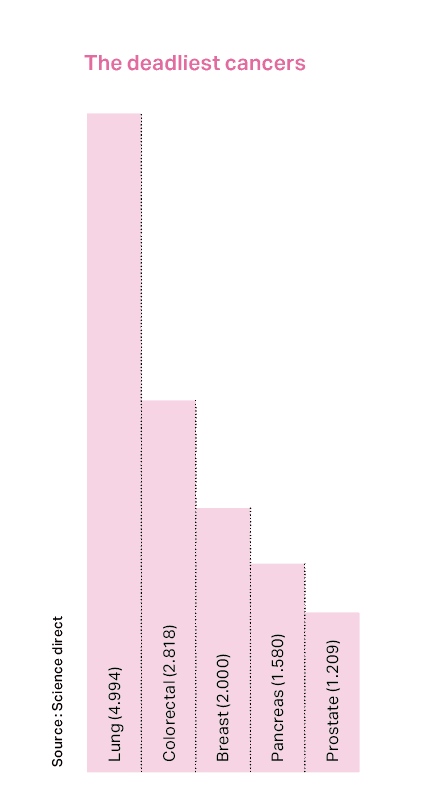
The deadliest cancers, according to Science direct. (Source: Science direct)
What kind of data do you use to better understand these biological processes?
“We work with multi-omics data, meaning data from different biological layers: genomics, proteomics, transcriptomics, and metabolomics. By combining these data, we can get a more complete profile of a patient, which allows us to better understand the biological processes involved in cancer.
How can this approach help us better understand the biological diversity of breast cancers?
“That’s the core of the challenge. Biologically, breast cancer is not one single disease. It's a group of different conditions that all start in the same tissue but have very different causes and behaviours. The multi-omics approach is about creating a complete, high-resolution 'molecular portrait’ of each tumour and we integrate data from many levels. AI is the only tool powerful enough to synthesise these vast and complex layers of information. It can detect patterns and connections that a human simply cannot see, allowing us to go beyond the current subtypes and create a much more granular map of the biological diversity of breast cancer.
How could your work contribute to improving the personalisation of therapies for patients?
“A key limitation of many standard-of-care treatments is that they are based on broad classifications, targeting the 'average' characteristics of a cancer subtype. But in reality, every tumor has a distinct combination of individual features. The molecular data from such a tumor is a complex signal that overlays many different biological processes happening at once. A key technique we use is 'deconvolution', which computationally untangles this mixed signal. By untangling these complex signals, we build the foundation for a truly individual treatment strategy. My work helps identify 'biomarkers'. Ultimately, this provides clinicians with critical information, allowing them to predict which therapy is most likely to be effective for that specific patient.
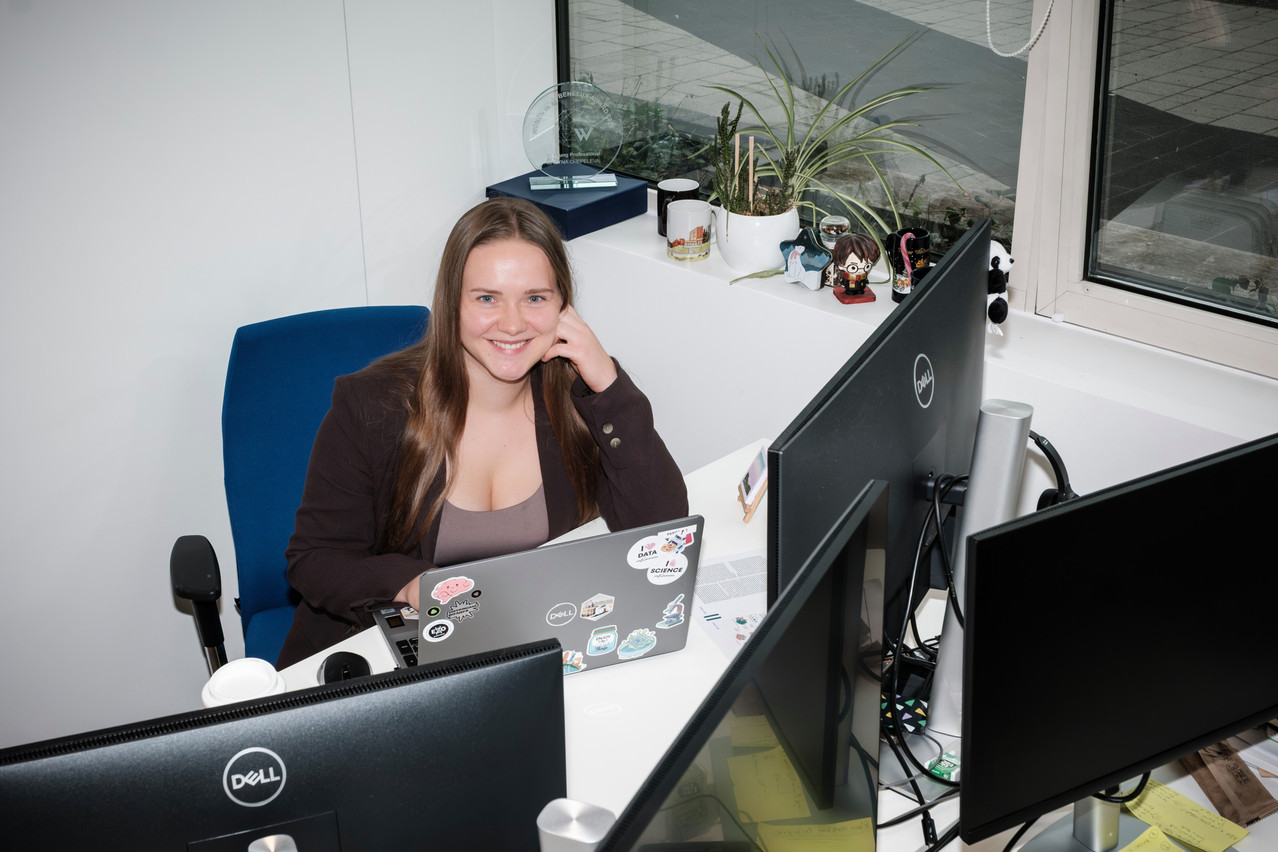
Maryna Chepeleva: “AI and computer tools can reduce the costs of diagnosis while improving the accuracy of cancer detection and identifying mutations.” (Photo: PANCAKE! Photographie)
How do you evaluate the data to ensure it’s relevant?
“There are several steps. It all starts with a thorough inspection of the data to see how it was collected. Then, we use specialised algorithms to analyse the data and extract relevant features that help us classify patients based on their biological profiles.
How do you see the Luxembourg ecosystem in terms of technology and research? Do you think it has enough support to sustain ambitious projects like yours?
“I’m optimistic. In health, for example, there is a lot of funding, and institutions are growing well. My group has doubled in size in two years. We’re getting great support, and the ecosystem is expanding. With projects like the building of quantum computers, Luxembourg could become a leader in tech, particularly in AI and health.
Where do you see yourself in ten years? What are your professional goals?
“I would like to continue developing tools in computer science, ideally in biology. After finishing my PhD, I’ll need to decide whether to stay in academia or move to the industry. Industry can offer more opportunities, but I would love to apply my biological knowledge, acquired over these years, in a field related to biotechnology or pharmaceutical companies.
With competition from major companies like Google or Microsoft, how do you cope with research in this area? Do you have the resources you need to move quickly?
“I’m not at the level of decision-making in those companies, but in our group, we obtain funding through grants from the government and the European Union. The process is long and requires a lot of work, but it allows us to fund our research and continue moving forward.
Do you see yourself leading a large research laboratory or a department in a pharmaceutical company in the future?
“I see myself leading a group of data scientists, working on complex projects and developing comprehensive data analysis solutions. I prefer working on research and innovation rather than managing a large organisation.”
This article was written for the October 2025 issue of Paperjam magazine, published on 24 September. The content is produced exclusively for the magazine. It is published on the site to contribute to the full Paperjam archive. Click this link to subscribe to the magazine.