
Every year, UBS issues its Global Family Office Report, providing insight into how family offices invest. This year’s report found that private assets -- private equity, private debt, real estate, infrastructure, commodities, hedge funds, and other real assets -- accounted for 42% of family offices’ allocations.
This shows that alternatives are no longer considered a “niche,” said Stefan Van Geyt, head advisory & sales GWM Luxembourg at UBS. Historically, private markets have offered attractive returns and diversification opportunities, although outcomes vary across strategies, managers and market environments. “Indeed, we see them as an important component of many long-term diversified portfolios.”
“There’s an entire part of the world that is privately held,” he added. “If you only invest in public markets, then you may miss exposure to part of the economy that is only accessible through private investments -- at UBS, we want to help eligible investors gain access to opportunities that are not available through public markets.”
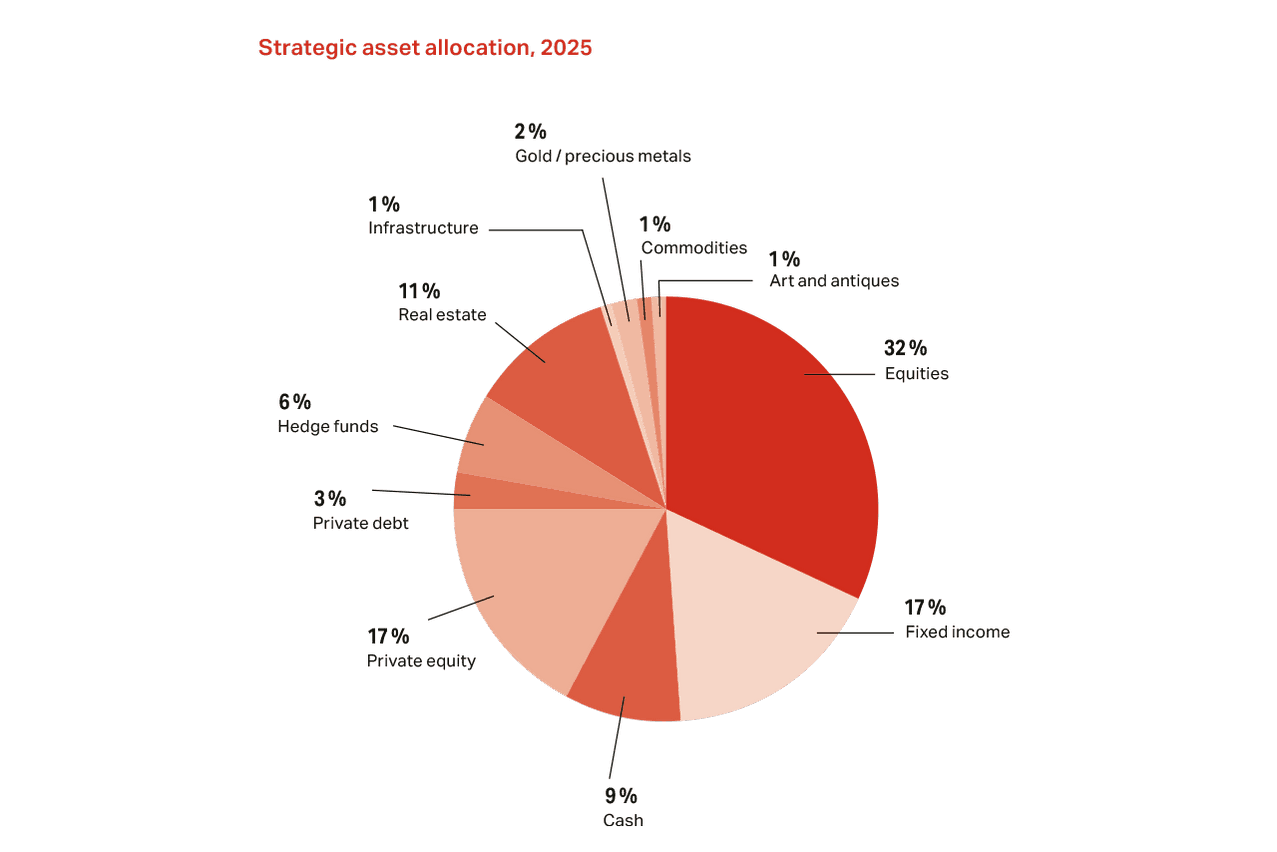
Strategic asset allocation 2025 Paperjam Studio
A leading hub for private market fund structuring and distribution
Luxembourg is the largest fund centre in Europe and has built on its existing ecosystem to become one of Europe’s leading hubs for private market fund structuring and distribution, said Christian Borner, Luxembourg country head for UBS. Flexible structures, the regulatory environment, expertise in the cross-border space, the entire ecosystem -- from law firms to management companies to consultants -- as well as Luxembourg’s distribution infrastructure are among the reasons behind the grand duchy’s strong position in the realm of private assets.
Eltif 2.0 could also play a role in the future. Revisions to the European Long-Term Investment Fund legislation have introduced additional flexibility and made private markets eligible to a broader class of investors. “The framework is an interesting development,” said Van Geyt, while cautioning that it remains a “fundamentally illiquid investment” and that investor understanding is crucial. “More and more long-term investors are allocating part of their portfolios to private markets,” noted Van Geyt. “But our role is also to educate investors, particularly around related risks.”
More and more long-term investors are allocating part of their portfolios to private markets.

Investing in private assets means that those funds will be locked up for a significant period of time. “Investors generally expect to be compensated for taking on illiquidity risk -- that’s one of the attractions of private markets -- but it’s important for investors to understand the trade-offs involved.”
Rigorous, informed, and long-term planning is essential. Private assets encompass a wide range of strategies, each with distinct characteristics and roles within a portfolio. “These investments are not just an assembly of good ideas, but part of a well-structured portfolio that considers aspects such as liquidity, distribution, capital calls, diversification, and manager selection,” said Borner. “Experienced guidance is key.”
Turning access into long-term investment plans
UBS operates across two complementary areas of activity. On the one hand, it provides depositary, custody and banking services to asset managers and financial intermediaries. On the other, it supports high-net-worth individuals and family offices with wealth management services. Its role includes supporting clients in structuring long-term investment strategies while also helping them understand the characteristics and implications of their investment decisions. “We provide services not only for the investor, but also for the industry that delivers the product,” explained Borner.
It’s about more than maintaining the wealth over the lifetime of a beneficial owner. It’s about investing for a future beyond that.

Access is a major challenge linked to private markets, and helping clients navigate this complexity is a core part of UBS’s role. “Manager selection is particularly important in private markets, where performance dispersion is typically greater than in public markets,” said Van Geyt. “A wealth manager like UBS is able to combine access, research and manager selection expertise to help identify opportunities that fit a client’s objectives.”
UBS also carries out research on different asset classes and regions. “We can leverage our global footprint and provide access to a broad range of managers and investment vehicles,” added Borner.
Liquidity, longevity, legacy
UBS holds the philosophy of “managing wealth over generations,” and considers itself the partner of not just the client, but of the generations to come. When preparing investment plans, it uses a three-bucket framework consisting of liquidity (the more immediate needs), longevity (to maintain the standard of living), and legacy (planning for the next generation).
Given their long-term investment horizon, private markets play an especially important role in the “legacy” pillar of wealth management, said Borner. “It’s about more than maintaining the wealth over the lifetime of a beneficial owner. It’s about investing for a future beyond that.”
For more information contact UBS here.