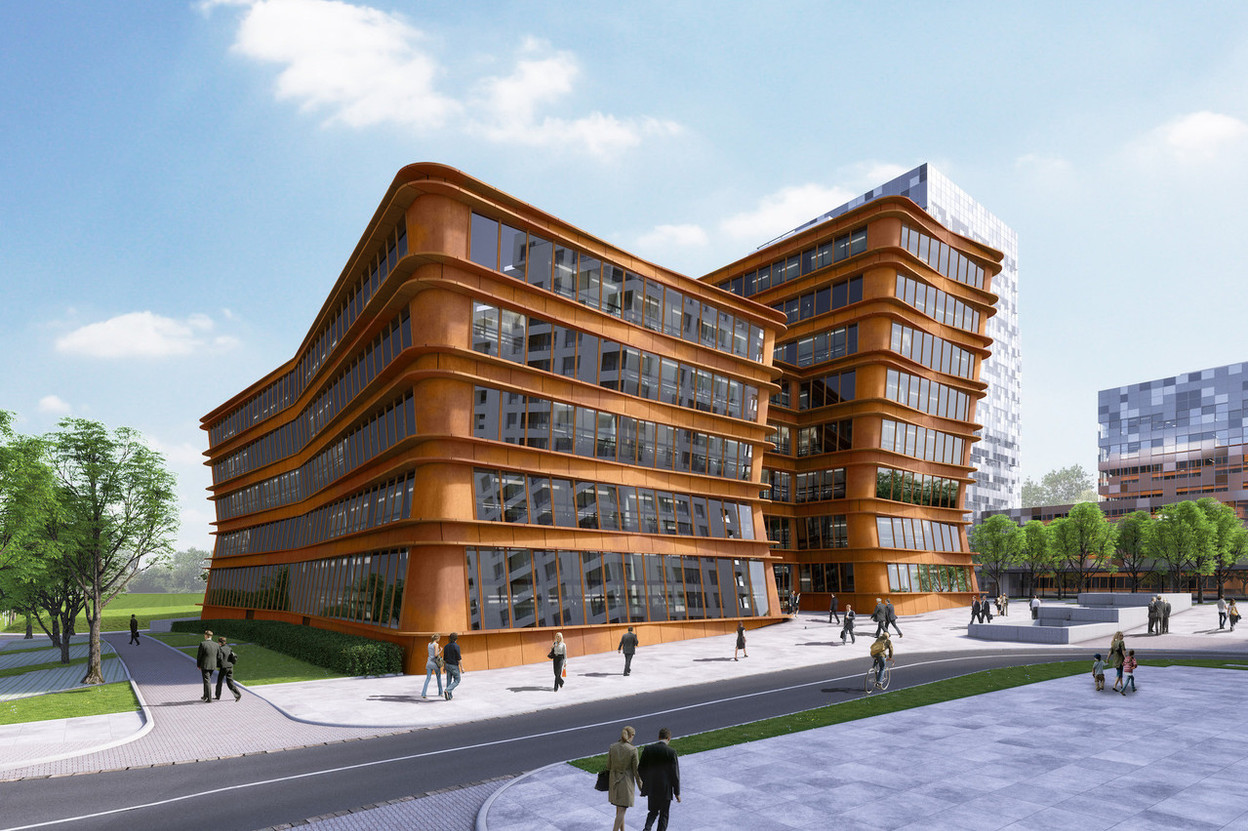
According to JLL’s 2025 annual review, office take-up in Luxembourg rose by 36% year-on-year to 181,160m². This rebound comes after two years of marked decline, even though transaction volume remains 26% below the average for the last five years.
“The market is mainly driven by its occupiers, led by the financial sector, which accounts for 30% of demand. If we add in corporate services and law firms, these key sectors account for 49% of activity”, explains office agency director Jonathan Morand.
Major transactions include the letting of 14.000m² by JP Morgan in the The Waves project at Kirchberg, the pre-letting of 9,970m² by PwC in the Eosys project at Cloche d’Or, as well as the signing of 5.468m² by law firm Linklaters in the Kronos building at Kirchberg. New buildings, known as “Grade A”, accounted for 65% of transactional volume, compared with 56% in 2024.
Decreasing vacancy and converging rents
Over the past twelve months, almost 108.000m² of office space were delivered in the Grand Duchy, notably with the second phase of Skypark at the airport (23,000m²), The Waves in Kirchberg and the Sekoia extension to the offices of BGL BNP Paribas. Total office stock remains stable at around 4.6 million square metres, with new deliveries offset by demolitions or renovations.
The rental vacancy rate is estimated at 3.9%, down from 4.2% in 2023 and 2024. “This decline shows that the market is absorbing new deliveries well, which is keeping availability at one of the lowest levels in Europe,” analyses JLL’s head of research, Pierre-Paul Verelst.
As far as rents are concerned, JLL is seeing a convergence in central districts. Prime rents are reaching 43 euros per m² per month at the Gare and Kirchberg, 41 euros at Cloche d’Or, while they remain stable at 54 euros near Boulevard Royal. Increases are also marked at Howald (+10% over a year, to 33 euros) and the airport (+8%, to 34.5 euros).
An upturn in investment, dominated by offices
Property investment up 38% in 2025, 839 million across all asset classes, a level close to the average seen over the previous five years. Offices account for 54% of volumes, ahead of retail (22%), logistics (15%) and residential (9%).
In the office segment, several core assets have changed hands, including the Charlotte 10 and Vertbois buildings, as well as Unicredit’s headquarters in Kirchberg. Prime yields in central districts fell by 25 basis points to 4.50%.
“Thanks to these new benchmarks, we now have visibility on exit yields,” stresses Vincent Van Brée, head of capital markets. For her part, country lead and head of markets,