At the beginning of 2026, Noémi Zsolnai came to the NXTGen Women in Finance & Technology programme at the Luxembourg House of Financial Technology (Lhoft) with an idea. She did not have a company, a founding team or a finished product. What she did have was a conviction: banks could do much more to support their customers during the most important moments of their lives.
A few weeks later, when the ten selected projects of the programme were announced, something unexpected happened. Participants were invited to join the projects they found most compelling. Around Noémi’s table, the crowd kept growing. “At the beginning, around 13 women wanted to join the team,” she recalls. “I was really happy because they came to me. My project resonated with them.”
The enthusiasm was an early indication that her idea addressed a widely recognised need. It also marked the beginning of a journey that would take Anchor from a concept to an emerging fintech venture in just a few months.
When banking meets real life
Anchor’s proposition starts with a simple observation: banks are often among the last to know when something important happens in their customers’ lives. Marriage, the birth of a child, buying a home, losing a job or preparing for retirement can all have significant financial consequences. Yet customers frequently have to navigate these transitions themselves, searching for information about financial products, tax advantages and public benefits.
Anchor aims to change that relationship. Described by its founder as a “life intelligence layer for banks”, the solution works as a data layer: it picks up signs that something has changed in a customer’s life, asks the customer to confirm it, and then provides timely, personalised guidance.
For example, the arrival of a child-related allowance in a customer’s bank account could indicate the birth of a baby. Once the customer confirms the event, the bank can offer information about available family benefits, potential tax advantages and relevant banking products, such as a savings account for the child. Customers can also flag an event that is still ahead of them and start planning early. The objective is not simply to generate additional sales, Noémi insists, but to make financial guidance more useful and accessible.
“These things are all connected,” she explains, referring to banking products, taxation and public benefits. Her ambition is to bring information that is often fragmented into a single, more coherent customer experience. For banks, Anchor tackles a customer retention problem. According to the startup, major life events can prompt customers to reconsider their banking relationships. By combining relevant financial products with local tax and benefit information, Anchor aims to give customers more reasons to stay with their existing bank.
The gap runs both ways. Anchor’s survey in Luxembourg found that customers rarely turn to their bank for help at these moments. Meanwhile, advisers may overlook relevant products, such as joint accounts or savings plans, simply because they are unaware of changes in a customer’s personal circumstances. With the customer’s agreement, Anchor can send a short summary of their situation to their bank adviser, creating an opportunity for a more relevant conversation.
The team is currently developing a rules engine incorporating Luxembourg’s tax and benefit framework, with plans to extend its coverage to neighbouring countries, including France, Belgium and Germany. Importantly, the figures presented to customers are generated by the rules engine rather than artificial intelligence, allowing banks to trace each number back to its source.
A working demonstration is already live. The solution is primarily designed for retail banks, although it could also be applied to private banking and wealth management. According to the founders, several wealth management firms have already expressed interest.
A programme that created a team
Anchor’s story is also closely linked to the Lhoft’s efforts to encourage women to develop innovative solutions for the financial sector. Launched in January, the 2026 edition of the NXTGen Women in Finance & Technology programme brought together 66 women with entrepreneurial ideas. Ten projects were selected to move forward, with other participants invited to contribute their skills to the teams. Over five months, participants benefited from mentoring, training and repeated opportunities to pitch their ideas to financial industry professionals.
For Noémi, the experience proved transformative. Her initial team brought together five women, including Daphne Dijkstra, whose own project had focused on a similar challenge in private banking. As the programme progressed, the participants refined Anchor’s proposition and tested it against feedback from industry experts. In June, their work culminated in a presentation at Nexus Luxembourg, where Anchor won first place.
According to Anthony Martini, head of education & talent of the Lhoft involved in the programme, the project stood out because its underlying problem resonated with participants. While some proposals were highly technical, Anchor addressed a situation that many people could immediately recognise. Its appeal lay in connecting a practical everyday challenge with a potential technological solution. But winning the competition was only the beginning.
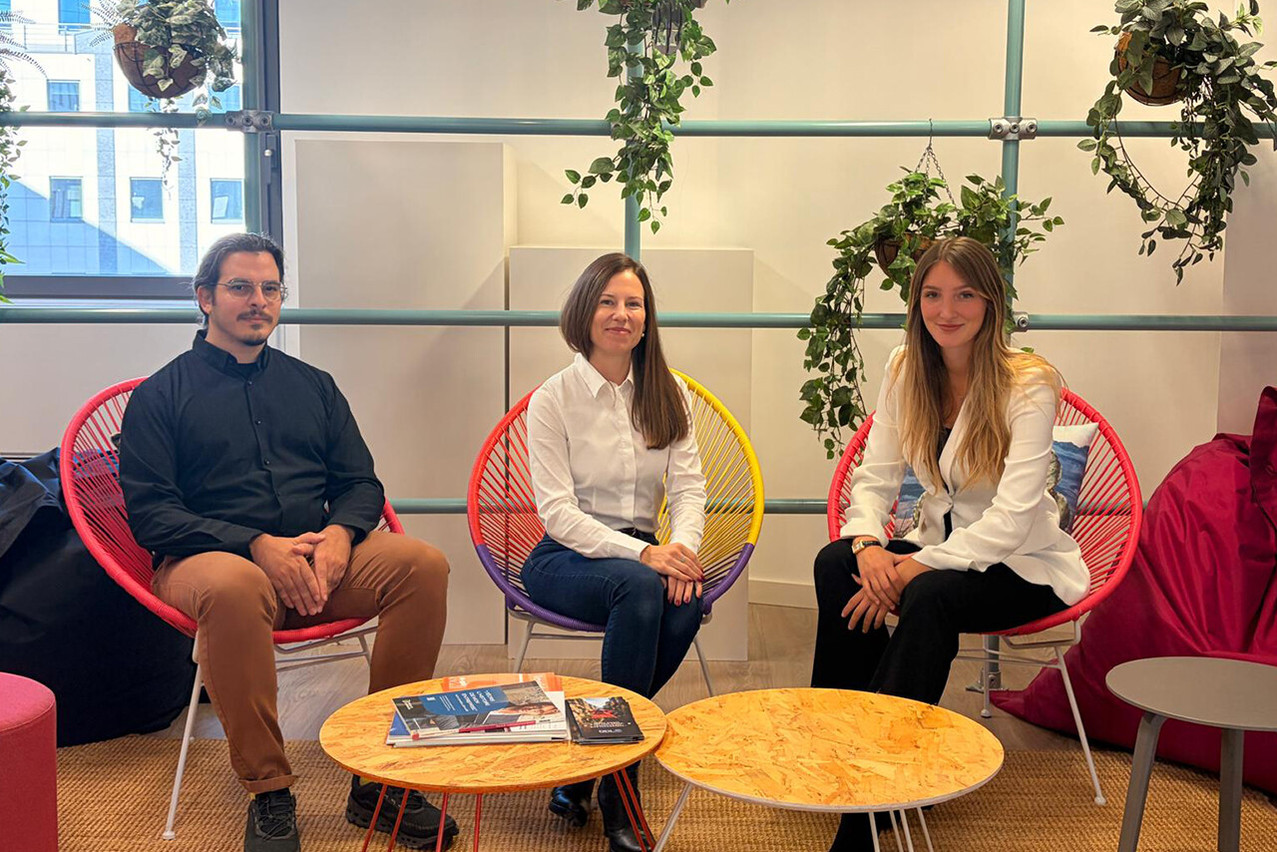
Once the programme ended, Noémi had to determine whether Anchor would remain an award-winning concept or become a business. She met individually with her teammates to understand who wanted to continue the journey. Daphne was ready to commit, and Noémi subsequently brought in Kypros Vassiliou, a former colleague with expertise in fintech architecture and software development. Together, they formed a founding team combining three complementary profiles.
Noémi, a former product owner and business analyst with 13 years of experience in digital product development, leads the product vision and strategy. Daphne, an EFPA-certified wealth planner with experience in private banking and venture capital, brings financial expertise and business development capabilities. Kypros, the company’s chief technology officer, oversees the technical architecture and product development, supported by engineers at his own company.
“We cover banking, technology and the product side,” Noémi explains. “We are very complementary.”
Turning recognition into a business
Since winning at Nexus, Anchor has begun attracting interest from Luxembourg’s banking sector. According to its founders, of the four banks Anchor has spoken with since the competition, three contacted the team first to explore potential pilot projects. For a young fintech attempting to enter a market known for its long decision-making cycles, that interest represents an important first step.
Outside Luxembourg, an electronic money institution (Emi) has already agreed to a pilot with Anchor, and work on the proof of concept has begun. The team’s main focus, however, remains Luxembourg’s banks. On 1st October, Anchor officially joined the Lhoft ecosystem. The company is also in the process of incorporation, while its founders continue discussions with financial institutions.
Not every milestone has brought the outcome they hoped for. Anchor was selected to pitch at the final stage of Luxembourg’s Fit 4 Start accelerator programme, which received a record 556 applications this year. Despite reaching that stage, it was not among the ten startups selected in the digital category.
Noémi acknowledges the disappointment but remains pragmatic about the experience. The founding team only began working together in June, making its progress particularly rapid. Reaching the final selection stage was already an opportunity to test the proposition and gain further visibility.
The next challenge is to translate interest into commercial traction. Anchor now aims to turn its ongoing bank conversations into pilot projects and bring in its first investor in the coming months. From November, its demonstration will also be showcased for six months at the AI Experience Centre at the Lhoft. These are ambitious objectives for a venture still at an early stage.
But they reflect the determination of a founder who has already taken her idea much further than she initially imagined. For Noémi, the experience illustrates something broader than the creation of a financial technology company. It demonstrates what can happen when women with different backgrounds are given the opportunity to collaborate, develop their ideas and access the networks needed to bring them to market.
Anchor’s commercial future remains to be proven. Its first achievement, however, is already tangible: turning an individual idea into a collective entrepreneurial ambition.