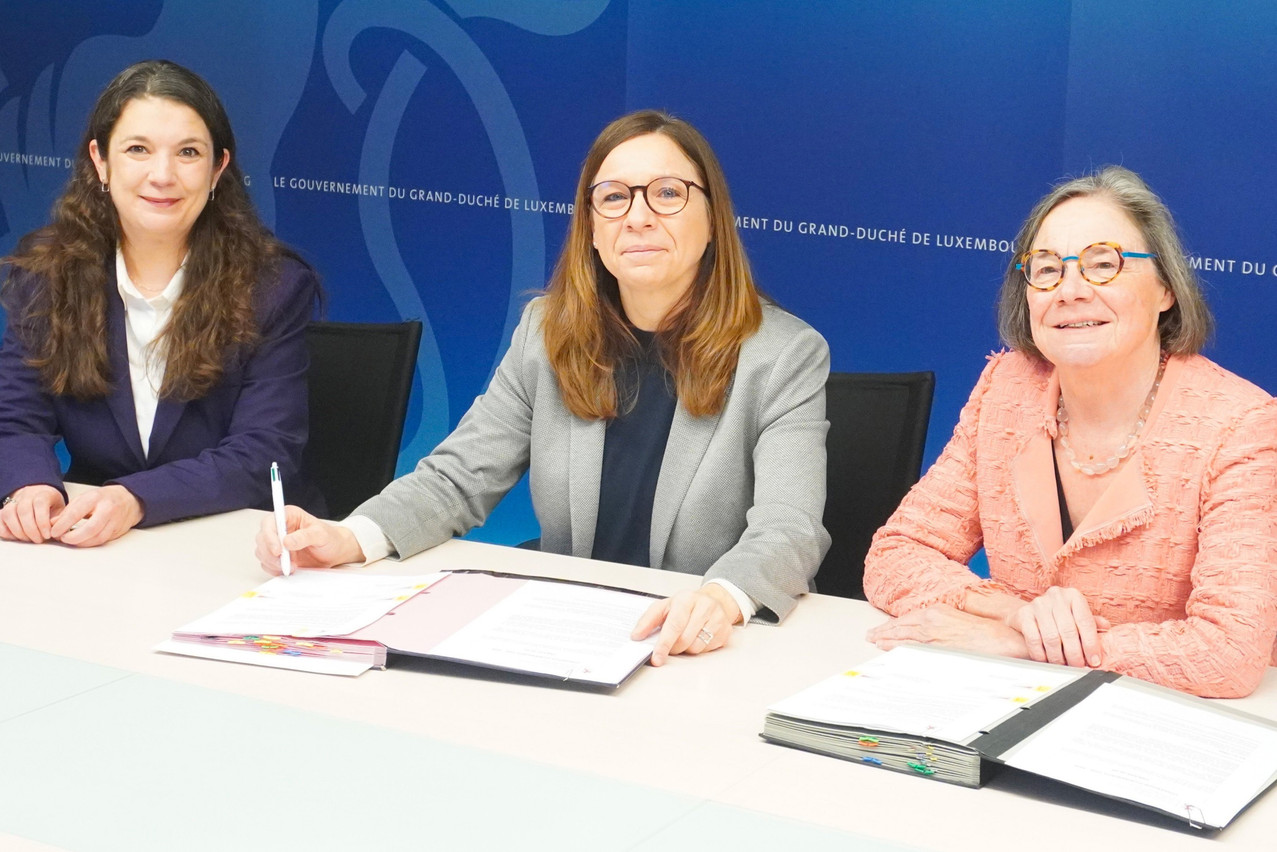
Isabelle Mossong, general secretary of the FNR, Stéphanie Obertin, minister of Research and Higher Education, and Martine Reicherts, chair of the FNR board of directors, at the signing of the multi-year agreement with the State. (Photo: Ministry of Research and Higher Education)

Isabelle Mossong, general secretary of the FNR, Stéphanie Obertin, minister of Research and Higher Education, and Martine Reicherts, chair of the FNR board of directors, at the signing of the multi-year agreement with the State. (Photo: Ministry of Research and Higher Education)

The 2026–2029 multi-annual agreements between the State and the University of Luxembourg, the List, the LIH, the Liser and the FNR were signed on Thursday 5 February. The agreements together represent a total financial commitment by the State of €1,987.2m.

The Minister for Research and Higher Education, Stéphanie ObertinStéphanie Obertin (DP), signed the 2026–2029 multi-annual agreements between the State, on the one hand, and the University of Luxembourg, the public research centres List (Luxembourg Institute of Science and Technology), LIH (Luxembourg Institute of Health), Liser (Luxembourg Institute of Socio-Economic Research) and the Fonds national de la recherche (FNR). Together, the agreements represent an overall financial commitment by the State of €1,987.2m for the period 2026–2029, an increase of 19.3% compared with the multiannual agreements for the period 2022–2025 (€1,666.34m).

By institution, this represents for the university: €261m in 2026, €267.5m in 2027, €277.4m in 2028 and €285.9m for 2029—a total of €1,091.8m. The amounts are lower for public research centres, with a three-year total of €362m for the FNR (+23.1% compared with 2022–2025), €249.4m for the List (+13.7%), €208.8m for the LIH (+14.4%) and €75.2m for the Liser (+21.1%).

“The 2026–2029 agreements concluded with the University of Luxembourg and the public research centres define the missions, strategic objectives and indicators for assessing their achievement. These indicators fall into three categories: financial, results-based and structural. The new agreements introduce, for the first time, obligations concerning the implementation, in a structured manner, of measures to strengthen well-being, professional development and the quality of the working environment,” explains the press release from the Ministry of Research and Higher Education.