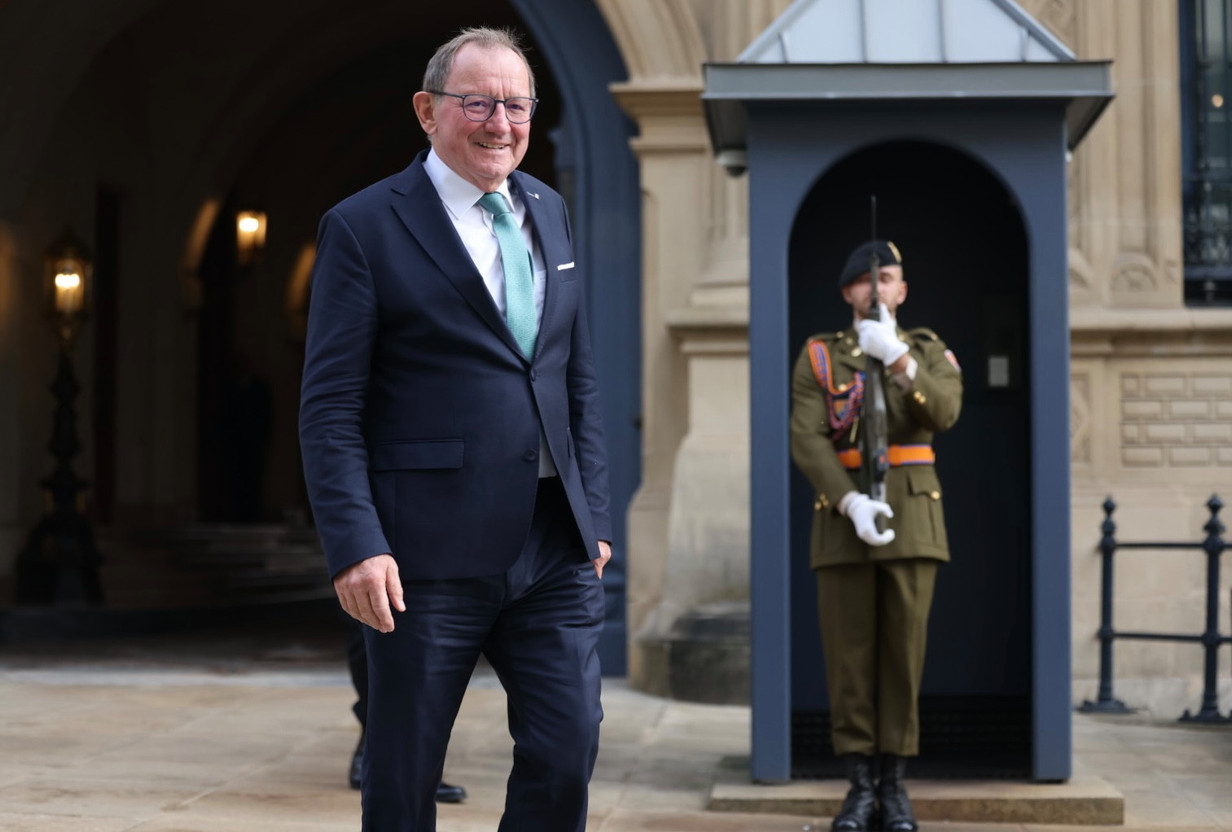
Marc Hansen was born in 1971. He began his career in journalism, working for RTL Radio Lëtzebuerg and RTL Télé Lëtzebuerg between 1995 and 2009. He then moved into politics. From 2009 to 2011, he was a parliamentary attaché, and from 2011 to 2014, he was appointed director and managing director of Éditions Lëtzebuerger Journal, the DP’s press house. He was first elected to Luxembourg’s parliament in 2013.
In 2014, he joined the first Bettel government as secretary of state for national education, children and youth, as well as secretary of state for higher education and research. He then succeeded 

How do you feel about being sworn in and returning to the Luxembourg’s parliament?
Marc Hansen. —“I am very calm and delighted to be able to exercise this mandate again. In these tense times, my experience can be useful in ensuring that Luxembourg stays on a good trajectory and remains the innovative country I knew in my youth.
You had a first stint in parliament in 2013–2014 before joining the government. What did you learn from this experience?
“It was a very special experience. In 2013, a DP-LSAP-Green government came to power. We were young compared to the previous team—I was 42 at the time. I was appointed chairman of the finance committee at a time when, for the first time in decades, we had to draw up a budget using the provisional twelfths procedure, a procedure that few people in the house or in the ministries had mastered. I remember that at the first sitting, next to me were the outgoing Prime Minister 


Having been through government responsibilities, you are aware of difficulties that may escape an MP.

You have the distinction of having been a minister much longer than an MP. What impact does this have on your vision of the role and how you will carry it out?
“I was minister for relations with parliament, which gave me a good knowledge of procedures. Legislative and executive functions are very different. Having had government responsibilities, you are aware of practical and technical difficulties that a member of parliament might not be aware of. It gives you a better understanding of certain decisions that have to be taken by a government that is in the thick of things every day, and that sometimes has to act quickly because decisions are expected. This can lead to mistakes. Being aware of this will enable you not to react on the spot, which is rarely productive.
Between absolute support for the government and constructive criticism, what is the role of a majority MP in today’s democratic game? How do you see the relationship between an MP and the government?
“A majority MP must support the government, but he or she must also be critical. In this respect, things have changed over the last 20 years. Parliament has become emancipated, and MPs are no longer standing at attention. They have their own opinions, which they have to defend to their constituents. I believe that it is in the executive’s interest to discuss major policy decisions with majority MPs and parliamentary groups before they are taken, in order to listen to their opinions and any criticisms they may have, and to take them into account. This can help to avoid negative reactions in the street.
When I was a minister, I always sought the best possible consensus to bring a project to fruition. I listened to members of parliament from both the majority and the opposition. There are intelligent people everywhere.
The top-down authoritarian model is no longer relevant.
In today’s world, you can no longer walk into a meeting and believe that if you decide on your own ex cathedra, everything will work out in the best possible way. It’s a general social change that doesn’t just affect the world of politics, and one that all governments need to take into account. The top-down authoritarian model is no longer relevant.
What will be your priority issues and which committees do you plan to sit on?
“I will sit on the finance, mobility, rules of procedure and defence committees. I will take over the chairmanship of this committee [a committee currently chaired by 
As far as the issues that are close to my heart are concerned, there is the rule of law and respect for human dignity. These are values that must not be trampled underfoot as is happening now. We must not live in a world where the only law is the law of the strongest.
We need to tell ourselves that Luxembourg has assets and opportunities instead of dwelling on what’s wrong.
Then there is this tendency to turn in on ourselves and systematically denigrate who we are. We have to stop only seeing what’s going wrong, what’s negative. We must once again be proud of our country and rediscover the sense of innovation and open-mindedness that have made us so successful. We need to tell ourselves that Luxembourg has assets and opportunities instead of dwelling on what’s going wrong. Being aware that there are negative things shouldn’t prevent us from having a positive attitude and moving forward.
We need to get out of the rut in which social networks are dragging us. People are turning their personal problems into social problems by making a fuss over issues that are often anecdotal or out of proportion. There are a lot of people—residents and cross-border commuters alike—who are not being heard, even though they have energy and good ideas. This energy and these ideas have been the strength of our economy over the last few decades. We need to be able to listen to these people.”