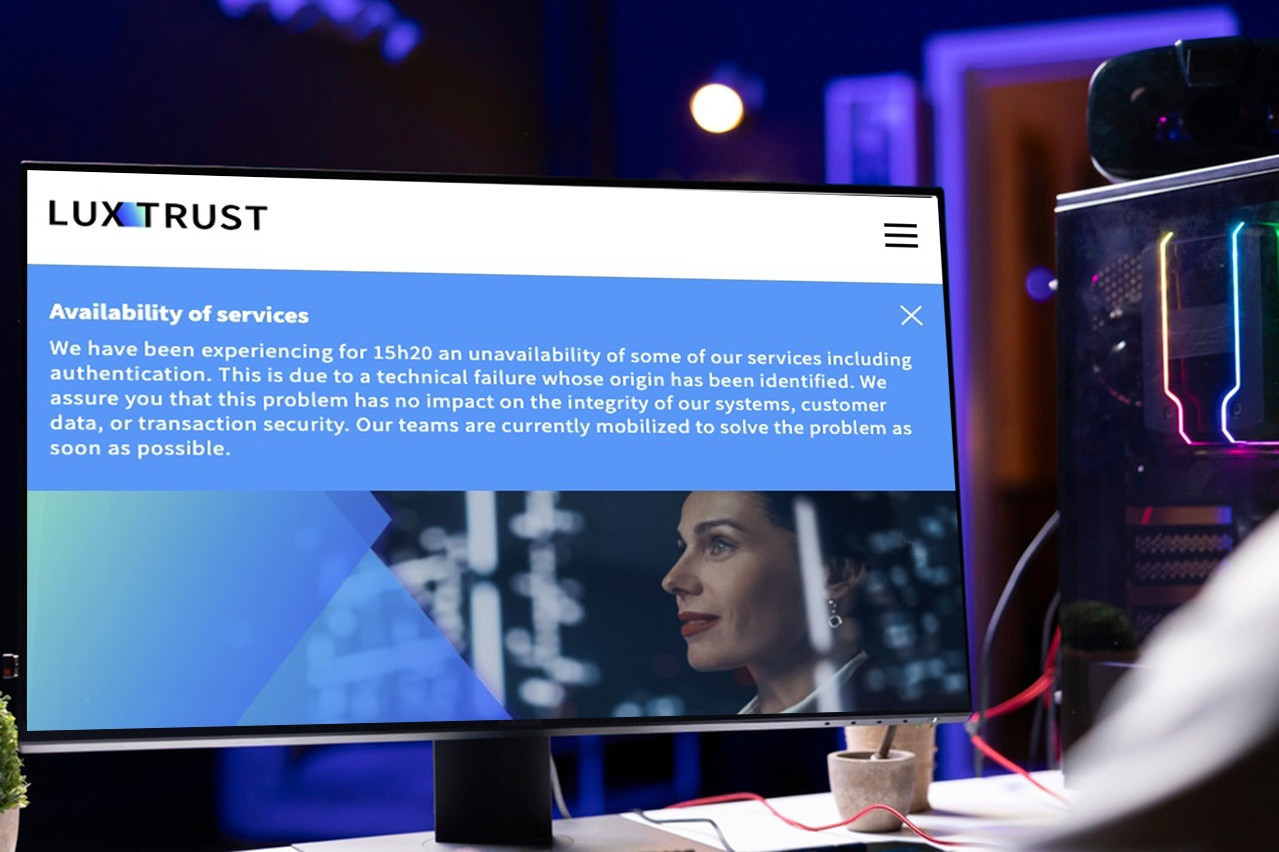
(Article updated at 4:20 p.m. on the recovery)
In the middle of the afternoon on Wednesday, LuxTrust provided an update on the situation in a press release. ‘The recovery operations that began on Tuesday afternoon and continued throughout the night have enabled a gradual return to service, including the restoration of LuxTrust authentication and electronic signatures at 12:40 p.m. on Wednesday 17 December,’ the press release stated. ‘LuxTrust sincerely apologises for the inconvenience caused and thanks its users for their patience and understanding.’
(11:20 a.m.) LuxTrust chief executive 
Aresu stresses one central point: this is not, under any circumstances, a cybersecurity incident. “This is absolutely not an intrusion or a security problem. There is no corruption, no breach of the integrity of the systems.” The problem is strictly internal to the infrastructure, at the level of the storage systems. Specialist experts have been mobilised to understand precisely what happened and to draw the necessary lessons in terms of resilience.
Although the infrastructure is designed to be redundant, that redundancy, for reasons still unexplained, did not prevent the incident. “Redundancy, for one reason or another, did not make it possible to restore the integrity of the data.” As a result, a critical component of the database refused to restart, forcing LuxTrust to activate its disaster recovery infrastructure. “We had to start up and provision our disaster infrastructure. These are fairly standard processes,” the chief executive says, while acknowledging that the situation itself is not.
The incident had an unusual domino effect. “What is not standard at all is that in fact redundant equipment… despite the quick replacement of a faulty component, it triggered a cascade.” This hardware failure then affected the software layers, causing persistent instability. Since Tuesday, teams have been working to restore “huge databases”, some running to several terabytes, which explains the length of the outage.
The affected services mainly concern LuxTrust’s qualified uses. “All services linked to the token are unavailable,” Aresu says, citing “services around identification, signing, as well as the electronic seal.” In practical terms, any operation requiring strong authentication via LuxTrust is affected.
On the economic impact, the chief executive strikes a measured tone. Service restoration is being carried out in order of priority: first government services, then interbank payments, then payments linked to purchases. Some corporate operations may nevertheless be temporarily disrupted, particularly where a LuxTrust electronic signature is required.
On the timeline for a return to normal, LuxTrust is proceeding cautiously. Restoration operations began overnight from Tuesday into Wednesday. “If the restoration works as it should, we can restore authentication and signature,” which would allow users to return to near-normal use. Some secondary services, such as ordering new identities or electronic sealing, could, however, restart later.
“Around 5pm, all our services should be operating normally,” Aresu concludes, while stressing that teams remain mobilised to fully secure the return to normal and to analyse in depth the exact causes of this exceptional incident.
Luxembourg’s central digital identity provider, LuxTrust, suffered a major outage from 15.20 on Tuesday 16 December, disrupting mobile and internet banking across the country and exposing the risks of heavy dependence on a single authentication provider.
Banking stalled
The disruption left thousands of customers locked out of online and mobile platforms at major banks including Spuerkeess, Banque Internationale à Luxembourg and BGL BNP Paribas. For many, the failure meant an abrupt halt to routine transactions--transfers could not be authorised, logins timed out and digital signatures failed to load. While core banking systems continued to function, the breakdown of the LuxTrust gateway effectively froze digital access.
Financial institutions have spent the past decade funnelling almost all customer interaction into secure digital channels that rely on multi-factor authentication. LuxTrust, jointly founded by the state and major banks, provides that second layer of security. The outage therefore hit the backbone of retail and corporate banking at once--a single point of failure in a system designed for resilience.
Migration risk realised
The timing added to the tension. In 2024, LuxTrust completed the deactivation of its physical Token devices, pushing all users onto the mobile application for authentication. That shift was meant to simplify user experience and reduce maintenance costs, but the migration has concentrated risk into one digital channel.
When the app failed, there was no fall-back method for most users. The result was not just customer frustration but a rare operational vulnerability across the financial system.
Digital dependence and the policy gap
Luxembourg’s long-standing strategy to build a “trusted digital economy” has made LuxTrust a linchpin for both public and private sectors. Its identity solutions are embedded in e-government, corporate filings and financial compliance systems. The current incident shows how that integration, while efficient, can also multiply the impact of a technical fault.
Regulators have already raised concerns about concentration risk in cloud and payment infrastructures. The same logic now extends to digital identity. As financial institutions invest further in automation, the balance between efficiency and redundancy is becoming a policy issue rather than a technical one.
For now, customers remain unable to authenticate through LuxTrust, and banks have limited options beyond waiting for the provider to restore service.