The Luxembourg Financial Sector Supervisory Commission (CSSF) on 28 August published its annual report for the year 2024, covering everything from its internal governance to its supervision of financial entities.
Part of the CSSF’s responsibilities includes conducting on-site inspections. The regulator in 2024 carried out 133 on-site inspections, says the report. Forty-seven of these inspections were performed by the undertaking for collective investments (UCI) department; 80 inspections were carried out by the on-site inspection department; and six inspections were conducted by the supervision of information systems and support PFS department. Risks related to anti-money laundering and countering the financing of terrorism (AML/CFT), climate and ESG aspects, and valuation were highlighted.
Investment fund managers and UCIs
There were 298 authorised investment fund managers (IFMs) in the grand duchy at the end of 2024, said the report. When it comes specifically to UCIs, there were €5.82trn of net assets as at 31 December 2024. The CSSF carried out 53 on-site inspections at investment fund managers last year and imposed six sanctions on IFMs following an on-site inspection.
Shortcomings related to the asset valuation function were also noted during the inspections carried out at six investment fund managers, said the CSSF. “Half of these shortcomings concerned deficiencies in the valuation models used, 36% of these deficiencies related to the review of source data allowing valuations and 14% of the shortcomings were linked to the composition and functioning of the valuation committees.”
€11,076,929 in fines
The total fines imposed in 2024 amounted to €11,076,929, said the CSSF.
—Three administrative sanctions were imposed on credit institutions and one on a shareholder of a credit institution. One of these sanctions was a €3m fine imposed on BGL BNP Paribas for non-compliance with professional obligations related to AML/CFT.
—Four administrative fines were imposed against investment firms.
—Administrative fines were imposed on three specialised PFS, amounting to €186,600.
Read also
—Two administrative fines were imposed on two support PFS.
—Two administrative fines of €40,000 and €68,000 were imposed on one electronic money institution and one payment institution, respectively.
—When it comes to investment fund managers and investment funds, the CSSF issued several decisions with respect to sanctions and prudential enforcement measures. These include administrative fines on the directors of two specialised investment funds (Sifs); fines on the directors of Sicars; fines for the non-filing of the annual financial report; a fine for failure to comply with the legal provisions relating to the requirements to have sound administrative procedures and adequate internal control mechanisms, as well as of the supervision of delegates; a fine for non-compliance with the professional obligations related to the transmission of year-end documents; a fine for failure to comply with the applicable legal provisions regarding the supervision of delegates; fines for the non-filing of the AML/CFT external report; and fines for the non-filing of the questionnaire on financial crime; amongst others.
Read also
—Looking at the securities markets, “the review of financial reports under the Transparency Law led the CSSF to issue, pursuant to Article 25 of that law, six administrative fines amounting to a total of €110,000 due to delays in the disclosure and filing of four annual financial reports and two half-yearly reports.”
—And finally, in the audit profession, eight fines were issued, six amounting to €10,000, one amounting to €17,092 and one amounting to €18,000. The regulator also imposed a permanent prohibition on a réviseur d’entreprises agréé from carrying out statutory audits and/or signing audit reports, as well as their permanent deregistration from the public register.
Climate risk gains importance
Environmental, social and governance (ESG) aspects and climate-related risks are also becoming more important. In 2024, the CSSF identified shortcomings linked to ESG criteria during governance and thematic inspections carried out at four investment fund managers. The shortcomings focused on two areas: insufficient supervision and an incomplete risk management process.
“Throughout 2024, the CSSF incorporated climate-related and environmental risk criteria in its thematic inspections on governance, credit risk and ICAAP,” added the report. “ESG elements were also taken into consideration during inspections at depositary banks. Moreover, the CSSF included sustainability-related aspects in the assessment of the clients’ investment preferences. Finally, since September 2024, the CSSF carries out on-site inspections concerning climate-related and environmental risk management at credit institutions.”
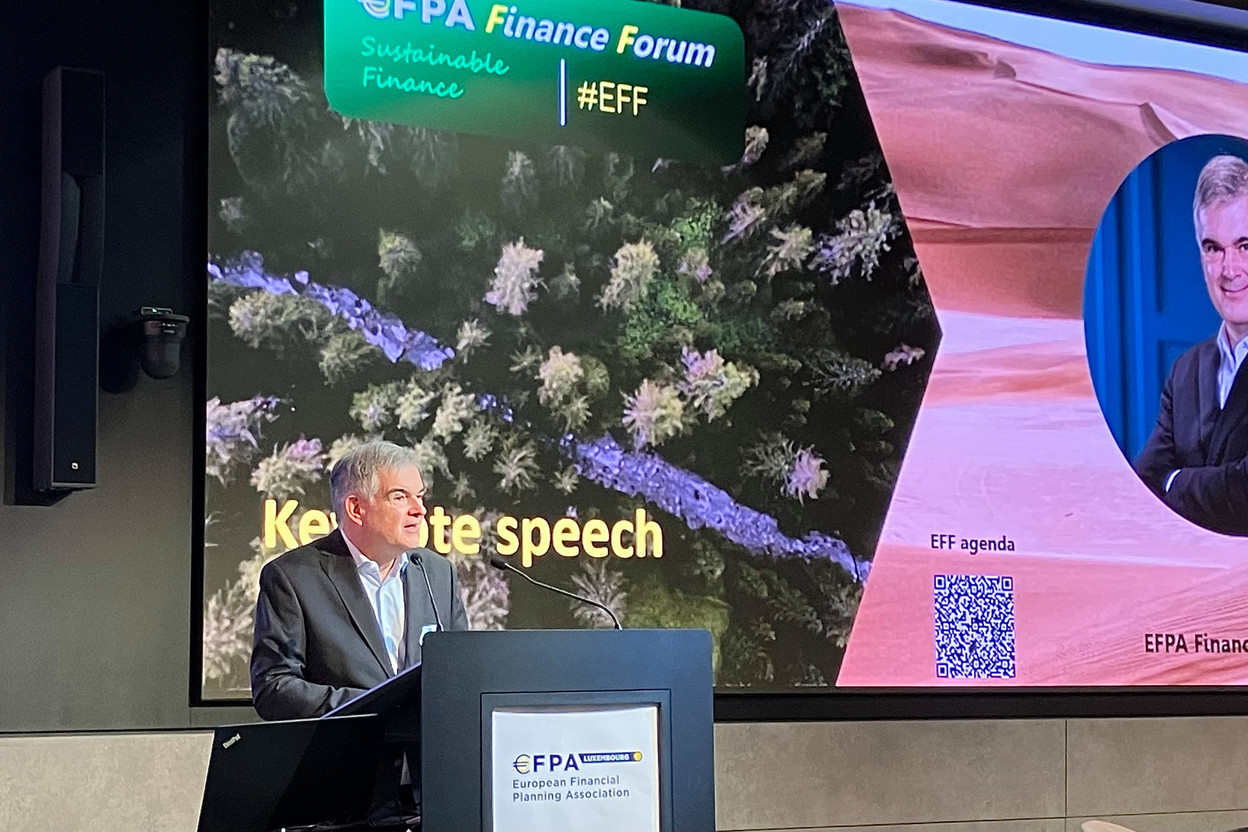
Sustainable finance is one of the focus areas highlighted by CSSF director-general 
“The revolution we are witnessing in US economic policy and the questioning of multilateralism are an important wake-up call for Europe. We may be moving away from globalisation and see increased fragmentation,” Marx wrote. “We are facing unreliability, uncertainty and unpredictability. Europe will need to seriously strengthen its defence capacity, including cyber defence, which warrants huge financing, in addition to the need to finance the sustainable and digital transitions. This represents in excess of €1,000bn a year. And as we know, public money will not be sufficient to finance these transitions. This is definitely the moment to boost capital markets in the EU, and also to reverse the decline in Europe’s competitiveness.”
“I would remind [everyone] that Onno Ruding, former Dutch finance minister and chair of the so-called Ruding Committee, proposed harmonising corporate taxation in the EU in 1992, i.e., 33 years ago. We cannot wait another 33 years to improve Europe’s competitiveness and capital markets.”