Yes, the The Grand Duchy is among the top 10 happiest countries, it is failing to capitalise on its strengths. According to William Russell’s Self Care Index 2026, Luxembourg scores 5.47 out of 10, far behind Austria (9.31) and Switzerland (9.21), which top the rankings. Above all, the country ranks among the ten lowest-ranked out of the 37 OECD countries analysed, a position that is out of step with its standard of living.
The index reflects a growing trend towards prioritising well-being as a key factor in lifestyle choices. “More and more people are giving as much consideration to well-being as they do to career prospects or the cost of living,” the study notes. To compile its ranking, William Russell, a specialist in international health insurance for expatriates, draws on data from the WHO, the OECD, Numbeo, AllTrails and Tripadvisor to measure access to healthcare, mental health support, leisure facilities and life satisfaction.
The index takes into account, in particular, access to mental health professionals, healthcare expenditure, the quality of the healthcare system, opportunities for well-being and residents’ levels of satisfaction. Each indicator is standardised to a scale of 10 and then incorporated into a weighted model to produce a final score, which is intended to reflect ‘each country’s ability to enable individuals to maintain and improve their personal well-being’.
Mental health is rarely discussed
On paper, however, several indicators remain strong. The healthcare index stands at 74.2 out of 100 and life satisfaction has risen to 7.2 out of 10 – levels comparable to those of countries ranked significantly higher. But these achievements do not make up for a structural shortfall in access to everyday well-being.
Luxembourg suffers from a lack of accessible leisure activities. The country has only two easy five-star-rated hiking trails – that is, 0.3 per 100,000 inhabitants – and just one well-rated venue for yoga or Pilates. In contrast, the leading countries are expanding their leisure and relaxation facilities, integrating them into everyday life.
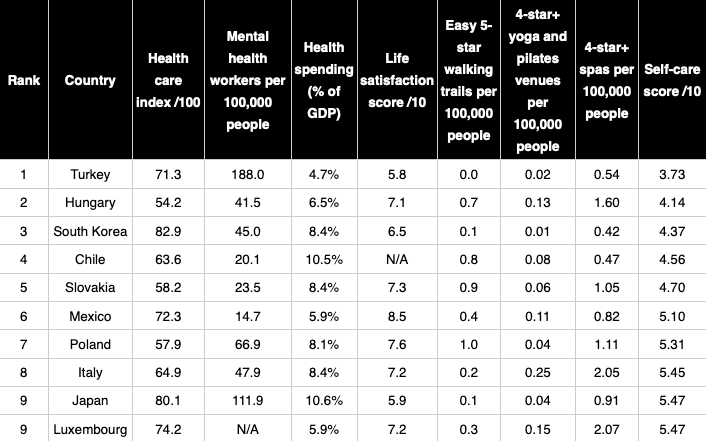
The 10 worst countries for personal well-being in 2026. (Screenshot: William Russell’s Self Care Index 2026)
The spa sector stands out as a relative exception, with 14 highly rated establishments, or 2.07 per 100,000 inhabitants. This is a decent figure, but insufficient to make up for the overall shortfall. Even more problematic is the lack of data on mental health professionals – a key criterion in the index – which drags down the final score. This is hardly surprising given that burnout, for example, is not officially recognised as an occupational illness in legislation.
Another area of weakness is that healthcare expenditure as a proportion of GDP stands at just 5.9%, well below the standards of the top-ranked countries, where it often exceeds 10%. This gap raises questions about the priority given to prevention and well-being in public policy.