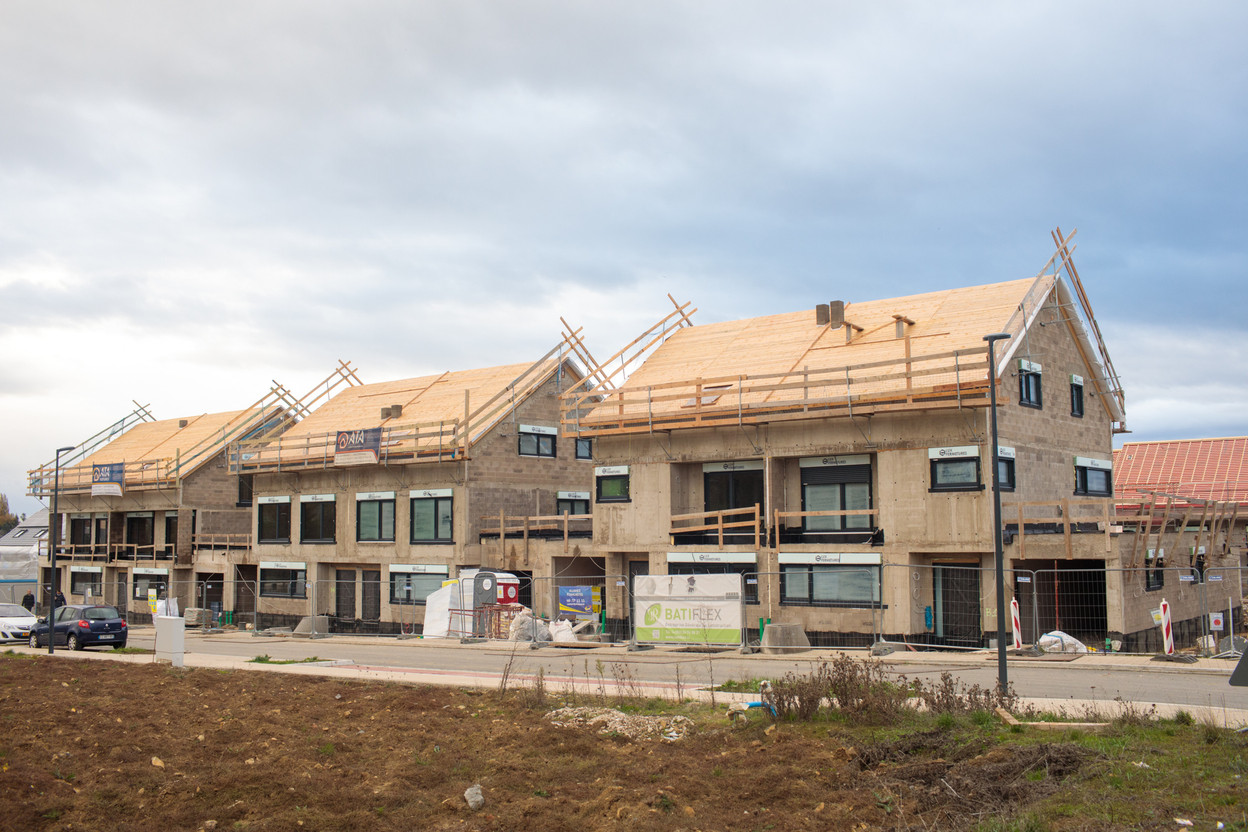
A housing problem? What housing problem? The message, delivered by the territorial planning minister, 

The two ministers announced on Wednesday that they had updated Raum+, the tool for managing land reserves at municipal level: 5,720 hectares should be available, 63% for residential areas, 13% for industrial and commercial areas, and 13% for mixed-use areas. At the beginning of July, the Observatoire de l’Habitat (housing watchdog) reported that 4,294 hectares of land were available for housing, representing three-quarters of the total area available for housing in the country’s land reserves (residential and mixed zones).
“Existing land reserves offer municipalities enormous development potential. As a result, on the one hand, there is no need to extend the perimeters of the current PAGs [general development plans], and on the other hand, there is a lot of land available for economic and artisanal activities,” emphasised Turmes, the minister for town and country planning. Housing minister Kox added that “the challenge is to help the communes to use these land reserves responsibly, for the best of their own future development and with respect for their specific characteristics.”
Public sector has little land; private sector prefers to hold on
While local authorities were called on to make the most of this potential, their room for manoeuvre remains fairly limited, since public owners such as the state and local authorities only own a relatively small proportion of these land reserves. In 2021 and 2022, public entities held just 14.5% of residential land. This is better than in 2013, when they held just 7.8%, but still low compared with the reserves held by private owners.
Among private landowners, 39% said they were interested in selling or developing, compared with 43% who were not. Missing are the 18% who were omitted from the press release and did not have to make a decision. In any case, they are not ready to sell.
While the distribution of land reserves is uneven between the public and private sectors, it is also uneven in geographical terms. The study shows that the conurbation around the capital has the largest share of housing capacity. The three conurbations (centre, southern region and Nordstad) account for 42% of the surface area of housing reserves and 58% of housing capacity.
According to the two ministers, the municipalities will have to implement a number of measures, such as the mobilisation of empty spaces--known as the Baulücken plan--the renovation of existing buildings, the diversification of the housing supply, inter-municipal cooperation and the fight against vacant dwellings.
Read also
Housing for 77,500 residents within five years
The two ministers also stated that “almost 21% of the residential reserves could be mobilised over the next five years, [representing housing for] almost 77,500 residents.” This would be enough to meet the demand expressed in the spatial development plan: an increase of between 10,000 and 13,000 residents per year, i.e., between 50,000 and 65,000 more residents within five years.
23% of additional land reserves could be available within five to ten years, and a further 10% after ten years.
Overall, 85.4% of land reserves can even be mobilised without any legal or physical obstacles, according to the press release. But “only around 19.6% are already ready for construction,” the ministers added. For the remainder, a few more land reorganisations or planning adjustments will have to be made.
Housing capacity varies from city to city
At the same time as measuring land potential, housing capacity was also examined on the basis of the housing densities authorised by the general development plans. “Housing capacity varies between 142,500 and 161,500 units, which corresponds, with an average household size of 2.3 people, to a housing stock that can accommodate up to 371,500 people.”
Finally, “a third of all land reserves have already been developed,” said the government’s press release. This is good news, as the development of these areas will not result in any additional consumption of land. These are mainly urban or industrial wastelands, as well as areas where a change of use is planned.
Read the original French version of this article on the Paperjam site