Inflation in Luxembourg is still a long way from levelling off. At 3.2% in December (compared with 3% a month earlier), the annual rate remains well above the central banks’ target of 2%. Core inflation (excluding food and energy) even gained 0.1 percentage points to stand at 4% in December, according to a Statec report from 8 January.
In Europe, the sharp rise in inflation since the end of 2021 has fuelled various analyses seeking to understand the effect of corporate profits on inflation (as well as on higher energy and commodity prices). This phenomenon is often referred to as “greedflation,” i.e., a rise in prices driven by the greed of companies, whereby they pass on the inflation they suffer while taking advantage of it to increase their own margins.
Statec was called in to examine this sensitive issue, but the initial results don’t match what has been observed elsewhere in Europe. “Corporate profits appear to have provided relatively little support for inflation in Luxembourg [since the end of 2021], unlike import prices and wage trends,” writes the statistics bureau in a report published in December.
“Many people must have been a little disappointed by these results,” says Statec director 
How do we know whether profits are driving inflation? To try and answer this question, we need to break down a price indicator derived from national accounts data, such as final consumption. This is what Statec has done, by replicating the decomposition carried out by the International Monetary Fund (IMF) for the eurozone with Luxembourg data. The results are shown below.
Breakdown of Luxembourg inflation
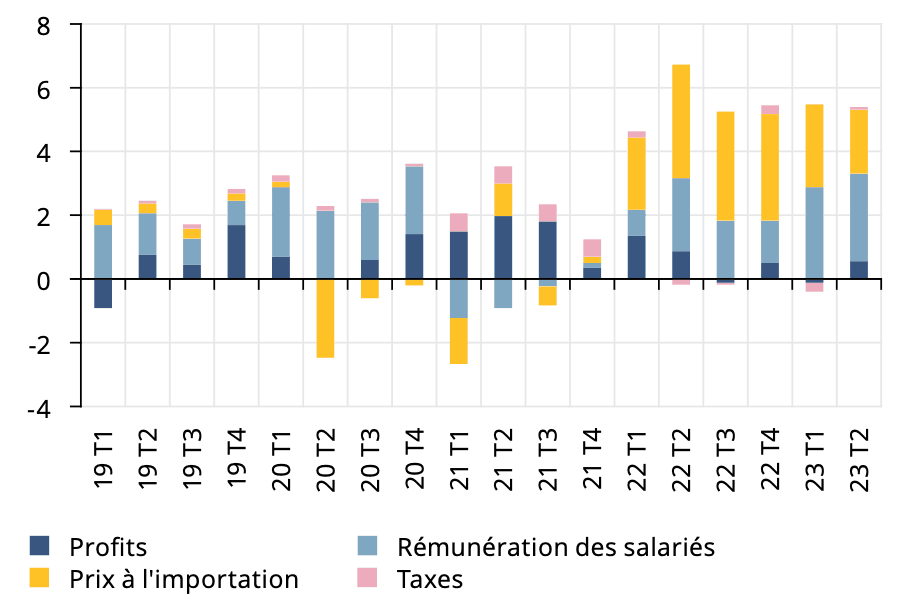
Contribution in percentage points. Sources: Statec/OECD
From 2022 onwards, and compared with the results obtained for the eurozone, we see a much greater impact--on final consumer prices in Luxembourg--from import prices than from profits. But we also see a greater impact from wages. According to Statec, this last observation has applied even more since the start of 2023.
In Luxembourg, inflation appears to be driven primarily by import prices--energy imports, but also food imports, says Allegrezza. “There is complete control over energy prices, via the state monopoly: Enovos and Creos are the importers. But for all other products, there is no control at all,” he comments.
Sharp rise in average wage costs
The second biggest contributor to inflation is wages. As Allegrezza points out, “Luxembourg is one of the countries where the purchasing power of wages, and also that of households, has increased the most.” In its latest economic outlook, Statec reports a sharp rise in average wage costs in Luxembourg: +6.4% in the first quarter of 2023 and +6.8% in the second quarter. This growth was driven mainly by indexation, which accounted for around two-thirds of the rise in average wage costs in the first quarter of 2023 and around 85% in the third quarter.
In contrast, corporate profits did not play a central role. For Allegrezza, the question is about which companies are passing on inflation to consumers and which have the necessary market power. “Clearly, competition is such that, even collectively, companies have tended to hold back on margins. If consumers think we’re exaggerating, they can go and do their shopping in Thionville. The fact that we’re a small economy seems to play a big part,” he says.
We are more and more in a situation of oligopoly.

This contrasts with the results obtained at the EU level. In its spring forecast last year, the European Commission noted that “unit profits have risen steadily in 2022” in the eurozone, with record growth in the last quarter (+9.3% year-on-year). According to Brussels, this increase “contributed more to national inflation than unit labour costs.” Other organisations (ECB, IMF and OECD) also confirm the existence of profit-driven inflation.
Bruno Colmant, economics professor at the Catholic University of Louvain and the Free University of Brussels, stresses the increasingly concentrated nature of markets, particularly in the food and energy sectors. “We are less and less in a context of perfect competition and more and more in a context of oligopoly,” he points out. This development gives companies greater pricing power, enabling them to pass on inflation to end consumers.
The problem of distribution structures
But there are safeguards, particularly in the food sector. Colmant points out that “the major distributors have done their utmost to ward off price increases from producers, by promoting their own products or others of lesser quality.” This is illustrated by Carrefour, which has just banned PepsiCo products from its shops because of their high prices. The fact remains: “Overall, at the European level, companies have certainly benefited from the rise in prices,” says the economist.
This is where Luxembourg, a major importer of foodstuffs, is a bit of a victim of greedflation, not to mention the eternal problem of distribution structures. Against this backdrop, commercial practices are limiting the freedom of Luxembourg companies to source their supplies from wherever prices are most advantageous abroad.
This article was originally published in Paperjam. It has been translated and edited for Delano.