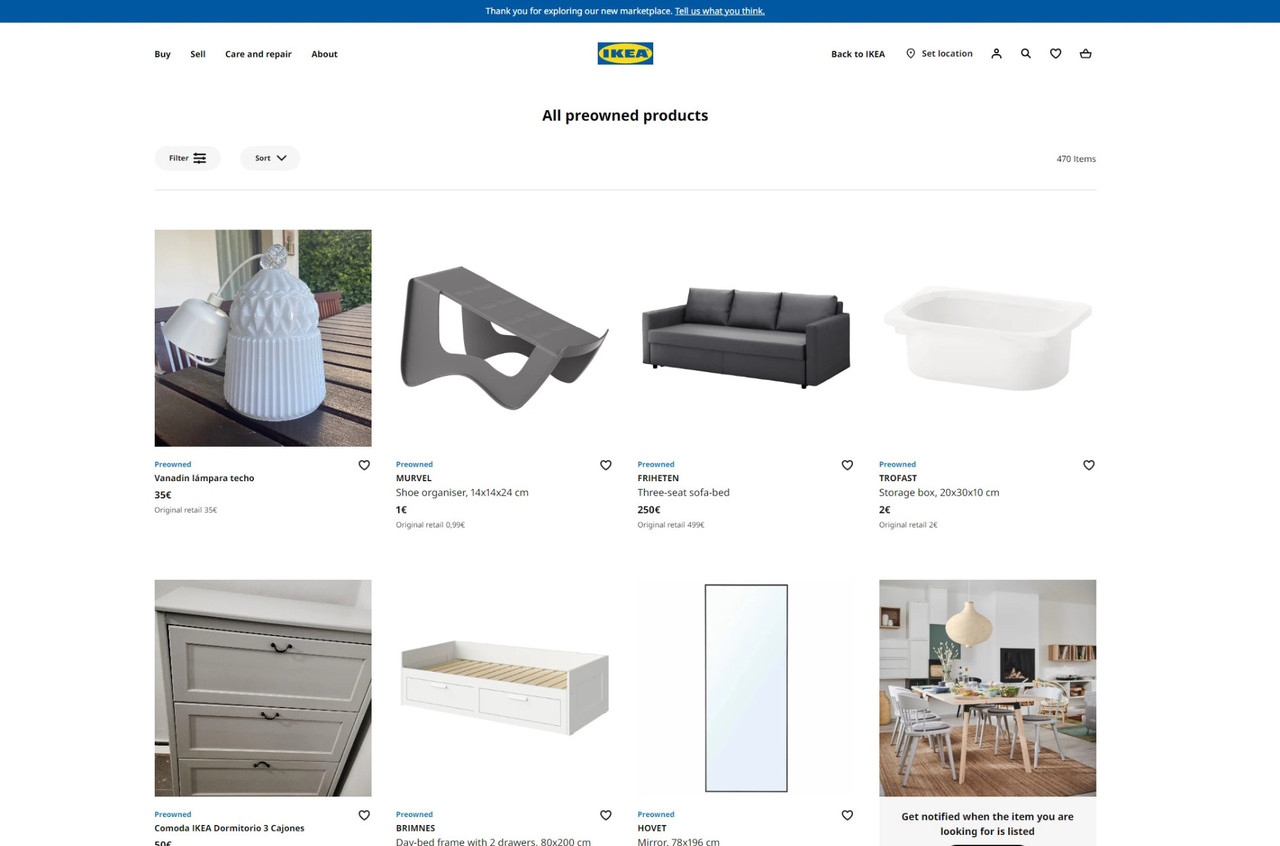
One city in the south and one in the north: this summer, Ikea has chosen Madrid and Oslo to launch a new online sales platform dedicated to the secondhand sale of its furniture and decorative items, Ikea Preowned. The aim of this market place is to connect Ikea customers and give them access to the brand’s furniture at affordable prices, while supporting Ikea’s digitisation policy and strengthening its actions in favour of sustainability.
“The trial will run until December, during which time we will continually interact with users to understand customer behaviours and interests in a secondhand digital marketplace, as well as what it would mean for us from a business perspective,” says Jesper Brodin, CEO of Ingka Group, which owns the majority of Ikea outlets. “After December, we will evaluate and decide on the next steps.”
Assisted sales
The pilot platform is free for the moment and allows users to upload their own photos and set their own prices. But they can also get help from an artificial intelligence that suggests a selling price, product photos and item dimensions. Each listing also includes detailed product descriptions, assembly guides and care instructions.
On average, items are sold at half their original value. Sellers can receive 100% of their sale price if they choose to pay by bank transfer or 115% if they take a voucher payment from Ikea. It will be interesting to see whether customers on this platform use the direct payment system or the voucher system, the latter being a good way for Ikea to reconnect with customers.
In order to preserve privacy, buyers can only access a perimeter of the seller’s location. They can also choose to have the product delivered in the public space or to a nearby Ikea shop.
A global approach
“The global secondhand furniture market is growing rapidly, with a forecast annual growth rate of 6.4% in 2024. Already today, 10% of the secondhand furniture market is made up of Ikea products. With this platform, we see opportunities to simplify and improve the experience for both sellers and buyers,” adds Brodin.
This platform is part of a series of initiatives initiated by Ikea to support the circular economy and sustainability, with the furniture manufacturer’s aim to become circular and positive by 2030. Indeed, it is already possible to resell items directly to an Ikea shop, or return an old mattress, appliance or sofa for recycling. There are also products in shop that are designed to save water, reduce energy consumption or encourage repair and maintenance. A virtuous approach, to be sure, but one that needs to be qualified when you consider that Ikea is a major consumer of wood, with supplies criticised by the NGO Greenpeace for using suppliers who exploit Natura 2000 protected areas.
This article was originally published in French.