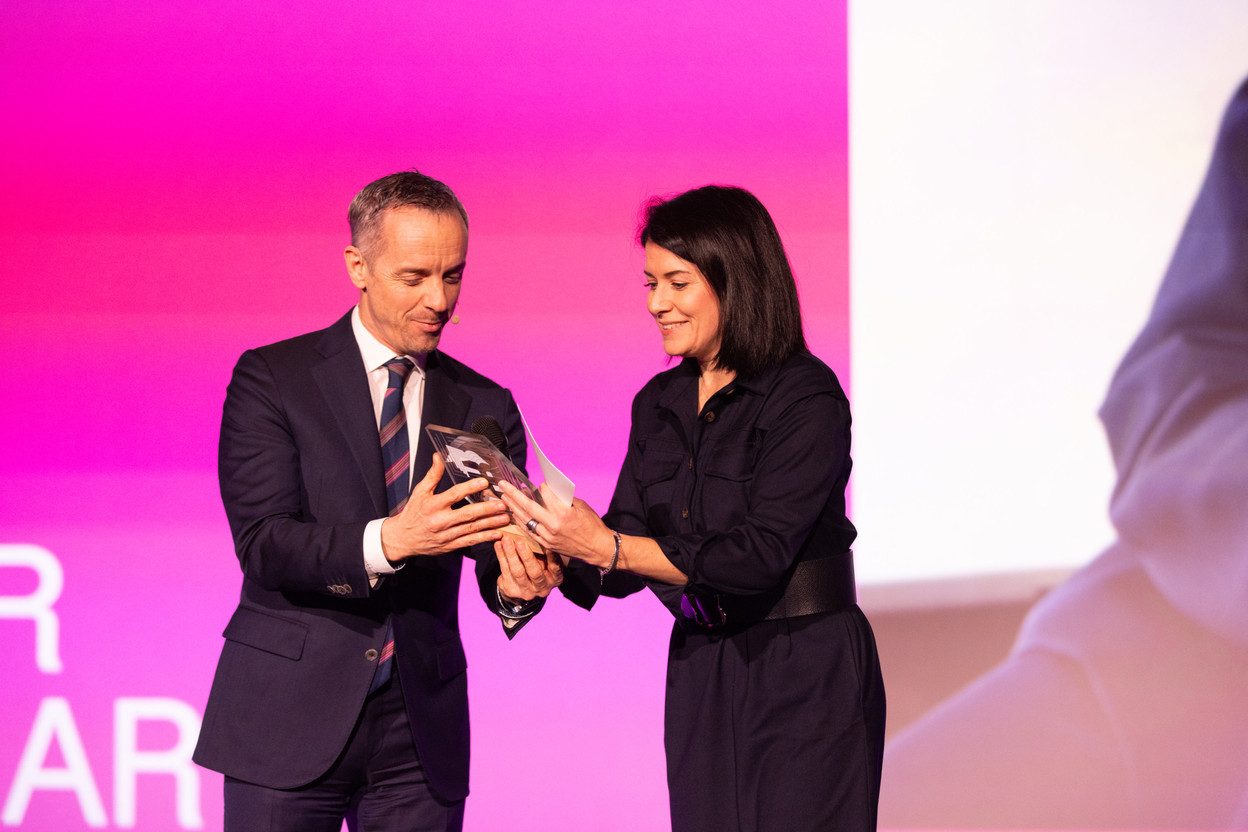
Against a backdrop of change, what is the position of the head of human resources alongside a CEO today? "The role of the HR manager is not limited to executing a roadmap; he or she actively contributes to the direction of the company's strategy," says Marine Cardé, HR manager at Delhaize Luxembourg. "Close alignment with the CEO creates a shared vision in which people are at the heart of performance. Taking care of our teams means ensuring that they, in turn, take care of our customers. A proactive, competent and committed HR department is the essential lever for keeping teams motivated and performing well.”
At Compagnie de Construction Luxembourgeoise (CDCL), Julien Bossu explains that "the HR manager is not just an executor of the strategy defined by the CEO. He or she plays the role of organisational architect, guiding strategic decisions by aligning human and organisational objectives. For example, using HR analyses to anticipate skills needs and supporting a strong, agile corporate culture."

A "transformed" function

The organisation is identical at Société Générale Luxembourg, where "the HR director is a member of the executive committee. In this capacity, they participate in the orientation of the company's strategy, which is ultimately decided by the bank's authorised management", explains Aurélie Ederle, who heads the department.
"Both aspects are crucial: guiding and executing strategy", sums up SLG's HR director 

The role of the HR director is to guide the company's strategy and align the projects to be implemented with it, by including and supporting managers.

Anticipation
"A good HR director has a dual role: executor of the CEO's vision, by translating strategic priorities into concrete actions, and strategic influencer, by providing ideas and advice to help make the right decisions, particularly on important issues such as diversity, innovation or changes in the company", explains Christelle Noel, HR director at Dussmann, the country's second largest employer.
“As HR director, the core of my strategic mission, alongside our CEO, is to be constantly on the lookout to prepare the organisation for future challenges, while ensuring on a day-to-day basis that the resources needed to execute the company's vision are available," says Delphine Bath, from La Mondiale Europartner. “It's a dual challenge that involves anticipating major transformations - in terms of the future of work, changes in skills, technological change, ecological transition or demographic upheaval - and guaranteeing rapid and effective implementation in the face of constantly changing environments, where agility is key to meeting immediate challenges."
As head of HR at the University of Luxembourg, Claire Audollent stresses her role "in building strategy, to help align human resources with institutional objectives: by anticipating skills needs and succession plans, ensuring the development of existing skills in a fast-changing environment and supporting managers and team leaders in the transformations they are leading".
Influence
As Edith Brunner at Lombard International Assurance points out, "The role of the HR director goes beyond execution: he or she influences, guides and creates conditions, and launches initiatives to ensure that the company succeeds collectively. As the CEO's partner," Brunner continues, "the HR director plays an active role in defining and implementing the company's culture, working with the CEO to develop a vision that fosters a culture of excellence and innovation; anticipating and managing change: whether it involves digitalisation, mergers/acquisitions/changes in shareholders or changes in business lines, the HR director supports the company's transformation by managing skills, developing leadership and engaging employees; managing human performance: measuring performance, but also wellbeing at work, diversity, equality and inclusion to align human values with the company's objectives; with the rise of teleworking and the arrival of artificial intelligence, the HR director is rethinking the organisation of the company to gain in agility and attractiveness."
"Over the last few years, the role has evolved considerably, enabling companies to use their HR director to guide their strategy, particularly in terms of human skills. This includes issues such as work-life balance and wellbeing at work. The HR manager listens to feedback from the field and helps to steer the strategy", stresses 
The HR manager must guide and participate in the company's strategy in order to optimise resources and define a personalised roadmap with the team leaders.

‘Many hats’
"After the pandemic, it became clearer than ever that the HR director deserves to sit on the management committee as a strategic partner of the company," observes BDO's Matina Korma. “The HR director is often asked to wear several hats: strategic advisor, performance specialist, organisational psychologist, talent development coach, change agent, employer brand ambassador, diversity and inclusion officer, and employment law specialist," Korma says. “In this multi-faceted role, the HR director plays a crucial part in the success of the organisation. As to whether HR guides or executes strategy, the answer is both. The HR director's input is essential in shaping and directing the company's strategy, as well as being integral to supporting and executing that strategy."
"The collaboration between an HR director and a CEO is now more crucial than ever in defining and implementing a company's strategic vision, particularly through its human capital. It involves a number of areas: corporate culture, alignment of objectives, talent management, performance assessment and monitoring, change management and communication," explains 
Leader in their own right
"In an environment that is more complex than ever, the HR director acts as a true leader. He or she is at the heart of the organisation. He or she guides strategic choices and shapes the company's image through the personalities and roles of each of his or her employees, taking care to ensure that they are part of a learning organisation," says Olivier Schmitt, CHL's HR director.
"The HR director must shed light on situations, seize opportunities and anticipate the unknown... by starting from a different angle to that of other directors: that of the human factor," adds Dorothée Schneider of the Luxembourg Red Cross.
"The HR function is gradually evolving from an administrative role to that of a strategic partner, now integrating economic and environmental performance (Green HR). This transformation is strengthening its legitimacy in strategic decision-making and paving the way for the emergence of a strategic HR department at the heart of business transformation", says 
For Julian Troian of ING Luxembourg, "HR must participate in defining corporate strategy and be present to defend the corporate culture. It is vital to create a psychologically safe environment where talent can express itself fully."
Myriam Sibenaler of the ABBL sums up: "Reconciling performance and employee wellbeing so that they remain committed and motivated. What's more, the HR director ensures that the company has the skills it needs to achieve its ambitions and fulfil its mission."
Marc Parage of Lalux also emphasises this role: "The HR director at Lalux plays a strategic role alongside the CEO: they help to set strategic objectives by aligning HR policies, developing a culture that fosters the wellbeing and development of employees and ensuring an environment in which the Group's short- and medium-term objectives can be achieved."
"CEO and HR must form a strong duo to co-create the company's strategy, and this is even truer for the service company that we are, where employees represent our main means of differentiation", believes the HR director of Sodexo Luxembourg, Ann De Jonghe. "Achieving business objectives is undoubtedly linked to the ability to attract, develop, engage and retain essential talent... and the reverse is also true. It is therefore essential that the two management functions are perfectly aligned.”
This article was originally published in the Paperjam Extra HR leaders supplement, released with the the February 2025 print edition of Paperjam on 29 January 2025. Click here to subscribe to the magazine.
Is your company a member of the Paperjam Club? You can request an individual subscription delivered directly to your home or office. Let us know via club@paperjam.lu.