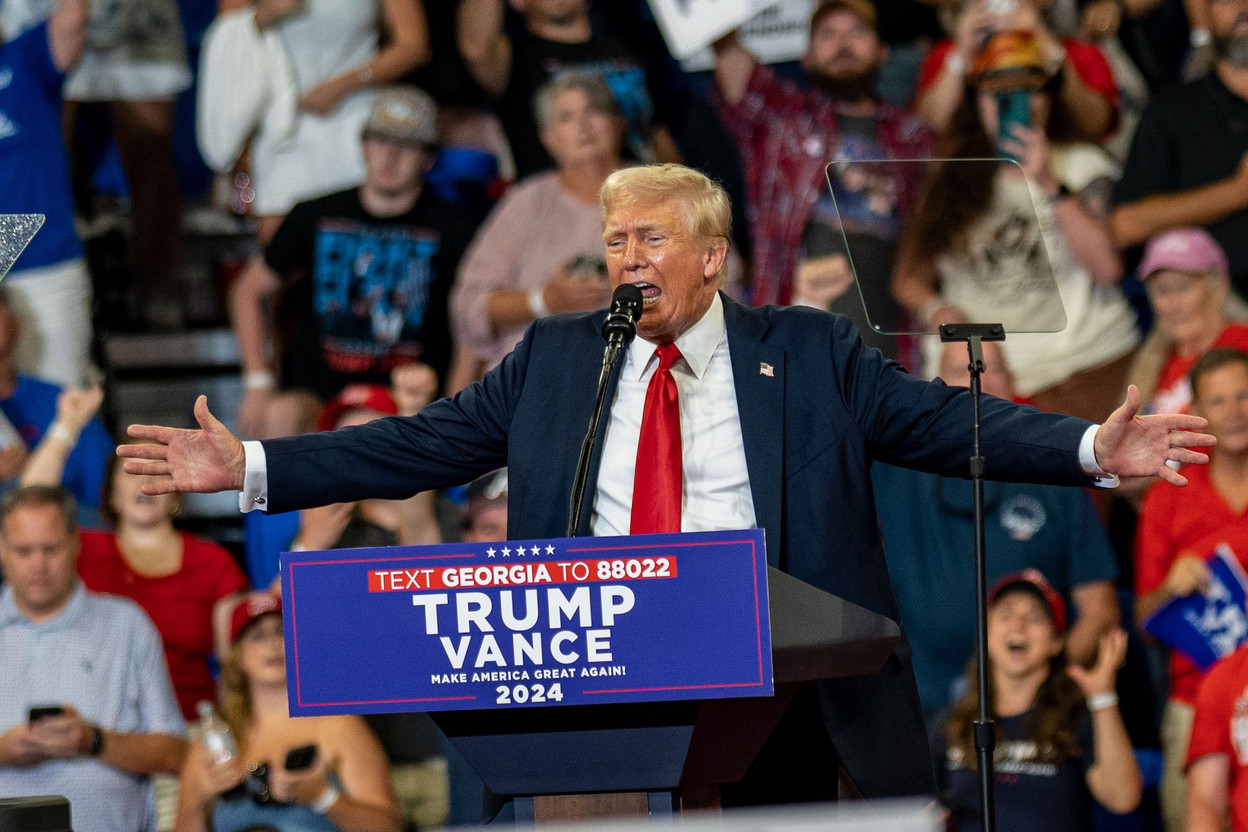
What if we are overestimating the impact of the US presidential election on the markets? For Alexandre Gauthy, macroeconomist at Degroof Petercam Luxembourg, “there will undoubtedly be a short- and medium-term impact on stock market performance. However, in the long term, we must not exaggerate the political impact on the markets, whose performance depends mainly on corporate earnings growth and long-term interest rates.” This is all the more true given that, for a candidate to become president and fully implement his programme, he or she would need a Congress--the House of Representatives and the Senate--that is fully committed to his or her cause. This is far from being the case. A view shared by Philippe Ledent, senior economist at ING Belux, as well as experts from the Spuerkeess Group, Quintet and the Edmond de Rothschild Group.
Trump, Mr Inflation
Of course, the election of either Kamala Harris or Donald Trump will have an effect on the major macroeconomic variables that, in a way, define the playing field for companies. For Gauthy, the effects of a Trump 2.0 administration will be felt above all on inflation. His proposals to restrict immigration and introduce import taxes across the board will lead to an increase in inflationary pressures. This would complicate the Federal Reserve’s task in its fight against inflation, prompting it to return to a more restrictive monetary policy just as it was beginning to cut rates. The economists at Spuerkeess have one caveat: “energy prices would tend to fall under Trump, given that he is planning a considerable increase in US oil and gas production. A structural rise in inflation cannot therefore necessarily be taken for granted.” On a potentially positive note for US companies, Gauthy, as well as the experts at Spuerkeess and Spuerkeess AM, pointed to the lower tax rate for companies producing on US soil.
Harris, the tax pressure lady
“Kamala Harris’ economic policy aims to increase taxation on the wealthiest households and businesses in order to finance social programmes, notably through housing subsidies and public control over the prices of essential goods. These measures to support the most vulnerable households would be a positive factor for the US economy. On the other hand, raising the corporate tax rate would have a negative effect on corporate profits, and therefore on the equity markets,” explains Gauthy. This analysis is shared by Spuerkeess economists, who believe that “short-term growth will probably be lower than under Trump because of the likely increase in taxes and regulations.”
Debt as the common denominator
What do the two candidates have in common? “Neither has a credible plan to consolidate public finances. Over the last 12 months, the budget deficit has risen to 7% of GDP. Never before has such a level been seen in a situation of full employment,” says Gauthy. This view is shared by the experts at Spuerkeess and Quintet, who believe that debt growth under a Trump administration would be faster than under a Harris administration. Nicolas Bickel, group head of investment private banking at Edmond de Rothschild, estimates that a victory for Harris would increase the US debt by $3.5trn by 2035, compared with $7trn under Trump. This will put upward pressure on long-term interest rates. Ledent points out that “the relationship with the debt is also always variable geometry: when the Republicans are in power, they don’t really have a problem with increasing the debt, but they criticise it as soon as a Democrat is in power.”
Elections and asset allocation
According to the experts at Spuerkeess, a Trump victory would favour US companies active in the local market, companies in the oil and pharmaceutical sectors as well as crypto assets. However, they believe that “in general, under Trump, markets are likely to be more volatile because of his unpredictability on tariffs.” “Significantly lower stock market valuations in Europe already incorporate a sizeable risk premium related to the risk of additional tariffs. European underperformance in the event of a Trump victory is therefore not guaranteed.”
A victory for Harris would be positive for exporting companies outside the US, particularly in Europe, as well as for the renewable energy sector. On the other hand, “growth prospects for stock market indices will be less good than under Trump, for the simple reason that corporate profits will probably, at least in the short term, develop less favourably because of higher taxes.”
For Quintet, a Trump victory would be positive for US equities and rather negative for ‘rest of the world’ equities. The dollar would rise, as would bond yields. “The market reaction would be more moderate in the event of a Kamala Harris victory, rather a continuation of what we are currently seeing, with the market being driven more by fundamental factors, namely an economy that is doing well with rate cuts.” For Quintet, the biggest difference between the candidates in terms of asset allocation certainly concerns the energy sector. “Harris will continue to favour renewables, while Trump will support fossil fuels.”
Equities for Trump, bonds for Harris
For ING’s Ledent, a Trump victory--if accompanied by the promised tax cuts--would benefit equities and corporate bonds, but “would be detrimental to government bonds, as it is likely to boost inflation and push bond yields higher. As for Kamala Harris, her less confrontational foreign policy and less aggressive rhetoric than Trump on the issue of tariffs should be appreciated by the stock markets, which obviously do not want a trade war with China. But this is likely to be partly offset by a less accommodating fiscal policy for companies. This prospect is also likely to penalise corporate bonds more than government bonds.”
From a sector point of view, he believes that a Trump victory would benefit the banking sector, the healthcare sector, companies looking to merge, fossil fuel companies and crypto-currencies. A victory for the Harris camp would be good for renewable energies and the construction sector, but not for financial stocks and pharmaceuticals, which could be penalised by stricter regulations in these sectors.
For Bickel from Edmond de Rothschild, “equities are the asset class that should benefit most from the election of Trump and bonds from the election of Kamala Harris. Foreign markets could come under pressure if Trump is elected, particularly the Chinese equity market, although the latter could be reassured by the election of Harris and the limitation of tariff increases. For the equity markets, if the president-elect has a majority in Congress, Trump should benefit financials, healthcare and technology as a result of deregulation and likely corporate tax cuts. Some consumer companies could also benefit as a result of tax cuts, as should the US oil and automotive sectors as a result of the dismantling of the Democrats’ pro-environment laws. A Harris victory, on the other hand, could better benefit basic consumption, boosted by greater purchasing power for the working classes, industrials and new energies, which should benefit from the continuation, or even intensification, of the programmes launched by Biden, notably the Inflation Reduction Act.”
This article was originally published in French.