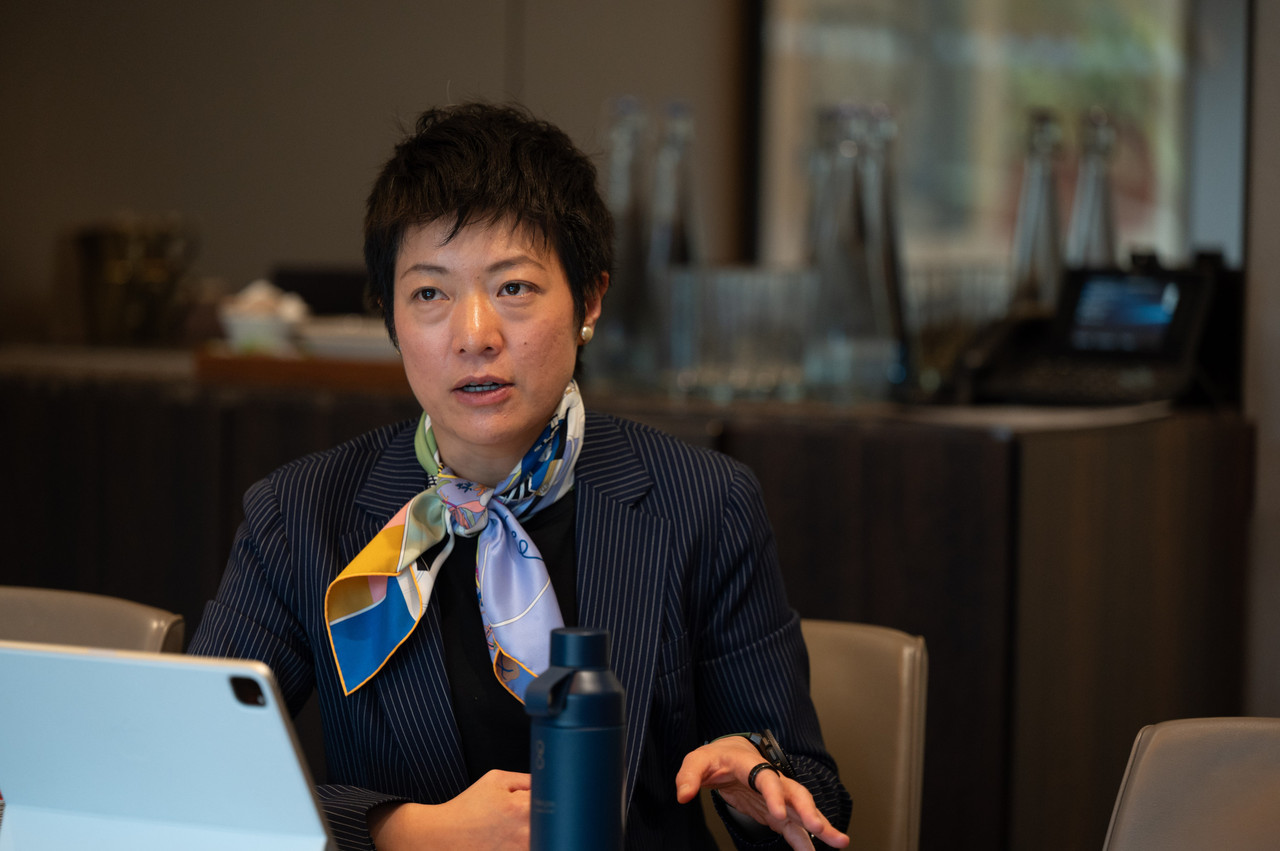
“I didn’t expect the other managers to pull out [of the Climate Action 100+] on the day that the Financial Times reported on our news,” said Jennifer Wu, global head of sustainable investing, during an interview on 13 March 2024 at the International Media Summit organised by J.P. Morgan Asset Management in London. She noted that her competitors left for various reasons. Some withdrew because of the phase 2 plan and others because of legal risks in the US, etc.
Upon the annual review of all their memberships, she explained that JPMAM decided to reallocate resources towards “bilateral engagement with companies because we think that is more useful for our next phase.” She added: “there’s no lack of commitment, we’re actually doing more on climate.”
“We always want to make sure that we are benefiting from a membership and that we are also able to contribute,” commented Wu. JPMAM’s annual review may also result in becoming a member of a “new thing.”
Short stay in the CA100+
She explained that JPMAM joined the CA100+ in 2020 when the firm “really had difficulties to get emerging market companies to agree to do a climate engagement….” It was hard to get climate disclosure, but this has changed.”
The biggest voice and the biggest potential impact that could influence how the C-suite decides what to do is their customers, and policymakers

She is visibly pleased that “the Task Force on Climate-related Financial Risk Disclosure is now mandatory in quite a few markets in Asia.” She observed a shift in the behaviour with companies that are now reaching out to large investors to assess how they perform against peers.
Out of 500 company engagements, Wu said that they met only seven through the CA100+, resulting into the reassessment of its relevance. Yet she thinks that the membership of small asset managers with limited capacity may still be appropriate.
ExxonMobil actions against ESG: an opposite trend gaining traction?
“The biggest voice and the biggest potential impact that could influence how the C-suite decides what to do is their customers, and policymakers,” said Wu.
Wu sees benefits in the carrot type of policies (tax credits or rebates for transition to renewable energy) and in stick types of policies (imposition of carbon tax or other measures to tighten emission standards) “because they’re coming from the government.”
She considers it equally important to engage on the demand side, i.e., with Exxon’s clients so that utilities, for instance, are transitioning from oil and gas toward producing electricity with renewable sources.
Wu admitted that there is so much that shareholders and bondholders can do. Yet she thinks that the beauty of being an active manager is that “we are not trapped as we do not have to own every single stock in the index.”
What should be the role of the fossil fuel industry?
“We still need oil. Probably in the future, not for power generation, maybe in some very exceptional cases but it should be very small, otherwise, we will not be able to get to net zero.” Wu thinks that oil companies should use their cash flow for capex and R&D to support renewable power generation such as solar, then “diversify and invest in areas whereby oil will be used for other purposes.”
Clients are in need of return, all of them
Wu thinks that her clients are generally looking for JPMAM “to use ESG to help enhance risk-adjusted return,” but she acknowledged that some clients are expecting also an “environmental and a social outcome.”
Why are article nine funds performing so poorly?
Wu thinks that one of the issues is that “most of the article nine funds are thematic funds” which are “more volatile than broad based funds.” She noted that most of the article nine funds launched in the last two years focused on the environment as the regulation requires the funds to define their “environmental or social objectives and there are very clear guidelines in SFDR.”
Wu claims that their picks in the “JPM climate change solutions fund” will do better in the long run, but not “all the time.” She stated that the companies in the fund are “the most aligned to the transition to a low-carbon economy across sectors and different key technologies.”
She could not comment on her competitors’ article nine funds but noted that JPMAM does not use ESG benchmarks but rather the MSCI World. Wu thinks that most of the article nine funds which excluded the energy sector or a big part of the energy sector--“stocks which went up a lot”--with a broad-based benchmark “performed terribly.” Consequently, she thinks that JPMAM will “probably need to change the benchmark to take into account the restrictions.”
ESG ratings: not relying on third party ratings
Contrary to some large competitors, when it comes to ESG ratings, “we basically build them from scratch,” said Wu. She explained that JPMAM pulls emissions or the employee turnover data from sources such as Bloomberg or directly from companies. It also uses NGO data “to create controversy signals.” She thinks that the rise of large language models will enable JPMAM to create more real time signals.
On the qualitative side, Wu explained their 300 analysts must answer 40 questions on ESG for around 4,000 companies under coverage.
Challenges related to defining “sustainable”
The usage of external ESG ratings results in unwelcomed “confusion” as operational sustainability (compliance with environmental regulation, fair treatment of employees, governance structure) and the impact of products (harm on public health or the environment or negative for climate change) often provide contradictory ESG ratings outcomes when both assessments are combined. Wu cited the case of tobacco companies that are undeniably harmful to public health but are using water very efficiently.
“If I care about both for a fund, I will just look for companies that are good on both sides. Keep it very clear.”
Delano was invited to attend the J.P. Morgan Asset Management’s International Media Summit in London. The latter paid for accommodation and transportation.