A new look at engineering
The essence of the “Next Level Engineering” project is based on a key principle: to be more agile in the face of complexity by adopting a global perspective that goes beyond standardisation to solve problems without compromise. It is based on a parametric, multi-scale and multi-physics approach, and presents a real opportunity for innovative solutions to emerge or for new knowledge to be created.

For what purpose? (Illustration: Schroeder & Associés)
As David Statucki, the initiator of the concept, explains:
“Every problem that engineers encounter daily is part of a large set of problems to be solved, just as every solution produced in response is part of a wide range of feasible technical alternatives. These two areas and their interrelationships evolve according to the issues at stake, the constraints imposed, the available approaches to solving them and the state of knowledge and techniques acquired. Our aim is to broaden the field of possibilities in our areas of expertise, by revealing the full structure of this continuum linking solutions and multiphysical problems, even when the latter seem distinct at first sight. The development of the Next Level Engineering project supports this ambition.”
We want to remain a reliable and recognised source of proposals, with the excellence that characterises us.
The four pillars of the “Next Level Engineering” project
Each of the four pillars plays a specific role in this innovative approach:
- Modularity: flexible, systemic linking of tools.
- Transversality: a combination of tools adapted to specific needs.
- Robustness: rigorous modelling of couplings and energy transfers to deal with contradictions and imperfections.
- Generative: advanced integration of artificial intelligence to enrich the development of solutions.
These pillars are supported by cutting-edge technological tools:
- TRIZLab: to prepare for problem solving and find innovative solutions.
- COMSOL: powerful multiphysics simulation software.
- A! NDL: COMSOL’s native AI, controlled by the engineer at every stage.
- FORGE: a collaborative software platform for developing and implementing solutions.
A group of tools for innovation
The use of these new tools makes it possible to analyse all the alternatives identified during the resolution process, including those that might seem less ideal for a given problem, because they are also the optimal responses to other problems that have become naturally identifiable through these original means.
For example, in the design of sustainable buildings adapted to modern constraints, these tools can be used to find an optimal solution for a building that can be transposed to other types of building, whatever their geometry or composition.
Our credo: to be a player in innovation and the bearer of new technical paradigms.
An approach centred on the physics of the building
To anchor the concept in concrete terms, Schroeder & Associés has chosen to focus on the physics of the building, encompassing all its disciplines (thermal, acoustic, mechanical, etc.). This vast field makes it possible to deal comprehensively with the complex relationship between a building and its environment, while integrating the sustainable and innovative aspects of modern construction.
“It is important for us to ensure that building physics and the multiphysics themes involved in this project are part of a long-term approach, and to create a set of development and support tools for new materials and/or construction systems. In this way, we can confidently maintain control over the complexity of innovative systems in the making. Our credo: to be a player in innovation and the bearer of new technical paradigms,” explains David Statucki.
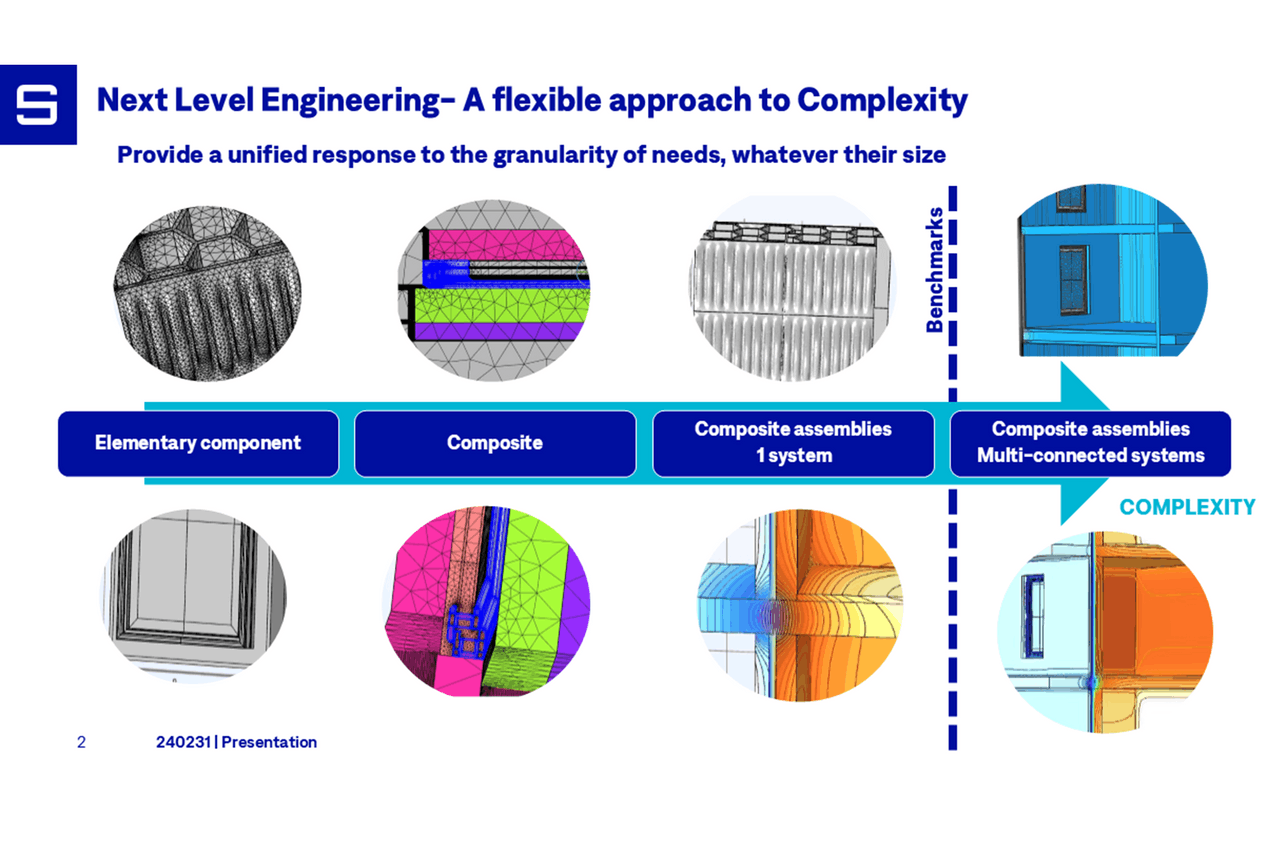
A flexible approach to Complexity (Illustration: Schroeder & Associés)
A promising future
The launch of the “Next Level Engineering” project is part of Schroeder & Associés’ 2030 strategy, which is aligned with international sustainability objectives. Internally, this approach aims to stimulate talent while promoting synergies.
Its development marks a decisive turning point for Schroeder & Associés, combining innovation, sustainability and global vision. By rethinking the issues and natively integrating artificial intelligence in a controlled way, this project offers solutions that meet the challenges of the 21st century.
Ultimately, it will also become one of the levers for transforming working methods and strengthening the company’s position as a leader in engineering.
Further information: www.schroeder.lu