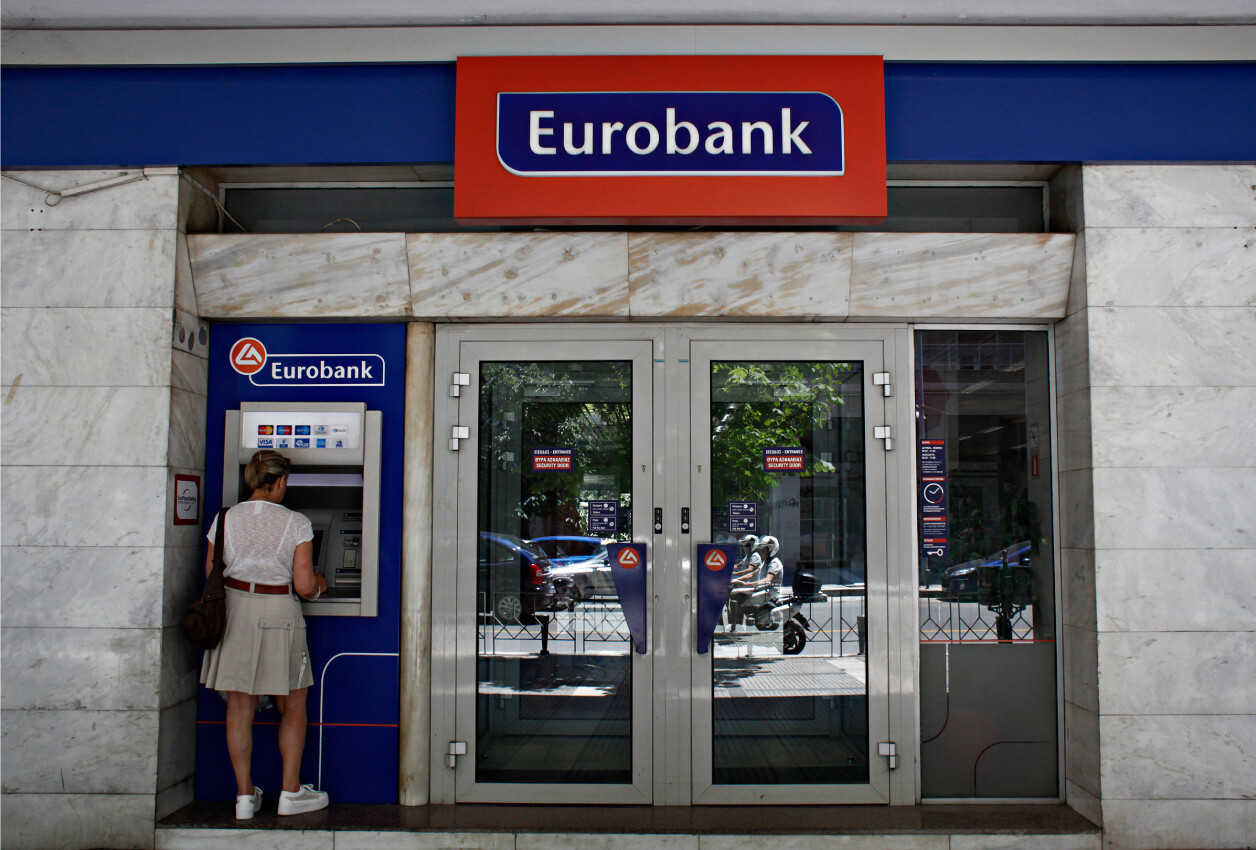
In the summer of 2015, Greeks withdrew their deposits en masse. Banks lost access to the markets. A referendum fuelled fears of a default and an exit from the eurozone. On 28 June, the authorities temporarily closed the banks and imposed capital controls. Eurobank would later describe this as a ‘perfect storm’. Its annual report details a liquidity crisis, the interruption of international funding and the deterioration of loan portfolios. When the European Central Bank assessed the four major Greek banks, it estimated their combined funding needs at €14.4bn in its most severe scenario.
Eurobank has raised €2.039bn from private investors. It has thus met its requirements for the recapitalisation at the end of 2015 without any further public funding. However, this success does not restore its independence. The bank remains subject to the restructuring plan approved by the European Commission. This plan provides, in particular, for a gradual divestment of activities that do not fall within its core banking business. Eurolife is one such activity.
However, the insurer is by no means a minor player. Founded in 2000 and led by Alexandros Sarrigeorgiou since 2004, Eurolife was then the third-largest player in the Greek market. At the end of September 2015, the group reported €241 million in gross written premiums. Its life and non-life businesses together account for around 10% of the Greek insurance market. Above all, Eurolife is already closely linked to Eurobank. The majority of its policies are sold through the bank’s branches. During the first nine months of 2015, around 82% of its business was channelled through this network.
A Canadian double white knight
Eurobank is to relinquish control of an insurance company for which it is itself the main sales channel. In December 2015, the bank announced the sale of 80 per cent of Eurolife to the Canadian group Fairfax Financial Holdings. It retains a 20% stake and maintains the agreements that enable it to distribute Eurolife’s insurance products through its branches.
Fairfax is not bearing the risk alone. The Canadian pension fund Omers is investing €158m to acquire an indirect 40% stake in Eurolife. Fairfax holds the same proportion. Eurobank retains the remaining 20%. The transaction is being organised from Luxembourg. On 4 August 2016, Costa Luxembourg, a company then jointly controlled by Fairfax and Omers, acquired 80% of Eurolife. The price paid on completion amounted to €324.7m, following the prior payment of a €34m dividend to Eurobank. Luxembourg is therefore not merely a legal backdrop tacked on at the end of the story. It is home to the vehicle through which the Canadian investors hold the Greek insurer, finance their stake and will receive the dividends generated by the company.
It remains a considerable gamble. Fairfax is investing in a country still subject to capital controls, largely cut off from financial markets and emerging from several years of recession. But the Canadian group is not starting from scratch. It is already familiar with Eurobank, in which it has become a major shareholder. Another key decision is that Fairfax is retaining Eurolife’s management team. Alexandros Sarrigeorgiou remains at the helm of the company. The change of shareholder does not mark a break with Eurobank, which remains its main distributor.
The transformation and the joker
At the same time, the insurer is embarking on its transformation. In its announcement, the management presents the ‘Eurolife 2.0’ programme as the transition from a traditional insurer to a company driven more by data and digital tools. Salesforce, in particular, has been chosen to centralise relations with customers and partners. In 2017, Eurolife announced investments of nearly €2m in its infrastructure. However, this modernisation accounts for only part of the company’s success.
In his 2019 letter to shareholders, Fairfax’s chairman, Prem Watsa, described Eurolife as a ‘jewel’ acquired during the Greek crisis. Between 2016 and 2019, according to figures published by Fairfax, Eurolife generated €347m in profits, paid out €298m in dividends and increased its equity from €400m to €720m.
Prem Watsa makes no secret of one of the main drivers behind this performance. Eurolife held a substantial portfolio of Greek government bonds. When the yields on these bonds fell from around 8% to 1%, their value rose sharply. Greece’s return to financial stability therefore enriched the insurer, which had agreed to maintain its exposure to the country. The company does not rely solely on this market recovery. Fairfax also highlights an average combined ratio of 72% in non-life insurance between 2016 and 2019. This means that, within this segment, premiums collected more than covered claims and operating costs.
Another ‘stress test’ with Covid
The 2020 results, however, show why it is important to distinguish between operational performance and financial gains. In that year, Eurolife reported €448.65m in premiums, €3.5bn in assets and €738m in equity. Its pre-tax profit reached €151.9m, but its operating profit stood at €22.2m. This discrepancy highlights the significance of the investment portfolio in the group’s profitability. Over the five-year period from 2016 to 2020, Eurolife reported cumulative pre-tax profits of €672.6m. This result reflects the growth of the insurance business, the discipline of the non-life division and the revaluation of Greek assets.
In 2021, Fairfax acquired Omers’ remaining stake. The transaction, which included a performance-related component linked to Eurolife, totalled €120.7m. The European Commission then authorised Fairfax to take sole control of the insurer. The Canadian group thus became the main beneficiary of a gamble taken at a time when Greece was still viewed with suspicion. But Eurobank never completely stepped out of the picture. It retained a 20% stake in Eurolife and, crucially, continued to provide it with the bulk of its customers.
In 2024, Eurolife Life recorded gross premiums of €589.6m. Its share of the Greek life insurance market stood at 21.6%, compared with 17.1% a year earlier. The banking channel still accounted for 77% of its business. Unit-linked products – whose value fluctuates in line with the chosen investments and for which the financial risk is borne primarily by the customer – accounted for 68.6% of sales. These figures demonstrate both Eurolife’s success and its interdependence with Eurobank. The insurer has developed its products, tools and profitability under Fairfax’s ownership. However, the bank has continued to provide it with the distribution network without which this growth would have been much more difficult.
In October 2025, Eurobank announced its intention to reacquire the 80% stake in Eurolife Life that it no longer held. Fokion Karavias described the move as a result of the bank’s financial recovery. “The sale of Eurolife Holdings in 2016 was a key element of the bank’s restructuring plan, at a time when most Greek banks were forced to sell assets in the wake of the severe consequences of the Greek financial crisis,” he said. “Today, Eurobank’s restored financial strength enables the bank to repurchase one of its most strategic assets.”
A new geographical balance
The final agreement was signed in May 2026. Eurobank announced a price of around €813m for the 80% stake in the life insurance business. On 29 October, following the granting of regulatory approvals, the bank confirmed the completion of the transaction. It now holds 100% of Eurolife Life. Fairfax, for its part, confirmed that it had sold its stake for a cash consideration of approximately €813m.
The transactions carried out around the time of the closure account for the sum of €805.1m being transferred back to Luxembourg. Eurolife Life’s parent company sold the entire subsidiary to Eurobank for €1.006bn. It is to distribute this sum to its two shareholders, Eurobank and Costa Luxembourg, in the form of dividends and a capital repayment.
Eurobank recovers €201.27m through its 20% stake in this parent company. Its net outlay is thus reduced to €805.11m. Costa Luxembourg, controlled by Fairfax, is set to receive the same amount. The €813m therefore corresponds to the approximate price announced for the 80% stake; the €805.1m represents the final proceeds accruing to the Luxembourg holding company following adjustments and distributions relating to the closing. However, part of the money is not due to be remitted immediately. Eurolife’s parent company has also approved a loan of €541.1m to Costa Luxembourg, with a term of eight months and bearing interest at the Euribor rate plus 0.9 percentage points. This financing is to be repaid once the corresponding dividend has been received.
Fairfax is not, however, withdrawing from the Greek insurance market. The group retains control of Eurolife’s non-life business, in which it holds an 80% stake, with Eurobank retaining the remaining 20%. Fairfax is also set to acquire a 45% stake in ERB Asfalistiki, Eurobank’s non-life insurer in Cyprus. This second transaction is separate from the acquisition of Eurolife Life and remains subject to its own timetable.
Prem Watsa attributes the success of the life insurance business to the work carried out under the leadership of Alexandros Sarrigeorgiou and says he expects it to continue to grow under the management of Eurobank and Fokion Karavias.
Ten years after the sale, the life insurance business is thus returning to Eurobank’s fold, accounting for 21.6% of the Greek life insurance market in 2024. This figure cannot be directly compared with the approximately 10% attributed in 2015 to the Eurolife group as a whole, including both life and non-life insurance. But the turnaround remains spectacular: the assets sold off to enable Eurobank to survive are being bought back because the bank believes it has regained the means to grow. The Greek tragedy has not disappeared from this story. It provided the starting point. The entrepreneurial success lies in having built, between Athens, Toronto and Luxembourg, a company robust enough for its former owner to want to buy it back ten years later.