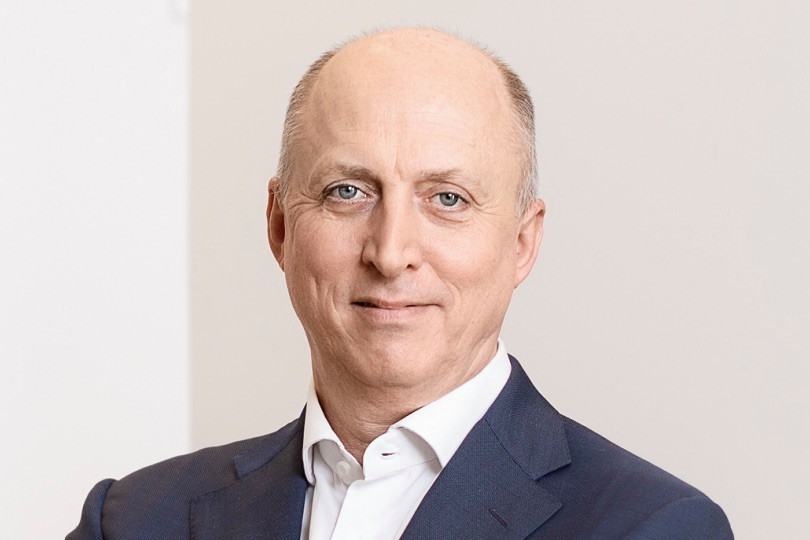
“This is probably the first time since the end of the second world war that we’re seeing such a significant and structural change to the economy,” said Sandro Pierri, president of the European Fund and Asset Management Association in his introductory remarks to the industry group’s Investment Management Forum on 23 November 2023. “We’re having four transitions happening at the same time.”
The first is the sustainable transition, which involves ensuring a just transition that takes into account all regions, argued Pierri. The financial sector will be “critical” in supporting the transition to net-zero, and “it’s very important that we maintain a long-term view without paying too much attention to the short-term noise.”
There’s also the technological transition, as illustrated by the recent hype around artificial intelligence, argued Pierri, as well as the demographic transition, which is often overlooked. The global population will continue to rise, but it will be geographically polarised: emerging markets will continue to grow, while developed markets are actually already in decline. In addition, the population in Europe is aging, and “millennials will have a very different attitude to saving, investment and consumption, which will clearly create a different macro-scenario.”
The fourth and last transition is geopolitical. “If we take a longer-term view, the balance of the world in the past 25 years was based on three major drivers,” said Pierri. These were access to cheap labour (mostly seen in the US), access to cheap energy (mostly seen in Europe) and access to cheap international trade (mostly Asia, and, in particular China). But these these three “building blocks for globalisation” are no longer in place. A new--and unknown--balance of power is coming in, and “it’s another element of disruption that we need to take into account.”
Key to transform savers into investors
For Pierri, these will lead to three important, long-term consequences: increased volatility, lower GDP growth and structurally higher inflation. “This is probably one of the most interesting and challenging times for our industry,” he said. But “it’s also important that we remind ourselves what is the role, the broader role that as an industry we play in society.”
“We are one of the most important transmission mechanisms of capital allocators. We help investors to achieve their long-term goals, and by doing so, we basically provide a long-term stable source of funding for governments, for companies and projects.”
It will be crucial for Europe to make significant progress towards a capital markets union that works for people and for financial industries

But looking at European household assets, only one-third of those assets are “professional.” “Attracting capital investors or transforming savers into investors is what’s going to drive the industry going forward,” said Pierri. “It is absolutely needed, also to fund the ambitious projects that Europe as a whole has, namely, the sustainability agenda and digital [agenda].”
So how can this be done?
Capital markets union is essential
“It will be crucial for Europe to make significant progress towards a capital markets union that works for people and for financial industries, to support the digital and sustainable transitions,” said Pierri. The completion of the Ucits/AIFMD review--and that the delegation agreement remains largely unchanged--is good news, while “the introduction of a wide range of liquidity management tools is very much welcome.”
“A second big achievement is Eltif 2.0 [the revision of the European long-term investment fund regulation], which clearly has the potential to unlock retail investors, to invest in real assets.” The review of Mifid--the Markets in Financial Instruments directive--is another positive point.
There has been progress, said Pierri, but there’s more to be done, in particular ahead of the European elections in June 2024.
Retail investment strategy and the need for tax incentives
Efama agrees with the European Commission’s objectives in the retail investment strategy, noted Pierri. “We absolutely need to attract new savers into capital markets, we need to increase retail participation, in the interest of investors themselves, but also in the interest of finding additional avenues of support. We are only afraid that as it stands now, the draft of the retail investment strategy might miss its mark.”
“As it stands, the focus is significantly on the cost side,” said Pierri. “And in our view, it doesn’t necessarily address all the reason why savers are not increasing their participation.”
During a Q&A session later in the afternoon, Pierri and Efama director-general Tanguy van de Werve expanded further on this point.
“We would have hoped for measures that will help increase retail participation: i.e., turning people who have never been invested in capital markets into first-time investors. Frankly, what is on the table today, what has been proposed by the [European] Commission has little to do with turning depositors into first-time investors,” said van de Werve. “This is far more to do with an attempt made by the commission to provide existing investors with better outcomes.”
Read also
So what should be done in order to encourage retail investors?
“There’s no silver bullet; otherwise, we would have done it already,” replied Pierri. “I think it’s a combination of things.”
One one hand, “everything around transparency and investor protection is giving more confidence to retail investors,” he continued. “We’re simply saying that this is not going to be enough. It’s not only a question of transparency, there’s an element of education--which is going to be longer-term--there’s an element of product governance in itself and there’s an element of incentive.” It’s a process, Pierri added.
Regarding incentives, “tax incentives are clearly the first thing that comes to mind,” said Pierri. When comparing the US and Europe from an asset management perspective, there are two main differences. One is that US asset managers operate in a single market, which is not the case in Europe. And the other relates to “prolonged, significant” incentives--such as 401K policies for retirement--which Europe doesn’t have.
“If we’re talking about retirement savings--whether in the US and also in the UK--if we want people to start saving for the long-term, you need to have tax incentives,” added van de Werve. “And where long-term retirement investment is popular across the world, usually you have a tax incentive element, which is part of the solution. It’s a no-brainer.”
Make competitiveness a central policy element
Concluding his introductory speech to the forum, Pierri said, “The overall message that I want to pass is that the work has been done, but we need to accelerate on some of the files that are going to be critical going forward.”
Looking ahead to the agenda of the next European Commission, the Efama president highlighted what he considered to be four main priorities. The first is boosting retail investor participation and promoting retirement investment. The second is improving the sustainable finance framework to “really unlock its full potential,” and the review of the Sustainable Finance Disclosure Regulation (SFDR) is “probably a good opportunity to move in that direction.” The third priority would be to “advance more efficient, stable and competitive capital markets in Europe.”
And last, but not least: “make competitiveness the central element of overall EU policy.” “It’s absolutely critical, in my view, that European industry becomes more competitive on a global scale.”