Aaron Grunwald: What will Luxembourg’s financial sector look like in 2035?

Luxembourg has always been a leader in sustainable finance, especially in blended finance, as well as green bond listings, and now I think it needs to do more, especially in terms of impact investing. This is what the focus should be. As well as gender finance. I really think that it will change in the upcoming five to ten years. Things will radically change.
How do we get there?
What has been lacking is measurement: how do we measure? How do we rely on data? How do we make sure we can really invest in certain projects over others, because we have good data and information available? So I’m sure this is where Luxembourg will invest. We see there is a good ecosystem here for data centres, for IT, and I’m sure we will see in the upcoming future, a lot more technological companies, more specialised in sustainable data.
In simple terms, what is the problem with sustainability data? What’s missing and why is it a problem for the market?
Basically, the main data vendors we rely on are all US-based companies. So we don’t have the same definitions and categorisations for certain kinds of data that we use in Europe. That’s one of the main problems. And there’s a kind of discrepancy according to the categories of international agreements. Sometimes we don’t define [in the same way, for example] renewable energy or some controversial behaviours. I mean, there’s a lot of different controversial weapons, a lot of different things that are not properly defined worldwide. If you consider there are 52 taxonomies worldwide, probably more, it’s becoming, well, a bit of nightmare.
What certain data are used for [by asset managers is for funds with a] threshold on certain kinds of investments to qualify as biodiversity, on renewable energy, and so on. You need to understand exactly what those investments are made of. Because some of the funds are investing in companies where it’s a mismatch, basically. So, it’s very, very hard to understand if they are qualifying as being sustainable or not.
Getting the data is already quite difficult, because you rely on external service providers or the company itself disclosing certain data. But then you need to control those data, assess how it was collected, how they verify. There’s plenty of small data vendors now, startups, entering that business... they contribute to clarifying [the picture] somehow, but then there’s another methodology on top.
Shifting gears a bit, what will the workforce look like and how will that influence the market?
I believe the financial centre in the coming five to ten years will be extremely diverse, much more than the local population. I imagine workers will be diverse in all [aspects, with more people] coming from third countries. I mean extremely knowledgeable candidates willing to relocate... and [there will be a greater focus] on gender finance, because we definitely will have many more women in leadership positions, who will really ask for specific sustainable products to invest in.
There will also be the younger generation that will be extremely engaged. You see that university students are quite keen on really choosing carefully the kind of product they could invest in and where we put their money. Women will also [demand more sustainable investment products].... it will help us towards the [climate] transition.
What steps are needed now?
We need to engage further with banks or mortgage companies to have specific products for vulnerable populations, like single women, or more marginalised populations.... if they try to get a mortgage from the bank, if you’re a single mum like me, well, it’s very hard.
How do we encourage the creation of more financial products and for financial firms to shift their thinking? Is it more regulation, an industry forum, new labels?
I think we need a plan. We need a kind of gap analysis, mapping what currently exists and what we are trying to achieve. And then after, encourage all sectors [to deliver on the map].
You know, everyone is overwhelmed with too much regulation to further develop their activities. It’s true that most of them probably are keen on investing or developing those kinds of innovative financial products. But probably we need to have something ready to plug in for most of them. Something that we could offer to them to plug into... to replicate it, or even improve it. The first thing is really to have them knowing that those kinds of products exist somewhere else that could be [developed for Luxembourg].
So how do we influence banks and investment funds?
I don’t want to say tax incentives, because I think public money is way too much involved [already]. I mean, we need a shift in the mindset and this is why it will take another generation to get there. Because when we get a new generation on board, things will start to change a bit quicker. For now, we see some actors are really keen to change, others are much more, well, comfortable [with the status quo].
Economically, it seems now it’s very hard for most of the fund managers, so they are not keen on doing much more... although I think for those that do try now, it will bring them a lot [of benefits] in the upcoming five to ten years.
Luxembourg has a history in responsible investing. Is it in a good position to maintain that leadership position or do you feel a bit threatened by markets like Singapore or the UK? Is the grand duchy still going to be one of the leaders in sustainable finance in ten years’ time?
I hope so. I mean, public or semi-public actors can do a bit. But private actors [need to play their part]; it cannot always come from the public side. So, yeah, I’m afraid. I’m afraid that we won’t react quickly, altogether. Singapore, Hong Kong, Japan, even Indonesia, is already thinking of [the next steps]... for sure, they will be quicker. They will. They are extremely, extremely smart. Not that we are not, but we need to move a bit quicker than we are doing at the moment. There are a lot of good things from Luxembourg. We have the legitimacy. We did a lot in the past. We are still doing a lot now, but it is speed. We need to get up to speed, because there’s competition for the financial centre and we need to capitalise on all what has been done so far.
What would you like to see happen?
Regulations should be a bit simplified and clarified, and maybe we should, for a while, just [let] everyone breathe. In the EU, bringing 27 countries together under the same legal framework was not that easy.... but because of certain regulations, like GDPR, Europe will be put aside. I mean, big global players are going to operate globally, maybe without Europe somehow, because we are not the big compared to the rest of the world.
And if you see major markets now, and this is the threat, Europe has been smart in having this legal framework to unite all of us, which is definitely, extremely necessary, but now we are a bit copied by others. They improve what we have developed in terms of sustainable finance, they are getting inspired, which is good. But certain points, for all European countries, are starting to be extremely hard to implement and to verify and to monitor. So what’s the plan for us in the upcoming five to ten years? I really think we need to react in Luxembourg, because we are still quite big [for the moment], but we need to have much more innovation, more than what we have been doing for the last 10 to 20 years, which was good. We need to bring new kinds of sectors to Luxembourg, to maintain ourselves and to further develop, because I see competition from Ireland and the Netherlands and even the UK, which is no longer part of Europe.
We can’t always count on the government to solve our problems.... private actors need to do their job.
Background briefing
Isabelle Delas
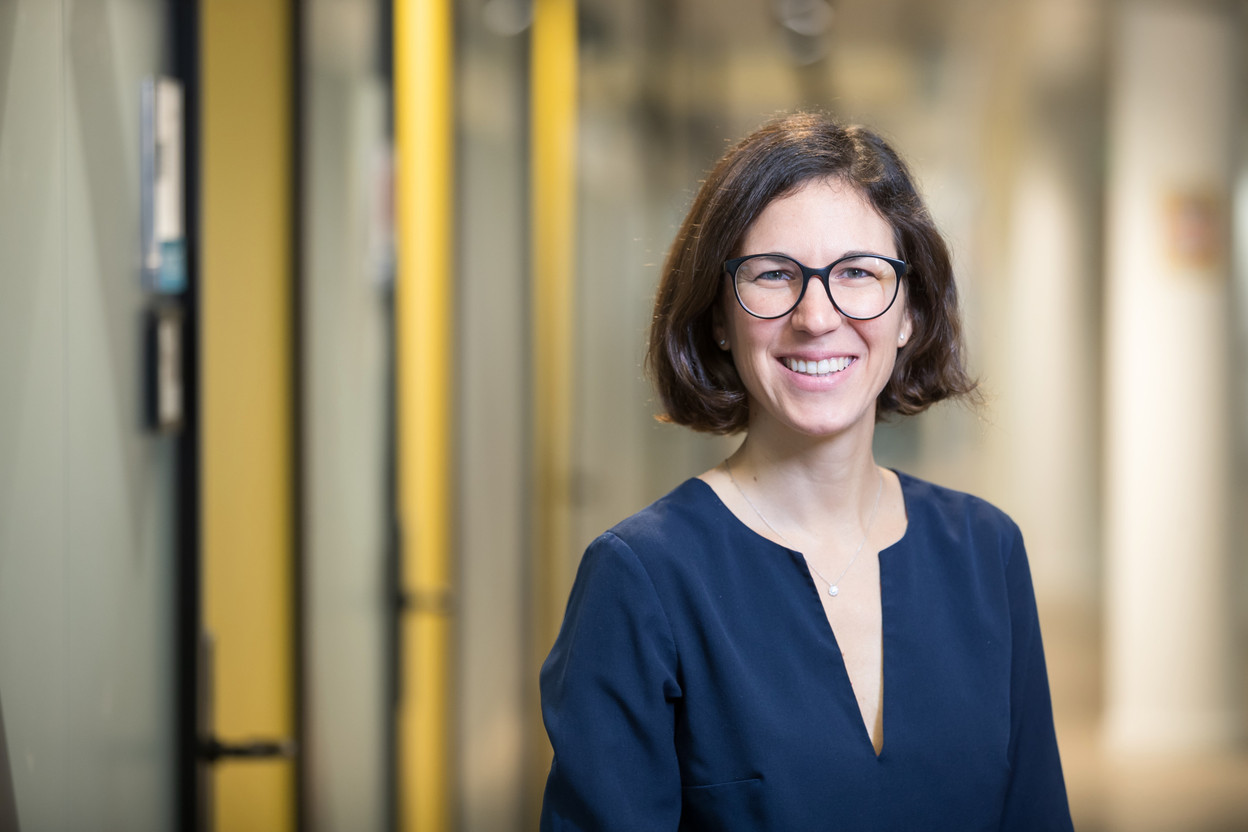
CEO of Luxflag since May 2022, Isabelle Delas was head of the Luxembourg branch of Finance in Motion, an impact asset manager, and member of the board of directors at FIM Asset Management for roughly five years. Previously she was a researcher at the International Development Law Organization in Rome and an assistant professor at University of Versailles-Saint-Quentin. Delas earned a master’s in law from the University of Poitiers.
Luxflag
Founded in 2006, Luxflag is the grand duchy’s labelling agency that checks financial firms’ responsible investing claims. It is a public-private partnership backed by eight organisations that aim to instil investor confidence in responsible investments.
Labelling challenge
As of 30 September 2024, the total number of Luxflag-labelled financial products shrank by 28% compared to 2021 and total assets under management in Luxflag-labelled products were down by 31%.
Delas has said the labelling agency faces tightening budgets at financial firms and increased competition from rival labelling agencies. To regain attractiveness with asset managers, in October Luxflag announced that it will extend the validity period of its labels from one year to three years starting in the first quarter of 2025. It also is working on digitising the application process and rolling out new labels.
This interview originally appeared in the December 2024 print edition of Paperjam