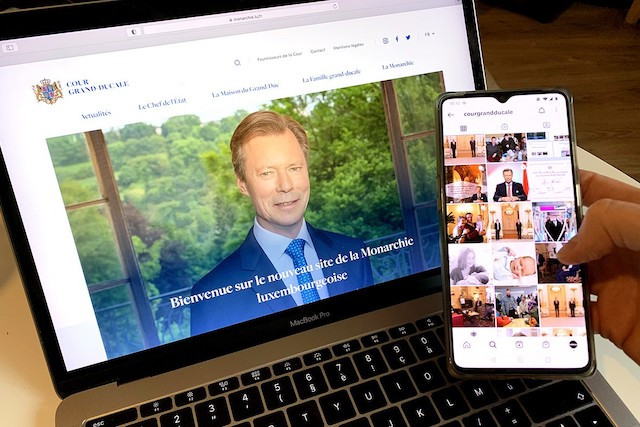
“It’s important for a monarchy to have a modern look,” said Yuriko Backes, the maréchale de la cour. “We began very quickly to work on a new site,” she said.
Backes took office on 1 June 2020, following a damning report into the grand ducal palace’s organisation--also known as the Waringo report--that highlighted shortcomings in how the household is organised, manages its money and communicates about what it does.
Backes’ aim was to launch a new site by 31 December 2020 and a committee including members of the palace administration, the ministry of state and the government’s press office quickly set to work.
“The committee led the reflections on the design and architecture,” Backes said. “But the royal family saw the projects and validated the content developed by the staff of the Maison du Grand-Duc. Grand Duke Henri is sensitive to this and fully aware of the importance of having a modern site.”
The Maison du Grand-Duc is a new organisational structure, aimed at better separating the royal family’s public and private lives, established in October 2020.
It exclusively deals with the official functions of the royal family, managing the public budget, relations with the government, official communications by the household and the palace staff, which is set to increase to around 140 employees from currently 110.
A budget of €80,000 was used to hire Luxembourg agency Explose to develop the site. “We wanted something very functional, adapted also to tablets and smartphones. It’s a site that’s evolving. The construction site is a work in progress. New functionalities will be added, notably translations, audio for visually impaired people…,” said Backes.
An up-to-date agenda allows to follow the different family members’ activities and a contact form is also available. “And we always respond,” said Backes.
More transparency
Backes since the reorganisation in October is in charge of communications, with a small team managing day-to-day operations. “It should soon become more diverse,” said Backes, after the palace posted a series of vacancies last year.
But Backes didn’t want to call the update a revolution. “It’s more modern, certainly. But to go from there to calling it a change in tone… It’s not a revolution after all. For me, when you are the head of state, it’s 24/7. Indeed, maybe there will sometimes be a family photo, or photos of memories…”
A separate website dedicated to the activities of Grand Duchess Maria Teresa has been integrated into monarchie.lu--another demand by the government and the Waringo report, which said the grand duchess should not have a special role within the palace’s organisation.
Despite representing Luxembourg’s royal family, the website is currently available only in French. “It’s a tradition to use French. But we are working on translations. Many are ready. It takes some time to sort out all the technical details.”
The new strategy also encompasses Facebook, Twitter and Instagram, “which permit to present more personal content,” said Backes. “It was a priority for me to professionalise their use.” But there are currently no plans to expand to other platforms like TikTok or YouTube. “You need a bigger team to manage these platforms well,” Backes said.
Since the grand ducal family isn’t a commercial enterprise, Backes said the first priority isn’t to chase followers. “All of this rather is part of a new long-term strategy.”
The strategy should help establish a close link between the grand ducal family and the public. “It’s important to transparently show the numerous activities of the family, the causes which they support, their involvement in everyday life, in normal times but also in times of crisis, like the pandemic,” said Backes.
This article was first published in French on paperjam.lu and has been translated and edited for Delano.