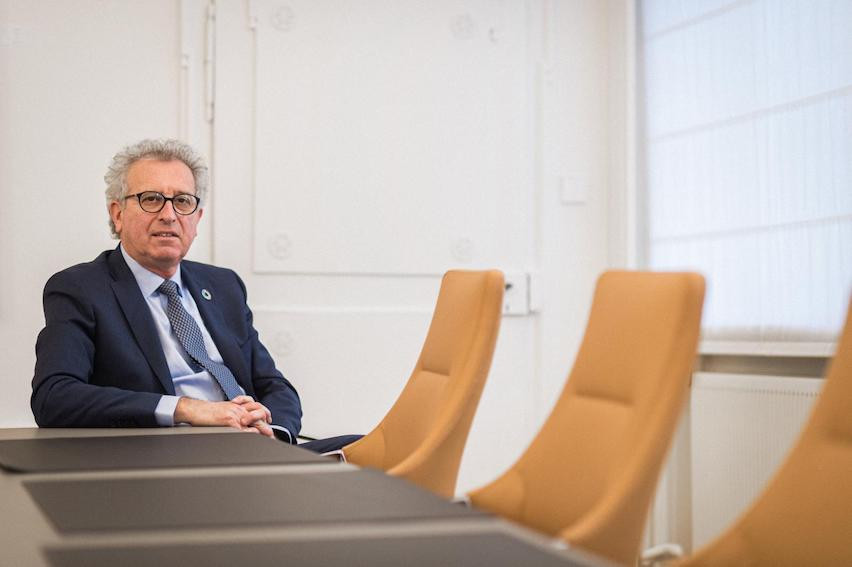
Rival financial hubs try to use the country’s previously murky image as a competitive advantage, Pierre Gramegna (DP) stated during an interview.
Luxembourg will need to meet and exceed EU and international tax standards, while being “patient” as perception evolves, he said.
The comments came before the publication of the Openlux investigation into the grand duchy’s beneficial ownership registry. Seventeen international media outlets concluded that Luxembourg’s €4.5trn investment industry is a “black box” that facilities financial crime.
Gramegna was speaking with Delano three weeks ago for its 10th anniversary edition and was not specifically addressing Openlux.
Delano’s Aaron Grunwald asked the finance minister:
“One thing you said at the beginning of the interview is that Luxembourg has moved towards more transparency. And still, when you talk to people internationally, they’re still calling Luxembourg a ‘tax haven’. It still comes up over and over again. What do you think needs to happen to shed this image? You’ve made reforms, but it’s apparently not enough, because people still use this term. So what needs to happen?”
Pierre Gramegna responded:
“I think once you have a reputation that established, it takes quite some time to change the image. I’m pretty well aware of that.
“We’ve done lots of changes in the last seven years. As we speak, Luxembourg complies with all the regulations of the EU and all the directives. We have introduced in our legislation everything that needs to be done in terms of transparency, in terms of tax changes triggered by the OECD programmes. In fact, the EU sometimes goes further then the OECD tax recommendations. And we have implemented all that. We have even been part of the solution, as we have [during] the Luxembourg presidency in 2015, [when we] brokered some of these deals. And nevertheless, people still find that we’re not doing enough.
“I think one has to realise that some critics are surprised that we’re still doing well as a financial centre. So they obviously try to use that bad image that we used to have, or that blurred image, I wouldn’t say a bad image, a blurred image that we used to have for competitive reasons. And fair enough, we need to answer those questions, as I’ve just done with you here. We are definitely today at par with all European capitals and financial centres. Some people think that it is because we are cheating, on transparency on tax issues that were successful; they’re wrong.
“But well, we keep need to continue to explain. And we also need to do our homework, to be really at par and even sometimes anticipating changes.
“As a matter of fact, tomorrow, we’re going to, for example, make our tax regulations stricter for countries that are on the blacklist of the European Union. We’ve been encouraged by the [European] Commission to do so. But we have chosen a few measures that are going to be stricter for those countries that are on the blacklist. So we will continue into that direction.
“And we have to be patient, because, yes, building a new, more sophisticated image takes time.”
The rest of the interview will be published in the Delano magazine out on 17 February.