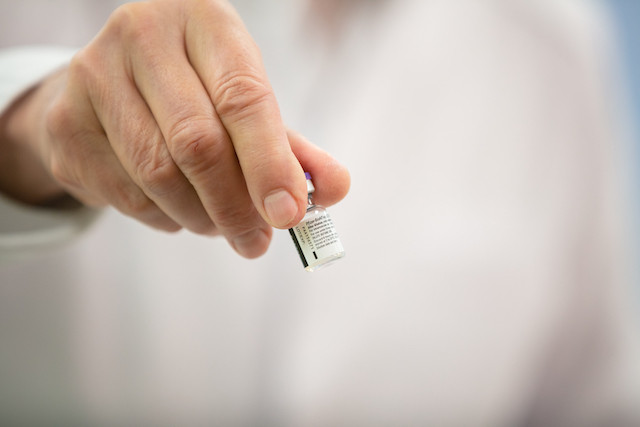
The European Commission has signed contracts for around 2bn vaccine doses, enough to immunise its entire population twice over. It bet on multiple suppliers, opted for maximum safety, ensured that all member countries have equal access for the best possible price.
Prime minister Xavier Bettel last year said Luxembourg would probably have lost out on early vaccine deliveries--or would have had to pay an astronomical sum--had it been left to fend for itself.
So far so good. Only things didn’t happen as quickly as they had been hyped up to. Luxembourg has administered a meagre 13,241 doses as of Tuesday. Public squabbles with suppliers and a failure from Brussels to defend its policy quickly led to jeers from within the EU, with a vociferous Germany at the forefront.
This past week, things only went from bad to worse.
Martin Selmayr, Commission secretary general under Jean-Claude Juncker, in response to the criticism tweeted that the EU was far ahead of Africa in its vaccine drive, a continent home to some of the world’s poorest countries and an ill-suited comparison.
Selmayr’s out-of-touch comments led to swift backlash on social media, prompting him to defend his statement. After all, he only meant to emphasise how important it is for everyone to get the vaccine. People had simply misunderstood his meaning.
German chancellor Angela Merkel stepped into the fray on 2 February. In an effort to defuse the situation she told public broadcaster ARD that the EU had done nothing wrong and that maximum safety and solidarity had been the right approach.
But the damage had already been done. The European Commission had to walk back on a hastily announced export ban that threatened the already tenuous post-Brexit Republic of Ireland-Northern Ireland relationship.
Adding insult to injury, Ursula von der Leyen blamed her trade chief, Valdis Dombrovskis, for the embarrassment, further undermining her own credibility, already slim considering the manner in which she was lifted into the Brussels top job.
Von der Leyen gave only one interview about the debacle, to Germany’s ZDF, showing all the more how her knee-jerk reaction was founded on party political squabbles in her home country, lacking a view for the much bigger picture.
Hope and expectation
We are all eager to resume our lives and it is frustrating to see other countries advancing at a much faster pace when, for months, so much hope and expectation has been piled on these vaccines.
I, too, yearn for my family whom I haven’t seen in over a year. I crave bear hugs between friends. I miss silly dancing during sloppy nights out. A single pringle nearing 35, I worry about lost opportunities to meet a partner. I long for life without fear of contracting Sars-CoV-2 or, worse, unwittingly passing it on to someone else with devastating consequences. I am also well aware that I am saying this from a place of privilege compared to so many who have lost so much or face far greater need.
From the start of this crisis, politicians have flaunted the pandemic as a time of solidarity when right from the beginning there was selfishness: Shoppers stripping shelves bare paying no heed to whoever came after them (usually essential workers who could not sprint to the supermarket as lockdown was announced).
Here we are nearly a year later with the wealthiest nations on Earth fighting for first place in line and with reports from the US and other countries where the rich and well-connected are skipping the queue to get their jab. Instead of stretching out our arms we are sharpening our elbows.
Good things come to those who wait. So, as we impatiently wait for vaccine doses to be delivered to the EU, let’s spare a thought for the nine out of ten people in the world’s poorest countries estimated not be vaccinated this year at all, not because they are less deserving but simply because they find themselves at the bottom of the metaphorical food chain. And they happen not to form part of a group of countries that decided to look out for one another and had the means to do so.
If patience is a virtue so is perspective.