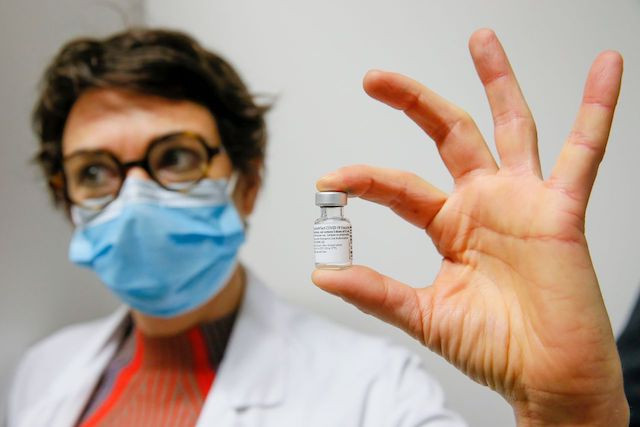
As a frontline worker, psychologist in a German hospital Ron Crouch was among the first wave to get vaccinated. He received a first Moderna jab at the hospital where he works on 3 January, from which he received mild side effects including fatigue and soreness in the arm.
“I felt I was starting to get a mild cold. That lasted about 1-1.5 days. Then it disappeared,” he told Delano. Crouch posted about his vaccine experience on Facebook, which attracted a lot of questions from curious people.
“For me this has been such a huge relief to get this vaccine. I feel I’ve been waiting for this so long and I’m so glad it’s here. It really breaks my heart that people hesitate or refuse to get it because of misinformation,” he said, adding: “All these people instead of lining up to get it, they are staying home to listen to conspiracy theories.”
Crouch advocates for training in critical thinking to help the public better navigate the mass of misleading information online. And he said vaccine hesitancy should not only be tackled with data or facts.
He said: “The most important thing you can do to make people more comfortable with the vaccine is to sympathise with their emotions and fears and share your own story if you’ve had the vaccine. Share what you know in a way that doesn’t make them feel their fears are illegitimate.”
Dr Gérard Schockmel, a consultant in infectious diseases for the Robert Schuman Hospitals group in Luxembourg had his first shot of the Pfizer/Biontech vaccine on 28 December. “I was looking forward to it,” he told Delano.
Besides mild fatigue and a soreness in the arm, he had no other side effects. Among hospital colleagues, he has heard of only one person who experienced a slight change in temperature. He was not aware of anyone having an allergic response to the vaccine.
Vaccine hesitancy
An internal survey conducted with staff at the hospital group found 54% wanted more information on the vaccines and 14% preferred not to be vaccinated. A non-representative survey conducted by Science.lu found a third of respondents were opposed or hesitant about receiving one of the new vaccines.
Dr Schockmel acknowledged the high level of vaccine hesitancy in Luxembourg and suggested authorities are partly to blame for failing to raise awareness during the development of the vaccines.
“I think they didn’t make good use of the year. It would have been better to keep people updated on a regular basis on the types of progress achieved in various types of vaccines, explaining why doing things in a fast way does not compromise security,” he said, adding: “Meanwhile the social networks were full of self-appointed experts raising fears about vaccination, mixing half-truths with non-truths. It is much easier to make people afraid.”