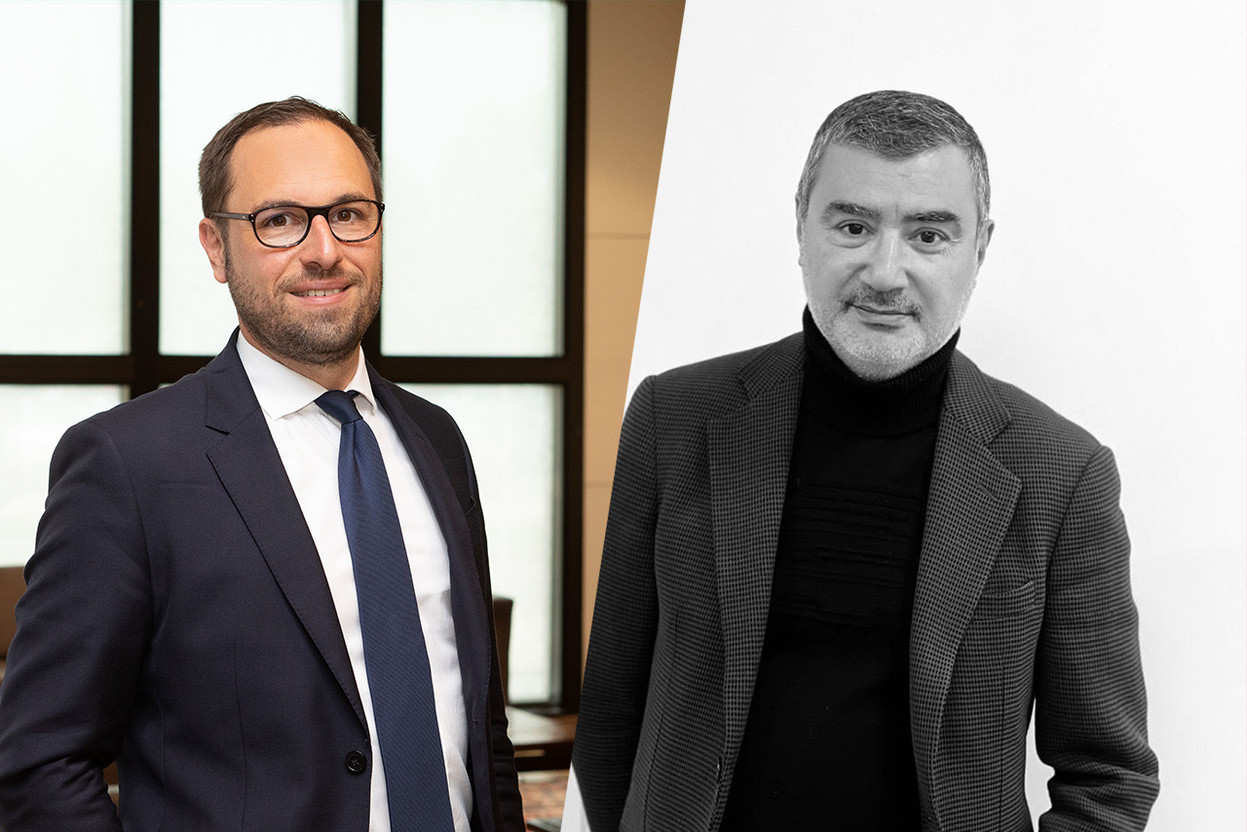
Starting in the group directly from school, Olivier Carcy, now the CEO of Indosuez Europe and the senior country officer for Credit Agricole Luxembourg, has played several roles (capital markets, credit export, project financing, LBO financing, M&A and private equity before overseeing the firm’s asset management operations) for Indosuez while not shying away from posts abroad (Hong Kong, Singapore, Indonesia and Switzerland) before landing in Luxembourg two years ago.
Now with more than 3,200 employees in Luxembourg, Credit Agricole Group (CAG) is one of the major financial players in Luxembourg with various brands--more or less--known by the public (Caceis in asset servicing, Indosuez, Camca in assurance, Leasys in auto leasing, Amundi, and FundChannel in fund distribution).
Paperjam interviewed Carcy on 10 July 2025 about the Indosuez strategies and their rationale for acquiring Banque Degroof Petercam (DP) in Belgium, an announcement made in June 2024.
Sylvain Barrette: What are the strategically important themes for the senior management?
Olivier Carcy: For Indosuez Europe, [our goal] is simply defined as promoting commercial development. To get more clients. The challenge is to say: how can I enhance existing client relationships by constantly expanding the scope of services and offering them efficiently? It comes from our mutualist DNA. Our strategy is built upon our members’s needs. We must cater to the needs of wealthy families that are increasingly international, whereas new wealth comes more from the youth.
Relational requirements oblige us to have various modes of personal interaction with them. Also, they wish to have a greater impact on their financial assets. Consequently, we have new infrastructure issues.
You are also partially listed (Credit Agricole). Consequently, the public market may ask you to develop the most profitable businesses, which are not necessarily what your clients want. How do you cope with these antagonistic demands?
The group is over 150 years old and was built thanks to its clients. Of course, we have shareholders, but not the whole group is listed.
We are here to support our clients… in all their needs wherever they go and in everything they do.
For as long as we have territorial autonomy with an obligation to deliver locally, the sum of our efforts will result in operational performance. If we always think of and serve clients well and put in place the right infrastructure, the results always follow. It’s a profession of faith. Market segmentation, for instance, comes second.
How is Indosuez important financially and strategically for CAG? Any large initiative for cross-cooperation between divisions?
This business is relatively strategic for the group, as it can ultimately capitalise on a very old history and its brand, which has its roots across Europe, the Middle East and Asia. The Bank of Indochina had its HQ in Asia before moving to France.
Indosuez is an essential building block in the universality of our CA Group, which finds its roots in the mutual bank configuration. We are here to ultimately support our clients in the territories where they are with a desire and a vision to support them in all their needs wherever they go and in everything they do.
We are seeking to have autonomous businesses with strong leaders in their market that are open to third-party partnerships while cooperating with our local banks and entities. The goal is to achieve scale while providing a broad array of products to our clients.
While Caceis and Amundi are European leaders, Indosuez must accelerate. Its transformation from a somewhat offshore to multi-onshore entity has created the conditions for becoming a consolidator in Europe.
It is a business that does not require limited capitalisation. It is also a source of long-term liquidity with diversified revenues, which operates, however, under an elevated cost structure. When the markets are more difficult, there is more volatility, and we do more transactional income.
Our revenues and earnings are becoming ever more important within the group [Indosuez’s revenues accounted for 6% of Credit Agricole SA in 1Q25], in particular after the acquisition of DP. Indosuez had 3,000 employees against a bit under 1,500 employees for DP.
What did Degroof Petercam have in its quiver that was absent at Indosuez?
[Wealth management] is a business where critical size matters. Our assets under management were increased by circa 30% to 40%. The same applies to our number of employees, turnover, etc.
We want to become a European leader wherever we have operations. The acquisition of DP enables us to become a leader in Belgium when combined with Indosuez’s own operations. It is a market with several wealthy families open to the world with various regional profiles, with Flanders being a hotbed of entrepreneurs in high need of saving solutions. Belgium became the largest market at Indosuez.
The acquisition strengthens our business, active in Luxembourg since 1920. It has required greater integration efforts as we underinvested in the country operations over the last few years.
DP broadened our overall competencies. Corporate finance activities were also reinforced through the combined operations. We can’t be a large wealth manager without supporting the large entrepreneurial families through their transformation plans. Moreover, Indosuez, as part of Credit Agricole, gives access to a large balance sheet for real estate financing, Lombard loans, etc.
DP Asset Management is a high-performing unit with a boutique mindset and a critical size with long-standing sustainable and emerging markets products.
We also observed a “sicavisation” of the wealth management industry. Large families are increasingly managing their family wealth to ensure its transmission through investment funds. DP has built an infrastructure to create funds, support them, tailor them, manage them and administer them. It was integrated with our operation in June 2025 to create Indosuez Fund Solutions with €60bn in assets. The entity serves our own asset management operations, families and third-tier asset managers.
Finally, having our IT subsidiary Azqore based in Switzerland allows us to retain full control over our infrastructure and its development, and to remain agile when acquiring other companies, while also offering services to third parties. For Belgium, it’s a bit different, as Degroof Petercam was – and still is – operating under Avaloq.
Could you transfer Azqore to Luxembourg a bit like Pictet with its IT subsidiary?
The department of 800 employees was created in Switzerland to serve our Swiss operation. It was subsidised to serve all the operations of Indosuez.
Beyond the fees going on your top line, what are the benefits of opening up Azqore to third parties?
I believe that controlling your strategic IT assets is important and key to productivity and efficiency. Facing third parties is also useful because you are constantly confronted with a certain obligation of excellence, efficiency and a capacity to create conditions for innovation. Fresh ideas may also come from outside the Indosuez group.
Flanders is often considered one of the wealthiest regions in Europe. Was that a driver for acquiring DP?
DP is first and foremost a Brussels-based bank. Yet it experienced a rapid growth in Flanders. The Netherlands is the region with the highest number of millionaires, which I am mandated to develop.
Has Indosuez bought the whole bank to be reallocated within the different divisions of the Credit Agricole Group?
No. We keep the Belgium operation unchanged, which became fully focused on the country. The Luxembourg and France operations of DP were respectively integrated within Indosuez Europe and Indosuez France.
Now that DP is integrated, what are your focuses in terms of region and products?
In terms of products, our priorities are private markets and credit, such as financing real estate or Lombard loans. Despite Mifid requirements and its elevated costs, there is an ongoing demand for investment advice, and it tightens our relationship with clients.
In addition to financing real estate, a strategic asset for wealthy families, in general, there is a high demand for advice for maintaining and transforming them around the theme of sustainability. We even created a platform called Startup Connection to connect our clients with the tech ecosystem. So we’re trying to find several angles that go beyond simple traditional financial management.
Geographically, Spain, Portugal and Italy are priority markets where we have a critical mass in terms of Credit Agricole infrastructures. Italy is our main growth market in Southern Europe due to the size of their markets and the potential for further consolidation.
Italy has become the second largest market for Credit Agricole. In wealth management, there is a high savings rate locally. Moreover, we take advantage of our full value chain within the country, a strong asset to support families, entrepreneurs and companies. Italy is the market with the greatest growth potential for Indosuez Europe.
What about Greece? Will you go back?
It has been a drama for the group. We continue to develop the business with wealthy families in the shipping industry. It is a bit too early to say that a return is in the cards.
Weren’t spreads of Greece below those of France recently, a sign of fiscal turnaround compared to 2012?
For a short period, yes. The turnaround of the Greek macroeconomy is positive for the country but also for Europe. Yet we have other priorities for now.
Where and how do you plan to grow Asian operations?
Our Swiss subsidiary is responsible for Asia [not Indosuez Europe]. We have historical wealth operations in Hong Kong and Singapore. Our development is rather organic, while mastering it is a challenge, as Asia is vast and there are different dynamics between countries.
As so many European banks have failed in Asia, don’t you think that locals may trust more local banks, except maybe the very wealthy moving their assets to global wealth managers such as UBS?
Or those who have the balance sheet. I would say yes. We aim at clients having global needs who will see our added value over local banks. We also target European entrepreneurs based in Asia.
We also consider ourselves a bit like a local bank in Asia. Indosuez still carries the same Chinese ideograms that we have had printed on our business cards since 1875. Yet we do not have the territorial reach as in Europe; we intend to focus on a few key strategic markets.