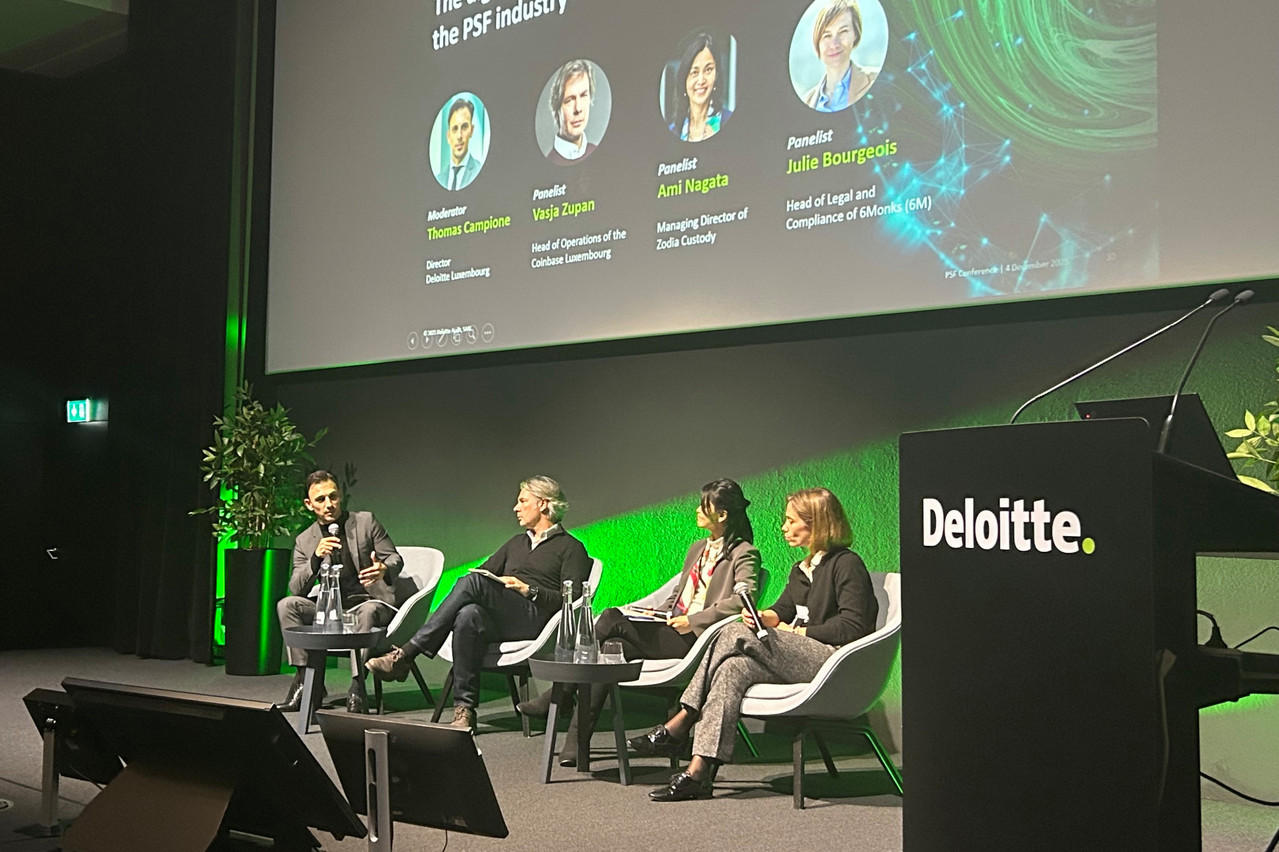
Four years ago, admitting to running a crypto exchange at a banking conference was social suicide. Ami Nagata, managing director at Zodia Custody, recalls bankers recoiling in 2021 and asking whether she was "one of the fraudsters".
Today, the reaction has flipped. The same bankers now approach discreetly, seeking partnerships and advice on how to enter the market without drawing attention.
This "mental shift" marks the end of the industry’s adolescence. Digital assets have abandoned the rhetoric of disruption for a more pragmatic doctrine: let’s make friends.
The 99 per cent problem
The driving force behind this détente is capital. The panel estimated the global digital-asset market at $3.2–$3.5 trillion. Thomas Campione, digital assets driver at Deloitte Luxembourg, contextualised the figure during his opening remarks: roughly 99% remains pure cryptoassets, with only about $35 billion—around 1%—representing tokenised real-world instruments.
Despite the hype around tokenisation, the imbalance remains stark.
For the assembled PSF professionals, the message was clear: you cannot embrace the technology while ignoring the asset class that powers it.
Julie Bourgeois, head of legal and compliance at 6 Monks, said the industry has moved from an "exploratory" phase to "execution". Digital assets now require treatment as a distinct asset class, comparable to private equity.
Luxembourg’s edge
Luxembourg’s CSSF gained experience early, supervising crypto exchanges as far back as 2016. That head start has created regulatory arbitrage. As Deloitte’s Campione put it, "As far as I know Luxembourg is the only country in Europe and maybe in the world providing a complete regulatory environment for AIFs investing into crypto and providing the flexibility to have up to 100% of exposure."
Ireland, by contrast, is "far behind us," Bourgeois said, describing the Irish landscape as where Luxembourg was "four years ago," particularly in depositary services. She added that the Irish regulator is "a bit less crypto oriented" than the CSSF.
Campione agreed that the Central Bank of Ireland has "historically been a bit lagging," though it is now "catching up".
Rethinking risk
Resistance persists among traditional risk officers, often rooted in outdated views of volatility and liability.
To challenge this, Campione cited an internal analysis comparing realised volatility as of June 2025, showing Bitcoin was "less volatile than the magnificent seven" US tech stocks. He stressed it was not an anomaly but part of a longer-term pattern, noting that Bitcoin's volatility "has been decreasing consistently over the last 13 years".
While headlines focus on "market crash[es]," the long-term data shows convergence with traditional assets. "Volatility is no longer a bug; it is a feature," he argued, creating opportunities such as funding delta-neutral positions—structures impossible in ossified traditional markets.
The light-switch fallacy
A persistent misconception is the "Light Switch" theory: the belief that banks can ignore the sector until maturity and then simply "switch on the light".
This ignores technical reality. Blockchain transactions are irreversible, and mainframe expertise does not translate to decentralised settlement. "That is not the case," Campione warned. "It is a complete paradigm shift."
New rails
The future is a "hybrid" model. Traditional banks are unlikely to "reinvent the wheel" by building custody technology from scratch.
Instead, they are forming what Nagata called a "close partnership". Zodia’s "biggest shareholders"—major banks—use its technology to power their own custody services: the bank keeps the client, the specialist firm runs the infrastructure.
This re-wiring extends into the back office. Vasja Zupan, head of operations at Coinbase Luxembourg, noted institutions are exploring stablecoins as new "payment rails" and "settlement tools". Bourgeois pointed to tokenised "transfer agency processes" enabling new forms of fund distribution.
"We are building a bridge where you can use our safe and regulated custody as a door to enter this decentralized space," Zupan said.
The trains may look like traditional banks, but the tracks they run on—from custody to settlement—are being replaced, sleeper by sleeper, with blockchain.