"At 88%, I think it's a pretty exceptional result since we're not living in the Soviet Union," began 
Invited to draw up his first mid-term assessment, the head of government defended at length the pension reform, despite being judged insufficiently ambitious by some observers. He assumed its limited nature, while presenting it as a politically difficult but necessary first step. "We have successfully reformed pensions", he insisted. Luc Frieden pointed out that "pension reform is never popular" and that "in theory, people are in favour of reforms, but as soon as reforms affect them directly, they become less enthusiastic". He also asserted the logic of compromise: "It's true that we wanted to go further and we had to make compromises because in politics, if you want to maintain stability, social cohesion, you necessarily have to make compromises."
In his view, the reform has nevertheless changed the system "fundamentally" and saved time. "People have to contribute a little longer", he said. Above all, "through this reform, the legal reserve needed to fund pensions has been pushed back to 2040-2042. So we have gained time to continue this debate." A way of admitting that the subject will come up again. "This won't be the last reform that's been made," he warned, while adding that future majorities are unlikely to promise much more: "Don't expect the other political parties to necessarily announce major reforms at the next elections because in terms of popularity, it's not going to do much."
The function of the head of government requires maintaining social cohesion.

Luc Frieden also acknowledged that the past year had been testing in human and political terms. "Yes, it was a difficult year. I'm pleased that we closed the file at the end of the year." But, for him, social cohesion remains an essential asset of the country. "Stability and social cohesion are key elements in Luxembourg's economic attractiveness and, in general, in the way we live together. He defended a method based on ongoing, sometimes discreet, contacts with the social partners: "I speak regularly to the social partners, the trade unions and the employers. I don't always issue a press release on this, but I believe that the function of the head of government requires maintaining social cohesion."
On his falling popularity in the polls, the Prime Minister acknowledged that the subject affected him personally, while refusing to make it the main barometer of his action. "Of course it affects us, because when you're elected by the people, you obviously also have to be re-elected." But "if we only do things that please people, we certainly wouldn't be reforming pensions". And he contrasted polls with the electoral verdict: "Elections and polls are two different things."
The head of government was also keen to stress the solidity of his relationship with Deputy Prime Minister 
On budgetary trade-offs, Luc Frieden reiterated his caution about debt, while opening the door to additional flexibility for defence spending. "For us, the main thing is to keep our triple A rating," he said. "I am prepared, if need be, to make certain concessions" on debt levels when new security spending is required. But he reiterated that he refused any drift incompatible with his fiscal commitment: "The objective is also to keep the promise we made not to raise taxes."
A framework to promote stronger growth
On the economic front, Luc Frieden called it more than ever "the year of competitiveness". "We still need to do more this year because precisely when the world is going badly, when there is a lot of unpredictability, we need stability." The Prime Minister recalled the persistent weakness of Luxembourg's growth, despite a slight improvement: "0.6% is better than zero, but it's not satisfactory". His credo remains unchanged: "We need growth. And, for him, the government's mission is clear: "What we need to do is put a framework in place to allow businesses to grow."
When asked about the feeling among many SME bosses that the new government had not yet made a tangible difference to their lives as entrepreneurs, Luc Frieden replied that the work was still in its early stages. "We've been here, in fact, for three years. I think we've already done a lot, but I know there's a huge amount to be done." He cited administrative simplification, the "once only" principle and changes to the status of the self-employed as projects still in progress. "I'm also saying: there's still a lot to do."
Faced with criticism from the Opposition on funding for the future, he took a clear line, "certainly not like Monsieur Fayot whose only response has always been to raise taxes". His response, on the contrary, was based on a triptych repeated throughout the evening: "Lower taxes, try to increase growth" and support investment.
We are going to have to continue on our course, but become faster and more efficient.
The international sequence featured prominently in his speech, against a backdrop of geopolitical tensions and energy uncertainties. Luc Frieden acknowledged that the situation in the Middle East "is likely to have an effect on inflation and growth", but rejected the idea of a change of course. "On the contrary, we are going to have to continue on our current course, but become faster and more efficient." For him, the answer lies in Europe: "We must continue to strengthen Europe. We need to be more sovereign, more autonomous from shocks that come from outside." It is in this context that he defends competitiveness, trade diversification and free trade agreements.
On the social front, Luc Frieden rejected the idea of a generalised "sprinkling" of public aid. "Your criticism does not apply to the government I lead because we have tried to concentrate aid precisely on those who need it." He cited the energy bonus and the cost-of-living subsidy as examples of targeted aid. "I don't want the gap between those who have the most and those who have the least to become too wide. I think that would be very bad for stability and social cohesion in this country." However, he acknowledged that it is "sometimes difficult to find the right target".
Understanding why talent leaves
Housing was one of the main blind spots in the discussion. Luc Frieden recalled the measures already taken, whether in terms of off-plan purchases, tax incentives or simplification of procedures, while admitting that the effects are still partial. "We have bought almost 500 additional units", he emphasised, while acknowledging that some will consider this figure modest. "Still, it costs a lot." He called for state intervention, while pointing out its limits: "It's not a state that can intervene all the time." Above all, he hinted that new measures would be forthcoming. "I have asked the relevant ministers to propose measures to us once again" and, in the face of the crisis, "we are in the process of seeing what we could do".
Pressed to give a target for housing built by the end of the mandate, the Prime Minister refused to do so. "I'll tell you why. Because my predecessor announced 10,000 homes during his term of office and he didn't manage to achieve it." He preferred a methodical line: "We mustn't have a target figure, but we must certainly do more than we have done so far." Here again, the head of government insisted on the need for a collective effort. "As with all political issues, all social issues, everyone has to do their bit. And he insisted: "We need to build more and build faster, that remains our compass."
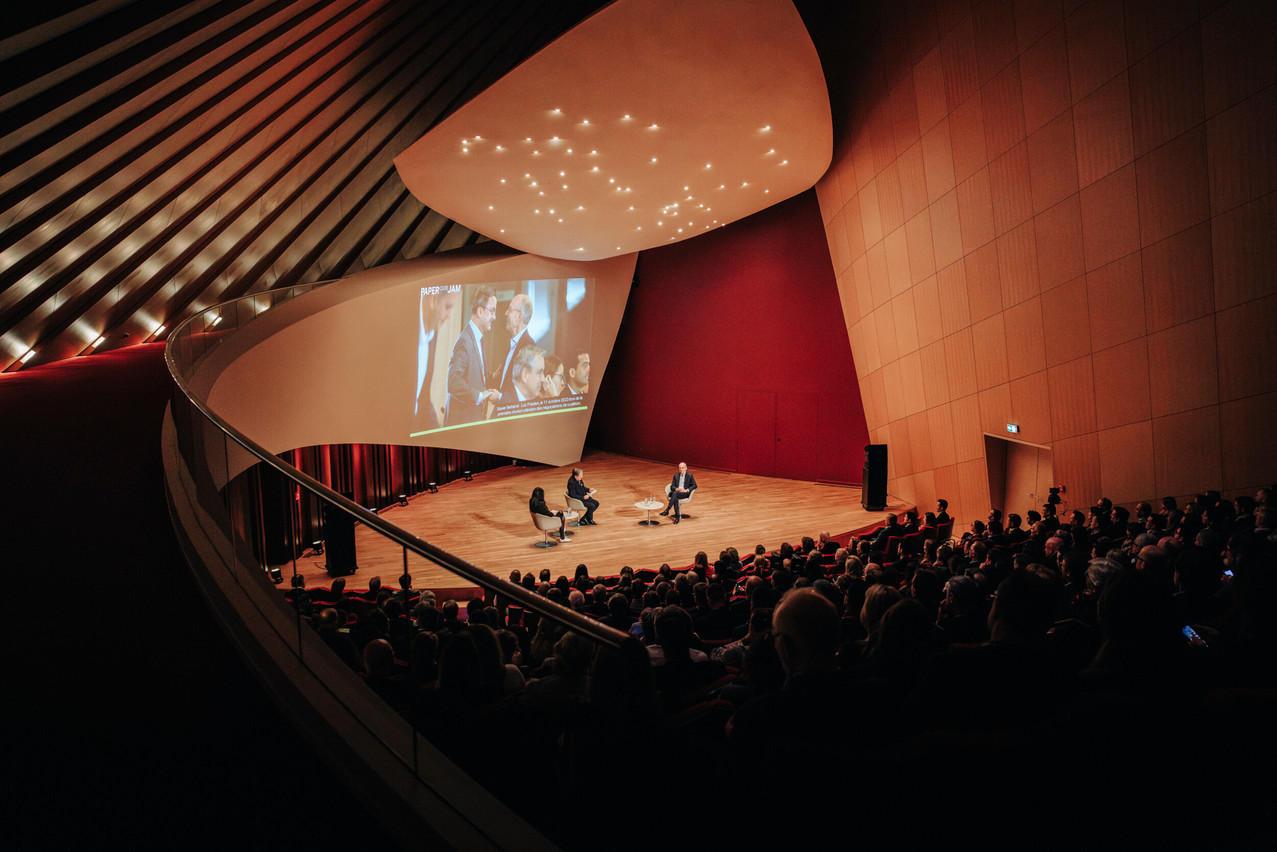
"We chose this partnership with Mistral", he explained, because Luxembourg wants "to have a sovereign artificial intelligence", meaning "that we are not 100% dependent on the United States or China". (Photo: Julian Pierrot / Paperjam)
Luxembourg's attractiveness, particularly for talent, was discussed from the angles of housing, taxation, quality of life and economic opportunities. Luc Frieden acknowledged the importance of the problem after the publication of a study showing that a significant proportion of talent is rapidly leaving the country. "That worries me, and I'd also like to understand better what the reasons are." He pleaded for a policy based on data: "A policy must always be based on facts, on data." But he also pointed out that attracting talent is not just about rents: "It's a combination of other means. I believe that taxation also plays a role. It's the general living environment, it's the cultural offer, it's the environment."
Bank accounts, an issue that "annoys me"
Artificial intelligence was the other major chapter of the evening. Here again, Luc Frieden defended an offensive, almost strategic vision. "When there's a technological revolution like AI, we need to be in the lead wagon as a country adopting this new technology." He said he did not want to "suffer" the choices of others. "Personally, I don't want to see others move ahead with this technology, and we're here to watch. In his view, the partnership with Mistral is in line with this logic of European sovereignty. "We chose this partnership with Mistral", he explained, because Luxembourg wants "to have a sovereign artificial intelligence", meaning "that we are not 100% dependent on the United States or China". He also linked this issue to the future of work: "We should not just look at the loss of jobs that may result, but above all I want to see the transformation of jobs and the creation of jobs."
On the very concrete issue of the difficulties of opening bank accounts for companies setting up in Luxembourg, Luc Frieden admitted his annoyance. "I don't open them... but I don't close them either! Obviously, it annoys me when I hear that... but I know that the compliance rules are extremely complicated." Again, no shock announcement, but a willingness to continue discussions with the financial centre. "We must continue to discuss with the private sector to understand exactly how we can improve this."
No to coercion
Finally, asked about climate and the environment, Luc Frieden rejected criticisms of a lack of sensitivity, while assuming a philosophy distinct from that of the ecologists. "I have a great sensitivity for the environment, for nature. I love nature." But he reaffirmed his refusal to place the environment above social and economic considerations. "My credo is that the economy, society and the environment must move forward in parallel. Above all, he expressed his preference for incentives rather than coercion: "I am opposed to coercion. In his view, "citizens are sufficiently informed and responsible to behave reasonably as a general rule".
He took a similar line on nuclear power: more openness to European realism, but without any official questioning of Luxembourg's position.
When it came to his final words, he summed them up in one: "Confidence." A confidence he called on us to maintain "despite the geopolitical difficulties".