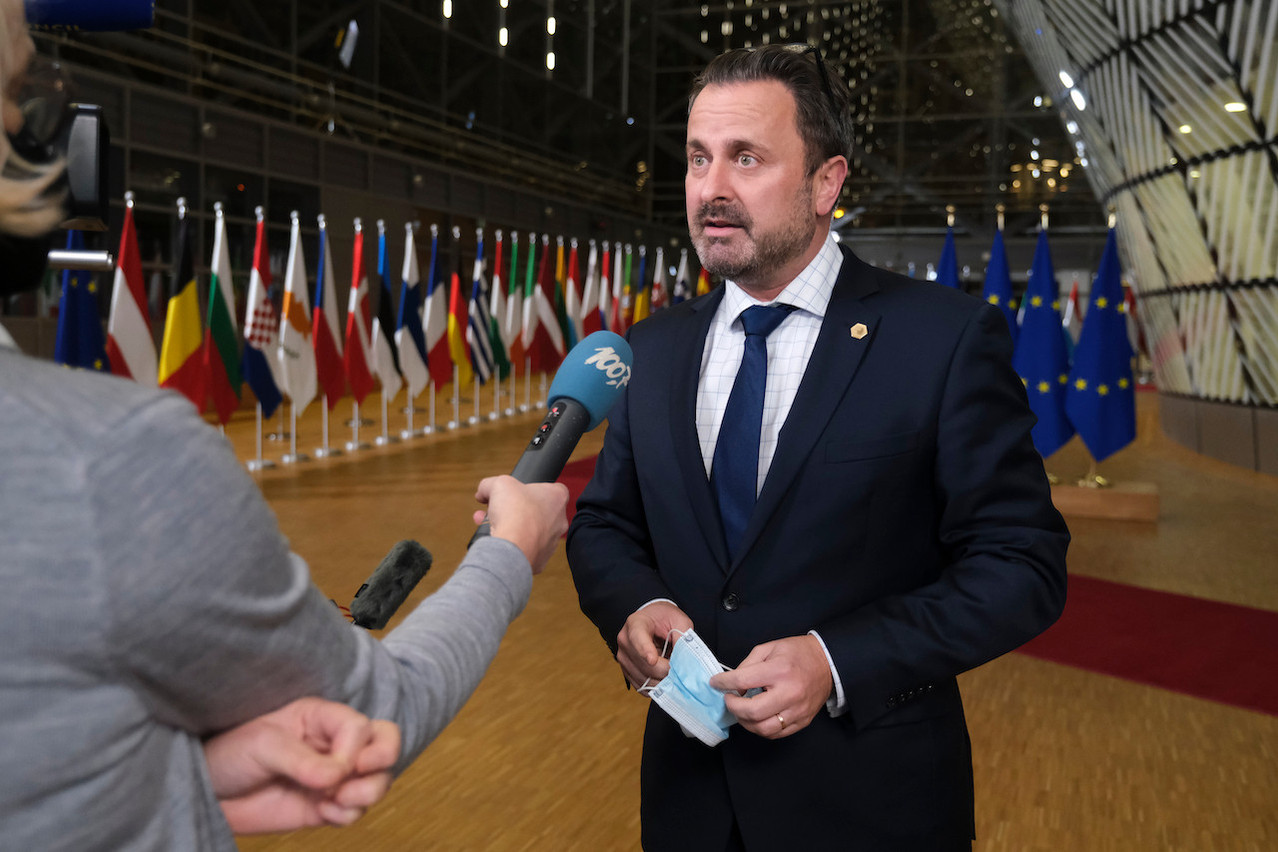
Speaking after an emergency meeting of EU heads of government in Brussels on Thursday evening, Luxembourg prime minister Xavier Bettel said that the “causative measures” approved at the summit, which will be formally adopted by foreign ministers on Friday, will have an impact.
“They will have a Europe-wide impact, an international impact. And they will have an impact in Luxembourg. The government will try to ensure that the impact on individuals will be as limited as possible, because things will become more expensive, and it will have an economic cost. But peace comes at a cost, and that is massive.”
Businesses that sell products to Russia--Bettel cited the aviation and space sectors--will be the first to be impacted. “It will also cost our banking centre, via certain links to Russia. It will affect everyone,” Bettel said. “But that is the price we are all prepared to pay. Solidarity is very very important.”
The European Council agreed on Thursday to a second tranche of sanctions that will target the financial sector, the energy and transport sectors, dual-use goods, export control and export financing, visa policy and a new list of Russian individuals. It also reaffirmed its full solidarity with Ukraine and that it will continue to support Ukraine through additional political, financial and humanitarian aid.
Today we see the devastating reality of full-scale war in Europe. Russia alone is to blame. It will pay a heavy price.

“We reached the conclusion quickly, and I think that was important and sent out a strong signal,” Bettel said after the conference. “We also dialled in [Ukrainian] president Zelensky. I must say that was a difficult moment for us…when Mr Zelensky said he didn’t know what his future looked like,” said a visibly moved Bettel.
Swift disappointment
But, when asked about Zelensky’s demands that Ukraine be taken into Nato as a member and that the EU remove Russia from the Swift bank transfer system, Bettel was less forthright. He appeared to deflect from the latter question by saying that the emergency summit in Brussels had not been a Nato meeting. “Swift is under discussion, along with a bunch of other propositions that were submitted today,” the prime minister retorted.
Asked about his position on Swift, after Belgium and Ireland both spoke out in favour of a Swift ban, Bettel again deflected. “There was no discussion today about whether to adopt a Swift ban or not. This second tranche is a huge package,” he said. “I have the feeling some people think it is nothing.”
Bettel explained that the EU is examining ways to ensure that the sanctions are “targeted on a system and certain individuals, and not the general population [of Russia]”.
The premier said that the situation is Ukraine was evolving and that there was still hope that it could deescalate before a third tranche of sanctions became necessary.