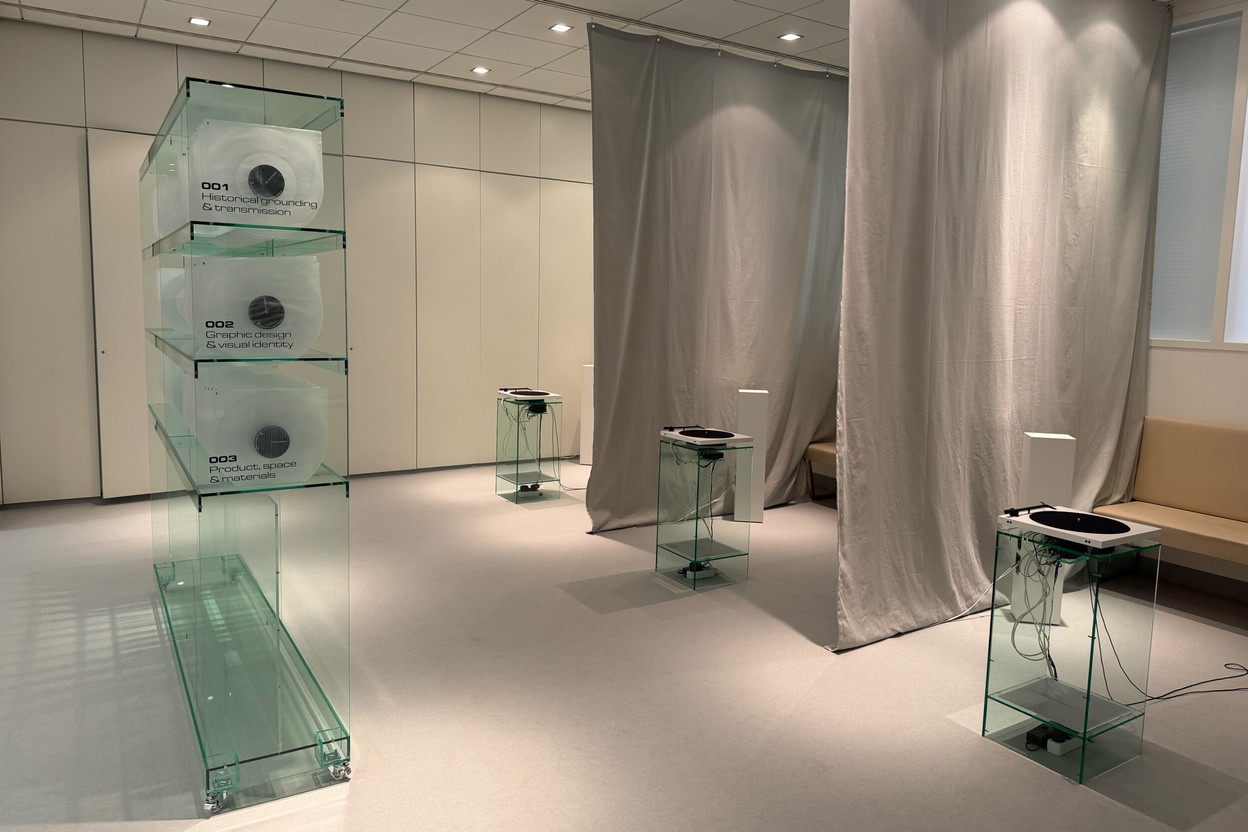
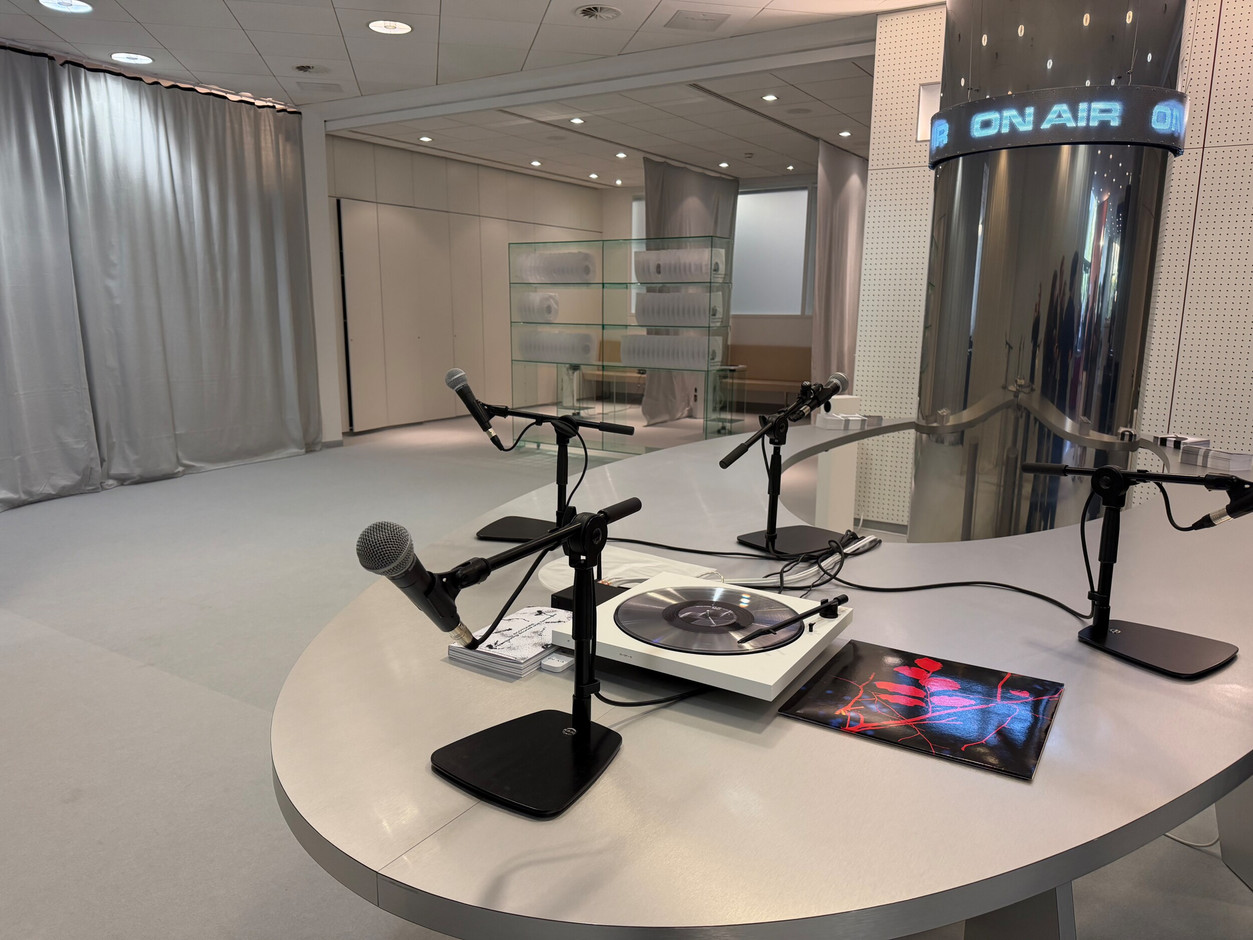
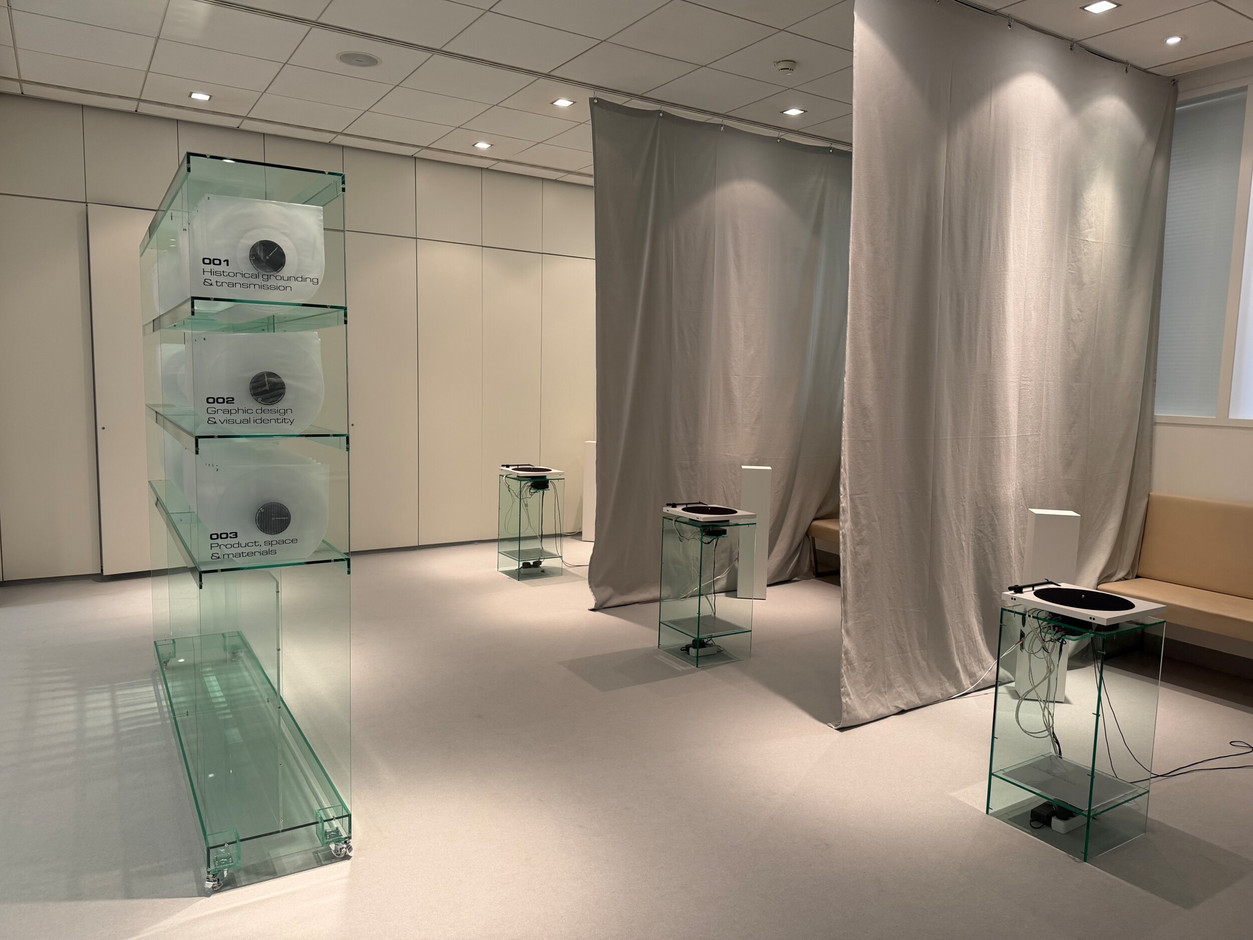
In the Luxembourg pavilion at Vienna Design Week, no objects are on display. Instead, there are vinyl records, six listening booths and a radio table. For a country serving as the guest of honour at a design festival, this choice may come as a surprise. Yet it answers a question the sector has long been asking itself: how can one showcase a scene that nobody can quite define?
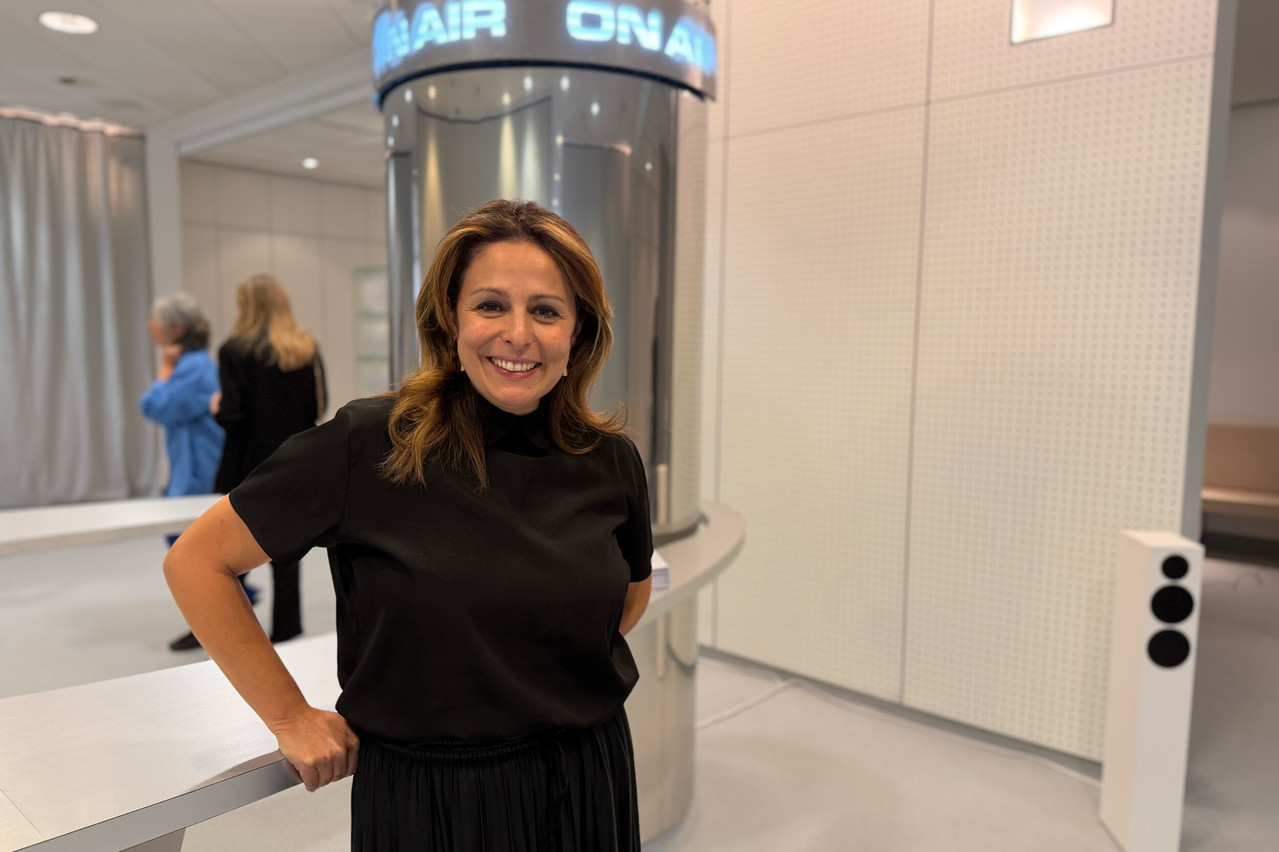
Anna Loporcaro knows this issue well. At Mudam, she launched Design City, with the aim of taking design beyond the museum’s walls. After working at Kanal-Centre Pompidou in Brussels, she went on to set up her own practice, and it is she whom Design Luxembourg and Kultur | lx have entrusted with curating the exhibition.
The title, “Two-O-Eight”, refers to Radio Luxembourg’s 208-metre wavelength. Why the radio?
Anna Loporcaro. – “I found myself facing the same issue as when I was in Luxembourg: not being able to define what the Luxembourg design scene is. The scene is large and very dynamic, but it’s incredibly diverse: graphic design, visual identity, product design, and then others working in social design, ethical design… How can we bring all of this together without excluding anyone, whilst maintaining a clear, concrete common thread?
I took a step back from this notion of the design scene and instead thought of Luxembourg as a country. When a country like Luxembourg is invited abroad, what can it talk about? What has put Luxembourg on the map? I looked at all the industries – ArcelorMittal, industrial production… And quite naturally, radio came up in my research. This year, there was that major exhibition on Radio Luxembourg at Villa Louvigny. I rediscovered – because we know it but don’t talk about it much – that radio was one of the media that helped Luxembourg reach beyond its borders. I contacted Dominique Santana to understand this deep-rooted connection to radio, and very quickly, I was convinced.
I have rediscovered – because, although we know it, we don’t talk about it much – that radio was one of the media that helped Luxembourg reach beyond its borders.

Is this difficulty in getting a clear picture of the scene something specific to Luxembourg?
“No, not really. I’m quite familiar with the French-speaking Belgian design scene, because I’ve been in touch with WBDM [Wallonie-Bruxelles Design Mode, ed.], which promotes Brussels-based designers abroad. But if I had to name any Flemish designers, outside the fashion industry, I’d find it harder. If I had to name any German designers, it’s not something that comes naturally. It’s not like in the 2000s, when you could mention someone like Starck, or Bruno Munari in Italy. And even then, you wouldn’t name 100; you’d name five or ten.
What do visitors discover when they visit?
“All the podcasts have been recorded on vinyl. These vinyl records are the only physical form they exist in, and you can listen to them on the spot: it’s an immersive listening experience. And then there’s the custom-designed table that houses the radio, with four microphones arranged around it and a programme to match. This agora really is a welcoming space. We’ve always brought together a designer from Luxembourg and one from Vienna for the live sessions – pairs whose approaches are similar.

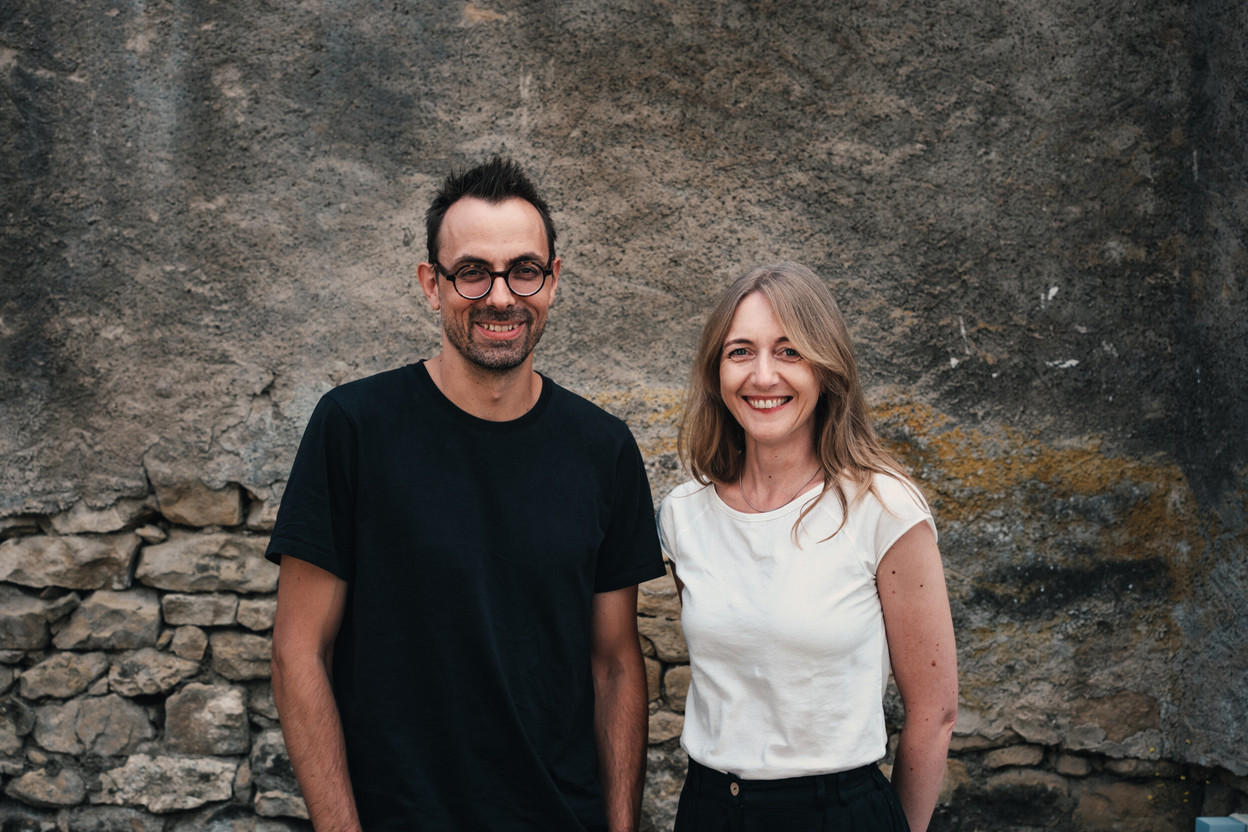
“It was mainly so I wouldn’t come across as a complete outsider in such a local and dynamic scene. I tried to act as a sort of matchmaker – a “Tinder for design” [laughs]. Annick Kieffer, from Studio Polenta, is going to speak with Jana Frantal and Hilal Avci from Sirene Studio, who created the visual identity for Vienna Design Week 2026: an all-female studio that works on lots of cultural projects, rather like what Studio Polenta does.
You could have narrowed down the selection to focus on a particular theme – people under 30 or the environment, for example. Why didn’t you do that?
“These are very topical subjects, but at the same time, focusing solely on them would have meant excluding others that were interesting to showcase, and which have laid the foundations for what design is today in Luxembourg. All of this came down to ethical choices and striking a balance.
The 28 speakers are divided into six sections. How did you organise them?
“There were far more people on the original guest list, but due to various constraints, not everyone was able to attend. The first section is about historical grounding and passing on knowledge, which includes some designers from a previous generation – the “dinosaurs” who shaped the scene in Luxembourg – as well as Nicole Lanners, a teacher at the Lycée des arts et métiers. The final section is “Beyond Borders”: internationally based designers working in Luxembourg. In each section, I’ve tried to strike the right balance between genres, generations, and different profiles, such as Charl Vinz, who really operates on the fringes of artistic practice.
Designers are often very committed: they wouldn’t create something they wouldn’t be proud to wear themselves.

In fact, where do you draw the line between art and design?
“I tend to say that designers respond to a commission, often a brief. They address a problem with a solution. In Charl’s case, he has his own practice and it goes beyond that, because in fact, he creates without being asked to do anything at all. But it’s not quite as black and white as that. Often, designers are very committed: they wouldn’t make something they wouldn’t be proud to wear themselves. Others, through their research, ultimately manage to fulfil a brief, because they have the material and because they create simply because that’s in their nature.
Each interview, conducted by Marc Clement, lasts ten minutes and is accompanied online by a photograph of the interviewee rather than their projects. Why this format?
“We wanted to limit ourselves to ten minutes per person, in the spirit of a portrait, and this was also due to technical constraints linked to the vinyl records. But it was good to get to the heart of the matter. We had a set of questions we’d come up with together: everyone talks about why they’re a designer, why design is important in life. The question about AI came up often, because it’s a question everyone asks themselves and nobody has an answer to. Some people wanted to include images of their projects. We took a really radical approach: we used portraits of the people themselves. I really wanted to talk about them, not their objects or projects.
The podcasts are in four languages. Was that intentional?
“They are in the languages in which the designers feel at ease. I didn’t want to put them in an awkward position by insisting on English or German. And as the idea is for the project to be shared widely, if one day we’re invited to Paris Design Week, those who speak French – who might be less well understood here in Vienna – will be very well understood in Paris. We’ve included the French and Luxembourgish versions in a small leaflet [brochure, ed.]: people can follow the interview by reading it. It’s also accessible to people with disabilities or those who are hard of hearing. We embrace this multilingualism; it’s something I really love about Luxembourg.
The archive, I think, was the key point. Perhaps this is [down to] my role as a historian and curator.

Is the exhibition intended to tour?
“It was part of the brief from Rachel Hoffmann, the set designer. All the furniture can be dismantled, packed up and transported elsewhere. Next year, the exhibition will be staged again in Luxembourg. This exhibition can tour a school, an embassy or another design week.
Beyond Vienna, what is the purpose of these podcasts?
“The archive, I think, was the key point. Perhaps it’s my background as a historian and curator: being able to archive all of this, to capture a snapshot of the moment… [For] Design Luxembourg, with all this at our disposal, [we] will be able to continue documenting newcomers and emerging designers on the scene. This archive will grow and become more comprehensive.
There is a lack of venues dedicated to design projects. There is no museum. The Mudam used to build up a collection, but no longer does so. The National Museum is very gradually beginning to take an interest in this area. If, in 100 years’ time, we look back, we’ll ask ourselves: where was that scene? It will be there through its voices. And podcasts are on the internet, accessible to everyone: every designer will be able to make them their own, send them out and share them. All of this spreads through the cracks, beyond the institutional sphere. [We are pursuing] this aim of reaching a wider audience, much as the radio did in its day on its 208 frequency.”
Vienna Design Week, from 25 September to 4 October in Vienna. Festival Headquarters at 13, Hietzinger Kai 101 (Hietzing), open daily from 11.00 a.m. to 7.00 p.m.