
The European active ETF market continues to evolve as investors seek different tools to navigate changing market conditions. Research commissioned by Fidelity International and conducted by CoreData Research [1] among professional asset allocators across five European markets, France, Germany, Italy, Switzerland and the UK, indicates that respondents expect their active ETF allocations to rise from 10% of portfolios today to almost 15% over the next 18 months.
The findings come amid rapid expansion of the active ETF market. Globally, assets in actively managed ETFs have surpassed US$2.4 trillion [2]. In Europe, UCITS active ETF assets are projected to exceed US$1 trillion by 2031, while the number of active ETF providers has more than doubled since 2023 and the number of products has risen from 95 to more than 400 [3].
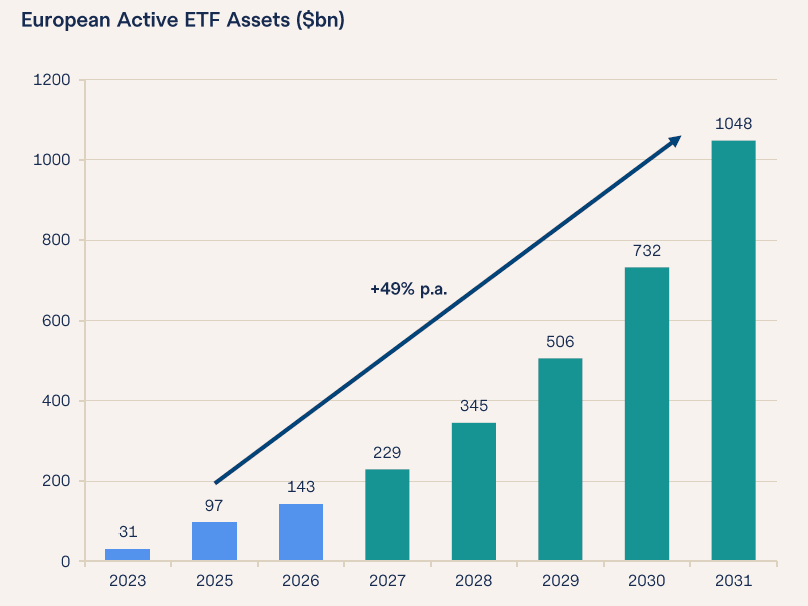
Fidelity International / ETFBook ,September 2026. 2023 and 2025 data as at respective year end, 2026 data YTD as at 31 August 2026. 2027-2031 figures represent forecasts. (Photo: Fidelity International)
The research covers private banks, wealth managers, family offices and asset managers across five European markets. Within these groups, active ETFs are being incorporated into broader portfolio construction frameworks rather than being used solely for tactical allocations.
Several factors are contributing to this evolution. Market concentration, geopolitical uncertainty and valuation considerations are among the themes influencing the discussion around active investing. More than half of respondents say that increasing market concentration risk is strengthening the case for active ETFs relative to traditional index-tracking ETFs.
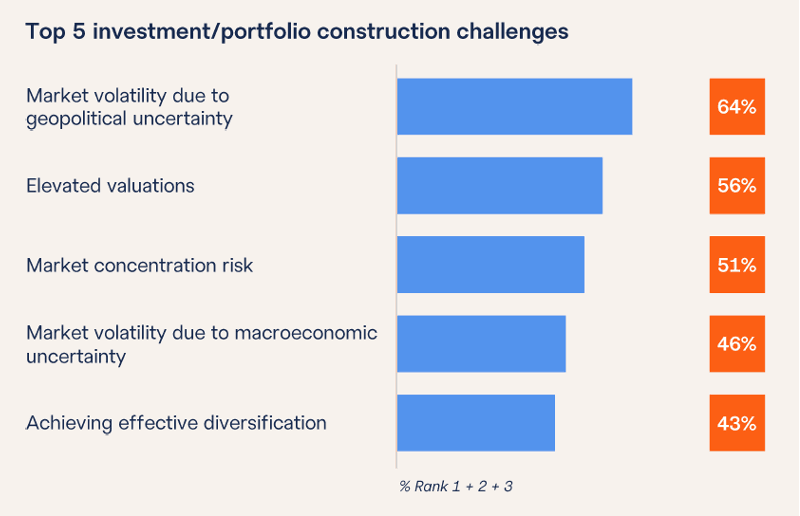
Fidelity international / CoreData Research, October 2026. Question: "Please rank the following investment/portfolio construction challenges from most significant to least significant over the next 12 months." Chart shows percentage of respondents who ranked each challenge in their top 3. (Photo: Fidelity International)
The use of active ETFs is also evolving. Approaches vary according to portfolio objectives, benchmark sensitivity, portfolio concentration and investment flexibility. Investors distinguish between benchmark-aware approaches and more unconstrained strategies when determining their role within portfolios.
The research also points to continued interest in a broader range of active ETF approaches. Half of respondents indicated they would like to see more high-conviction strategies, while others highlighted benchmark-agnostic approaches. Expected allocation increases span both equity and fixed-income exposures, suggesting that active ETFs are being considered across multiple areas of portfolio construction.
Looking Ahead
As the market continues to mature, professional investors appear to be taking a more differentiated view of active ETFs and their role within portfolios. Rather than considering the segment as a single category, active ETFs are increasingly assessed according to their investment approach, portfolio characteristics and intended use.
The evolution of the active ETF market reflects broader changes in portfolio construction, as investors evaluate an expanding range of tools and approaches to address increasingly complex market environments.
Read the full article Protection and uncertainty: Why more investors are turning to active ETFs.
[1]. Active ETFs: Unwrapping the Wrapper was conducted by CoreData Research on behalf of Fidelity International between July and August 2026. The research surveyed 310 professional asset allocators who currently use, or are planning to use, active ETFs across France, Germany, Italy, Switzerland and the UK.
[2]. Source: Fidelity International / Morningstar, September 2026. Morningstar Asset Flows, split by Index (Passive) and Non-Index (Active), as at 31 August 2026.
[3]. Source: Fidelity International / ETFBook, September 2026. 2023 and 2025 data as at respective year end, 2026 data YTD as at 31 August 2026.
Important Information
This communication is for information purposes only. It does not constitute investment advice, a recommendation, offer or solicitation. Investing involves risk, including the risk of capital loss. Information and views are subject to change.
Fidelity International refers to the group of companies which form the global investment management organisation that provides information on products and services in designated jurisdictions outside United States of America. Fidelity, Fidelity International, the Fidelity International logo and F symbol are registered trademarks of FIL Limited. 26LU1002.
Contact:
Fidelity International
Solène Garnavault