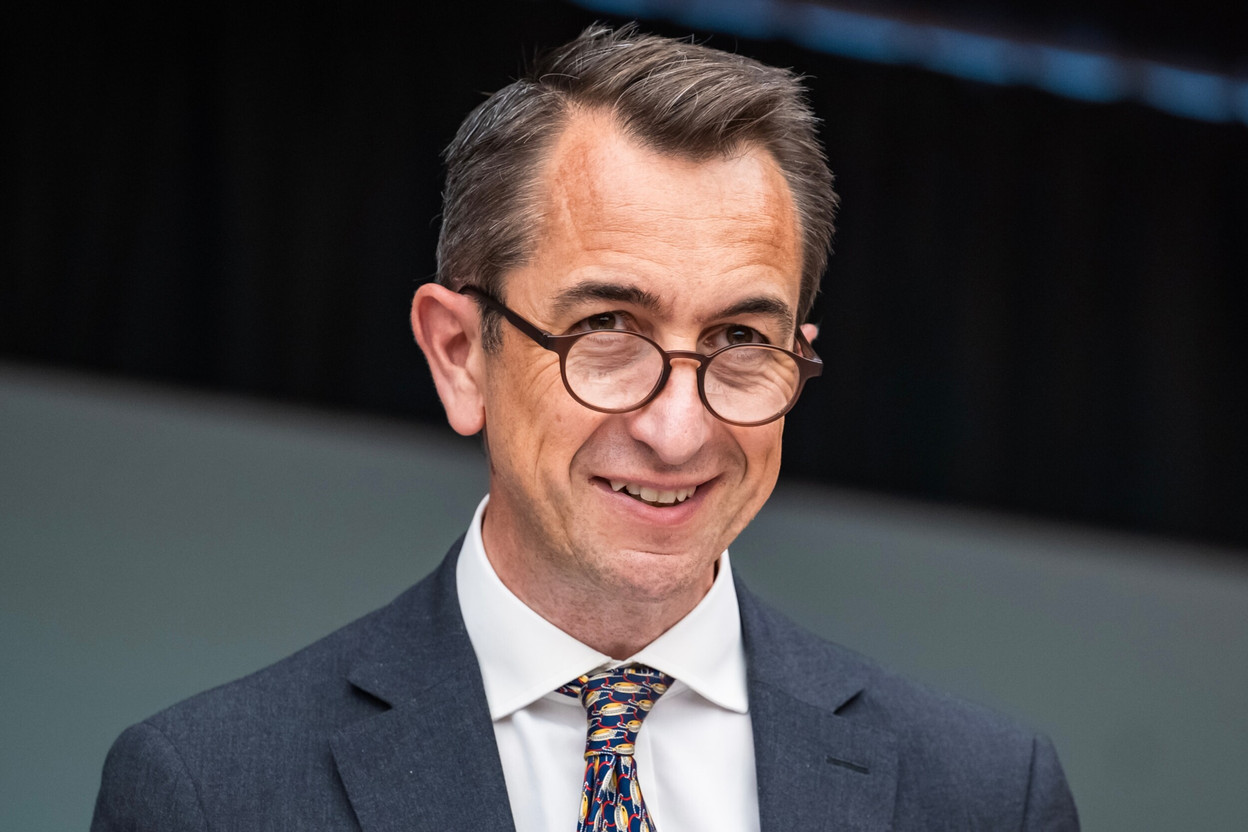
François-Louis Michaud, Chair of the European Banking Authority (EBA) – an independent European Union agency established in 2011 whose main role is to develop and harmonise banking regulations across Member States in order to ensure a stable, transparent and level single market – was visiting Luxembourg for the institution’s traditional annual strategic retreat. This retreat provides an opportunity for the 27 European regulators, joined by the European Commission, the ECB’s Single Supervisory Mechanism (SSM) and the Single Resolution Board (SRB), to discuss the future of the banking sector and the effectiveness of European banking supervision.
He took the opportunity to speak to Paperjam about his institution’s key priorities. There are three such priorities: modernising the way the banking sector is regulated; extending its remit to operational resilience – including the supervision of major technology service providers within the meaning of the DoRA (Digital Operational Resilience Act) and MICA – and the EBA’s role in becoming a service provider for the community of European supervisory authorities, in particular by making the most of the vast amount of prudential data collected.
Big Tech companies are becoming systemic players
For more than 15 years, European supervisors have focused their efforts on a single objective: to prevent another financial crisis from repeating the scenario of 2008. Capital requirements have been tightened, prudential rules significantly expanded, and banks subjected to ever more rigorous stress tests. “This strategy has borne fruit,” says François-Louis Michaud. “Today, the European banking sector boasts capital ratios of around 16 per cent and liquidity that far exceeds regulatory requirements.” Caution is warranted, however: the next shock is unlikely to come from the banks themselves, he believes. “The European banking sector is very sound in terms of capital and liquidity. Where the picture is less clear is its ability to absorb shocks from other quarters.” These new quarters have a name: cloud computing, artificial intelligence, cybersecurity and digital infrastructure.
For a long time, supervisors focused exclusively on banks. Now, they must also turn their attention to the IT providers on which the day-to-day functioning of the financial system depends. With the entry into force of the Dora Regulation, the EBA has been entrusted with a new remit: to directly supervise the 19 digital service providers deemed critical to the European financial sector.
This category includes the world’s leading digital giants, such as Amazon, Google and Microsoft. “We have been given new responsibilities relating to operational resilience. We have started monitoring the major IT service providers in the financial sector.”
This change reflects a profound shift in the very concept of systemic risk. In the past, a banking crisis arose from poor financial risk management. In the future, it could be triggered by a major IT failure, a cyber-attack or a disruption to the digital infrastructure used simultaneously by hundreds of institutions.
A dependence that calls into question Europe’s autonomy
Beyond cyber security, the EBA Chair identifies an even more structural risk: the lack of diversity and the geographical concentration of the technologies used by European banks. “The fact that most of these IT tools are American or Chinese is perhaps the main vulnerability today,” he acknowledges. He adds that this dependence extends far beyond the banking sector. “It ties in with European debates on technological sovereignty, control over critical infrastructure and strategic autonomy.”
For the EBA, these issues are now becoming prudential matters in their own right. The strategic retreat held this week in Luxembourg illustrates this development. Supervisors from the 27 Member States devoted a significant part of their discussions to the links between finance, technology and European autonomy, with contributions from the European Investment Bank (EIB) President 
Regulations that must look to the future
This development is also forcing the EBA to review its approach to regulation. The Chair believes that the last 15 years have mainly been spent building an extremely detailed framework designed to prevent the recurrence of traditional financial crises. The next step is now to anticipate emerging risks. “Today, regulation must be able to adapt to new challenges. We need to be more responsive and more ‘forward-looking’.” Geopolitical risks, cyberattacks, artificial intelligence, environmental changes and demographic shifts are now among the priorities of European banking supervision. This shift is accompanied by a change in philosophy: less regulation of the past, more preparation for the future.
This change in approach comes at a time when Brussels is seeking to reduce the administrative burden on businesses.
Banks, too, are calling for a simplification of their prudential requirements. The Chair of the EBA is in favour of this objective, but refuses to allow the achievements of regulation to be called into question. “Simplification is not the same as deregulation,” he insists.
With a view to simplification, the Authority has therefore proposed halving the amount of data required for prudential reporting and removing some of the regulatory obligations deemed to be of little use. The aim is to reduce administrative costs without compromising the supervisors’ ability to identify risks.
Competitiveness is not just a matter of rules
That said, the Chair does not agree with the view that regulation is to blame for European banks falling behind their US competitors. In his view, the main obstacle lies elsewhere: “The major European banks have a problem of size and scale.”
The continuing fragmentation of the European market, tax and legal barriers, and the lack of genuine cross-border consolidation continue to limit economies of scale. In his view, the project to establish a banking union remains just as strategic as that of regulatory simplification.
Luxembourg at the heart of this transformation
The decision to hold the EBA’s strategic retreat in Luxembourg is no coincidence. “We had never been here before, and Luxembourg is an extremely important financial centre in Europe.” The Chair sees the Grand Duchy as a testing ground for the current transformations in European finance. Having become a preferred location for international groups since Brexit, Luxembourg also exemplifies an organisational shift characterised by the growth of branch offices – a model that the EBA often considers more efficient.
A new generation of supervisors
A more profound shift in the role of prudential authorities is emerging. The supervisor of the future will no longer simply be required to check banks’ balance sheets. They will need to understand digital architectures, anticipate geopolitical risks, oversee technological infrastructure and prepare the financial system for hybrid crises in which the line between economic security and digital security is becoming increasingly blurred. “We must be able to issue guidelines and set standards. But we must also be able to show our teeth as a deterrent.”
This statement sums up the paradigm shift well. Having stabilised the banks, European regulators are now tackling a broader challenge: preserving the strategic autonomy of a financial system whose day-to-day operations depend on technologies developed, for the most part, outside Europe.