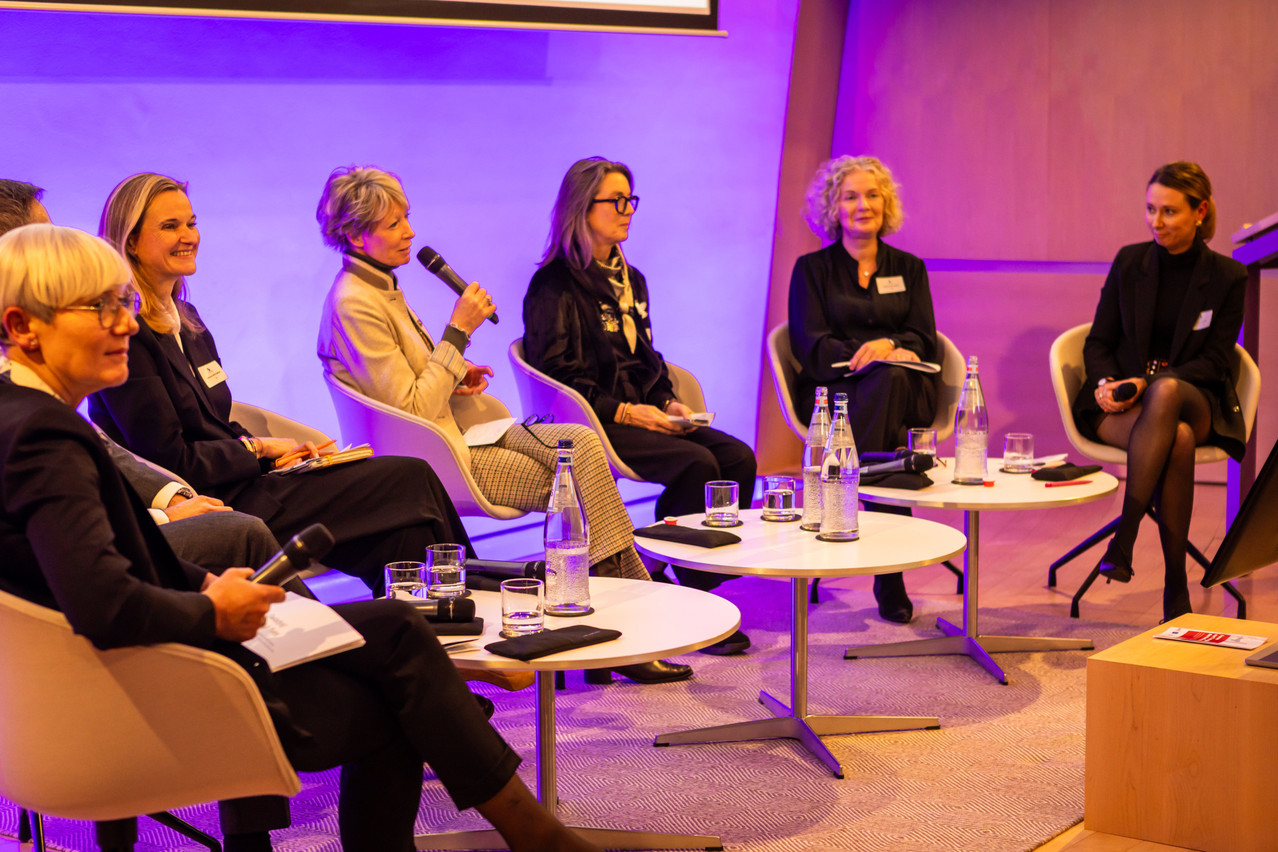
"We are living in a time of profound transformations. Demographic transition, the digital revolution, changes in the labour market: all these dynamics are putting increasing pressure on our social protection systems. It was with this observation that the Minister for Health and Social Security 
Around the table, Yves Baden (CFL), 


This round table didn't come out of the blue. It is a direct follow-up to the third employment barometer, launched by the Union of Luxembourg Enterprises (UEL) and the FR2S, with the participation of Fedil Employment Services (FES), the findings of which largely fed into the discussions.
The figures speak for themselves. A quarter of the applications received for open positions come from candidates aged over 50. Six out of ten recruiters say they pass these applications on to their managers. But in the end, only 15% of older people are recruited. A gap that illustrates in very concrete terms the persistent gap between stated intentions in terms of employing older people and the reality of recruitment practices.
Data from Statec and Adem confirm this diagnosis. The unemployment rate for the over-55s is 8%, compared with 6.2% for the working population as a whole. Nearly 8,000 jobseekers aged over 50 are currently registered with Adem, representing almost 30% of the total. Even more worrying: more than one in two has been unemployed for more than a year.
Numerous but poorly identified schemes
In light of these indicators, the minister reiterated: "The employment of older people is not just a social issue. It is a major economic and strategic issue, and a shared responsibility between the government, businesses and individuals."
The fact remains that businesses recognise their own blind spots. According to the barometer, 58% of them claim to be unfamiliar with existing public support schemes and 73% believe that financial incentives are insufficient. These are all obstacles that call into question the effectiveness of current schemes and the clarity of public policies on the employment of older workers.
Isabelle Schlesser nevertheless stresses the diversity of the tools available. The best known is the reimbursement of employers' social security contributions when an older jobseeker is taken on. This mechanism enables the government to pay all or part of these contributions: for up to two years for those aged 45-49, and, subject to certain conditions, up to the legal retirement age for those aged 50 and over. This is the type of assistance most frequently mentioned by the panellists... but it is far from the only one.
Among the lesser-known schemes is the re-employment contract (CRE), aimed at jobseekers aged 45 and over. This allows a company to take on a candidate for up to a year, without having to sign a conventional employment contract. The scheme is run by Adem: the beneficiary receives a government-funded allowance, while the company pays an occupation allowance, without directly employing the person.
Another tool championed by the director of Adem is the professionalisation internship. Lasting six to nine weeks, free of charge for the company and with no obligation to hire, it aims to remove prejudices. "If it doesn't work out, the candidate leaves with experience. If it works, everyone wins", she summed up.
There is also re-employment aid, which compensates for up to four years for a reduction in salary when a senior employee accepts a lower-paid position, and the outplacement tax credit, designed to encourage companies to favour internal mobility. In short, the tools exist. Their appropriation, much less.
Changing views, not generations
This raises the question: if the measures exist, why are they struggling to be put into practice? For the speakers, the problem is less legal than ideological. "Seniors are said to be expensive, over-ambitious and to want to take the place of their managers... But is this really the case?" asked Delphine Berlemont. She points out that a career is not linear: "Some seniors accept earning less, to reduce the pressure, to favour balance."
Nicole Dochen agrees. "At 50, the mental load is often different. Children are autonomous and the desire to learn returns. We need to talk about intentions, not ambitions." In her view, the expectations of older people are not fundamentally different from those of other generations. "Above all, they are looking for meaning, recognition and a feeling of being useful. However, managers need to be reminded of this, avoid age-related remarks and avoid reducing these employees to mere numbers.
Because beyond commitment and experience, their value is also operational. "They know how things work, how to react to a problem, who to call. This memory has value", stressed Delphine Berlemont.
For Isabelle Faber, the message is crystal clear: "A senior citizen is not more years, it's less unknown." As for digital fears, Isabelle Schlesser brushes them aside with humour: "Anything you don't like in a young person, you probably won't get in a senior."
Beyond recruitment
The issue is not limited to recruitment. In Luxembourg, the average effective retirement age remains close to 60, well below the legal retirement age of 65. Adapting the end of careers is therefore becoming crucial.
At the CFL, several levers have been activated to provide long-term career support, explains Yves Baden. The emphasis is on generational inclusion, but also on health prevention. Work is being carried out with doctors and ergonomists to maintain mental and physical health throughout a career. "Wear and tear is one of the main dangers", pointed out Isabelle Faber, who stressed the importance of listening and individual monitoring.
Nicole Dochen illustrated this approach with a concrete example. "An employee in his fifties, off work due to depression, was considering not returning to his job and was talking about early retirement," she recounts. At Christmas, she took the initiative of calling him, then sent him a personalised letter to mark his 30 years of service. Touched, the employee finally decided to stay. He was redirected to another department, where he worked for another three years.
Learning without an expiry date
This ability to redirect career paths is essential to keep senior employees engaged, particularly when their skills no longer fully match the requirements of their job. "We don't hesitate to invest in young people, who sometimes stay for three years. Why not invest in older employees, who may stay for another five years?" asked Isabelle Faber.
Continuing training, internal mobility and the passing on of knowledge are all interesting drivers. In particular, Yves Baden highlighted the strategic role that older employees can play as tutors, trainers or pass on experience. "Even at the age of 55, training a manager can have a lasting impact on the organisation."
Finally, everything hinges on the ability of different generations to work together. "Understanding what motivates each of them, their codes, their constraints. Leaving the office at 5pm doesn't mean the same thing to 25-year-olds as it does to 50-year-olds," concluded Delphine Berlemont.
One question remains: when do you become a senior? 45, 50, 55? Opinions vary, but the crux of the matter lies elsewhere. In a labour market under pressure and faced with the fragility of the retirement system, senior citizens are not a cost, but a potential.


