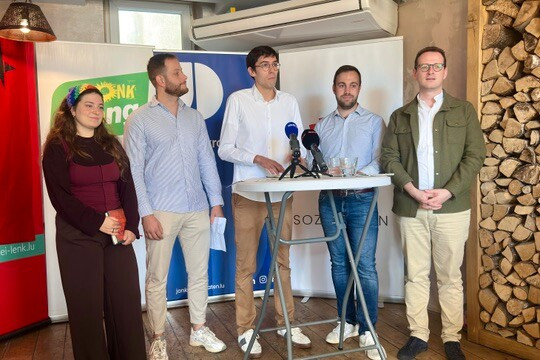
The youth wings of Luxembourg’s two governing parties joined three opposition counterparts on 30 September in calling for affordable homes to make up a fifth of the country’s housing stock. The five organisations presented 12 demands at a press conference in Luxembourg, arguing that the housing crisis particularly affected young people.
The CSJ and Jonk Demokraten, affiliated to the CSV and DP, issued the declaration with the LSAP’s Jonk Sozialisten, déi gréng’s Jonk Gréng and déi Lénk’s Jonk Lénk. They welcomed the government’s July housing measures but called for further structural action. “This cannot be solved through party politics alone,” said Metty Steinmetz of the CSJ.
“Invest 1% of GDP each year in creating affordable housing until the national target of 20% affordable housing is reached,” the declaration demanded, an amount of roughly €900 million a year. Every municipality should contribute towards that share, with local targets reflecting its circumstances.
The organisations argued that the weakened construction sector made sustained government support for housebuilding particularly necessary. Their programme set no deadline for reaching the national housing target.
For proposed measures to bring building land into use, Lou Linster of the Jonk Demokraten called for cooperation between ministries, parliament and the Council of State. “We must pull together on these measures so that it does not take another five years for them to come into force,” Linster said.
Room to build
To expand affordable supply, the declaration sought legal guarantees allowing public housing developers to build at a minimum density, adapted to the size of each municipality. Communes would have to permit at least that level of development. More homes on suitable sites would reduce building costs and the need to use additional land, the organisations argued.
“The price of SNHBM homes should be set not only on the basis of construction costs, but also on households’ actual purchasing power,” said the Jonk Lénk’s Alice Hoffmann, referring to the public housing developer. The declaration also called for SNHBM to have more scope to build densely to bring costs down.
The programme sought effective taxes on vacant homes and undeveloped building plots, including significant municipal property taxes on undeveloped building land. “We ask municipalities not to wait for national legislation, but to set up a local register now,” said Maxime Pantaleoni of the Jonk Gréng. The declaration also called for work on a national housing register to be accelerated.
A better deal for tenants
For people seeking a rented home, the declaration proposed widening access to the government-backed rental-deposit guarantee. It called for the annual income threshold for a single person to be set at €57,600, extending eligibility to more middle-income earners.
Rent ceilings should take account of a home’s energy performance, with lower maximum rents for poorly rated homes, the declaration said. The organisations argued that this would protect tenants and encourage renovation. Asked about a joint replacement formula, the Jonk Sozialisten’s Olivier Cano said: “We have not reached a consensus on what the rent ceiling should look like.”
Tenants who successfully challenged their rent within the first 12 months should be able to secure an adjustment and fair compensation for the period concerned. The organisations also sought swift parliamentary approval of a national rental conciliation body, with sufficient resources and powers to check whether rents complied with the law. Procedures should be simpler, faster and more transparent for residents, they said.
Municipalities should systematically record furnished rooms and homes in unhealthy conditions, the declaration said. Tenants should be encouraged to report problems without fear of reprisals, with better access to legal and social support to help them find safe, decent accommodation.