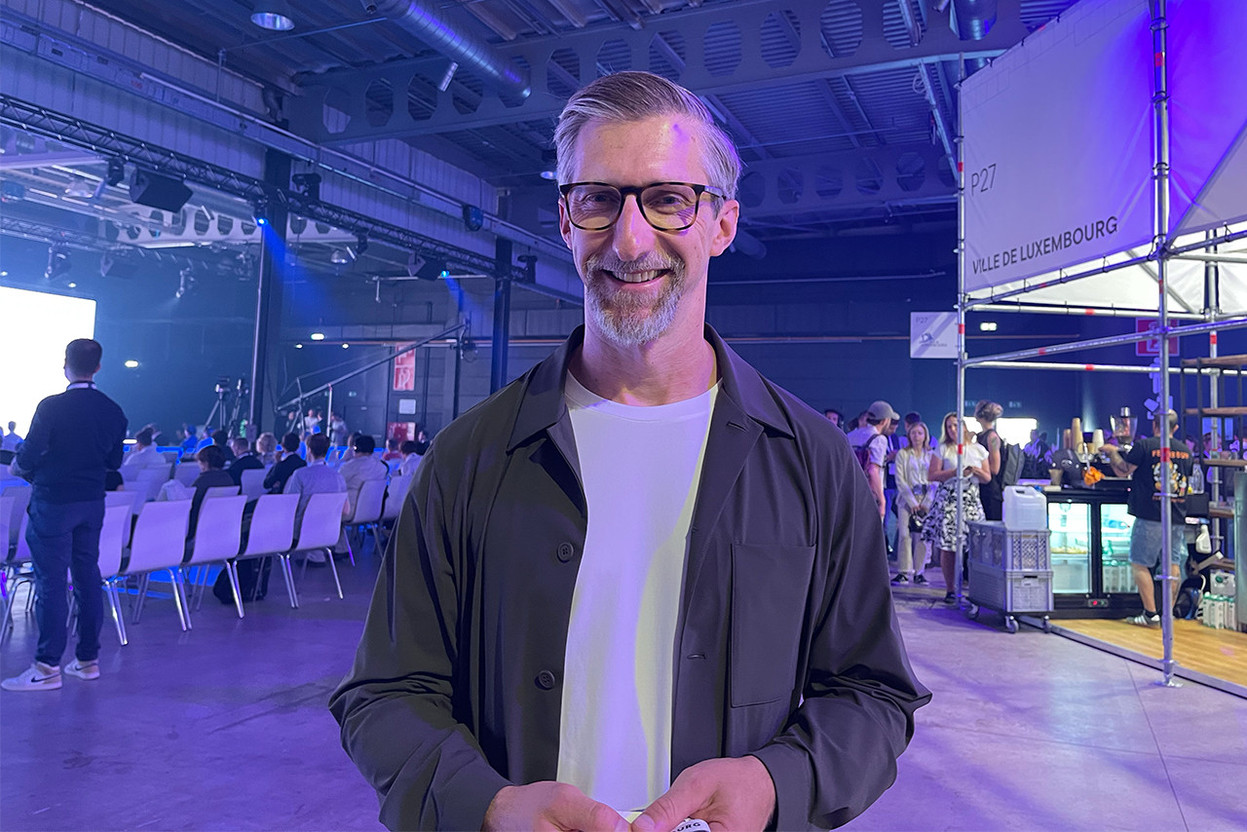
Paperjam: Thomas, explain what you do.
Thomas Semah: The company is called Yneuro. We are a team based in France at Station F, passionate about neurotechnology, artificial intelligence and cybersecurity. We have created the first biometric authentication solution based on what has been called the “neural signature.” With NeuroID, the idea is to no longer have to use easy recognition, fingerprint, iris and retina scans on a daily basis, but to be recognised with the utmost simplicity and also to protect the user's private information thanks to our solution.
Neural signature: what does that mean?
The tech giants, whether in the United States, Japan or South Korea, are going to integrate neural sensors, which are capable of measuring the electrical activity of a brain, of a user. Our solution uses algorithmic processing chains based on an AI developed in-house to recognise the user. In fact, we’re going to extract recognition patterns and capture them to build this NeuroID. And the idea is for it to become a genuine authentication norm, a new standard and really take over the whole market.
Like an image of your brain’s electrical activity?
I like the comparison. But we prefer the term signature. It’s like turning neurophysiological data into an access key somewhere for the digital world.
A series of numbers and letters...
You could put it like that, yes.
And how is it stored?
Today, everything is secured on our own server. Of course, when we expand, we’ll have to use cloud services. We’re currently looking into this matter.
Is this a signature with a limited lifespan? At the rate of our brain’s activity?
What’s interesting about the neural signature is that if you take facial recognition, the face is fixed, the fingerprint is fixed, the iris is fixed, passwords are forgotten! With us, the signature improves over time. The more technology the user wears, the more we’ll be able to shape and improve the signature on an ongoing basis. And that’s where we really stand out from so-called traditional biometrics.
Who remain static and end up getting hacked, you mean?
Exactly. Last year, 5.6m Americans had their fingerprints stolen. Our solution is unassailable. It protects the user and today, it’s true, we’re currently in the fund-raising phase, we’re expanding the team and we’re really rolling out the solution around the world at the same time as we’re taking part in events like Nexus Luxembourg today.
Can you tell us a bit about your company?
Yes, of course. We are a startup founded in 2019, we are housed at Station F. Today, we’re about to have our very first revenues. There was a long period of R&D, particularly with the engineering team, and we’re currently in the process of raising some very attractive seed funding. The amount is confidential. It’s going to be some very good names. Today, we have a number of business angels who have joined us from the fields of biometrics, artificial intelligence and cybersecurity. Above all, we’re looking to surround ourselves with the right people and people with knowledge of our market so that we can accelerate the go to market.
And how are you going to attack the market?
Our vision is to get in touch with the consumer electronics players, all those who make connected glasses, audio headsets, augmented and virtual reality headsets on which our technology can work. So right now, we’re in a commercial deployment game and we’re focussed on it.
The other way would be to integrate your solution into those already offered by trusted providers, such as Luxtrust in Luxembourg, right?
That’s exactly it. Today, we’re really banking on our technology, NeuroID. And perhaps we might find this technology in Luxembourg and see it become a real standard that everyone uses. Our solution, it’s private by design, it’s irreplicable and that’s something that’s still pretty essential and very different from traditional biometrics.
All whilst hoping there are no hacks…
Impossible. The signature is not the original data. We transform it, so it’s not like it’s a face.
All right. You need to have both the sauce and the recipe to make the sauce, so to speak?
Exactly.
This article was originally published in French.