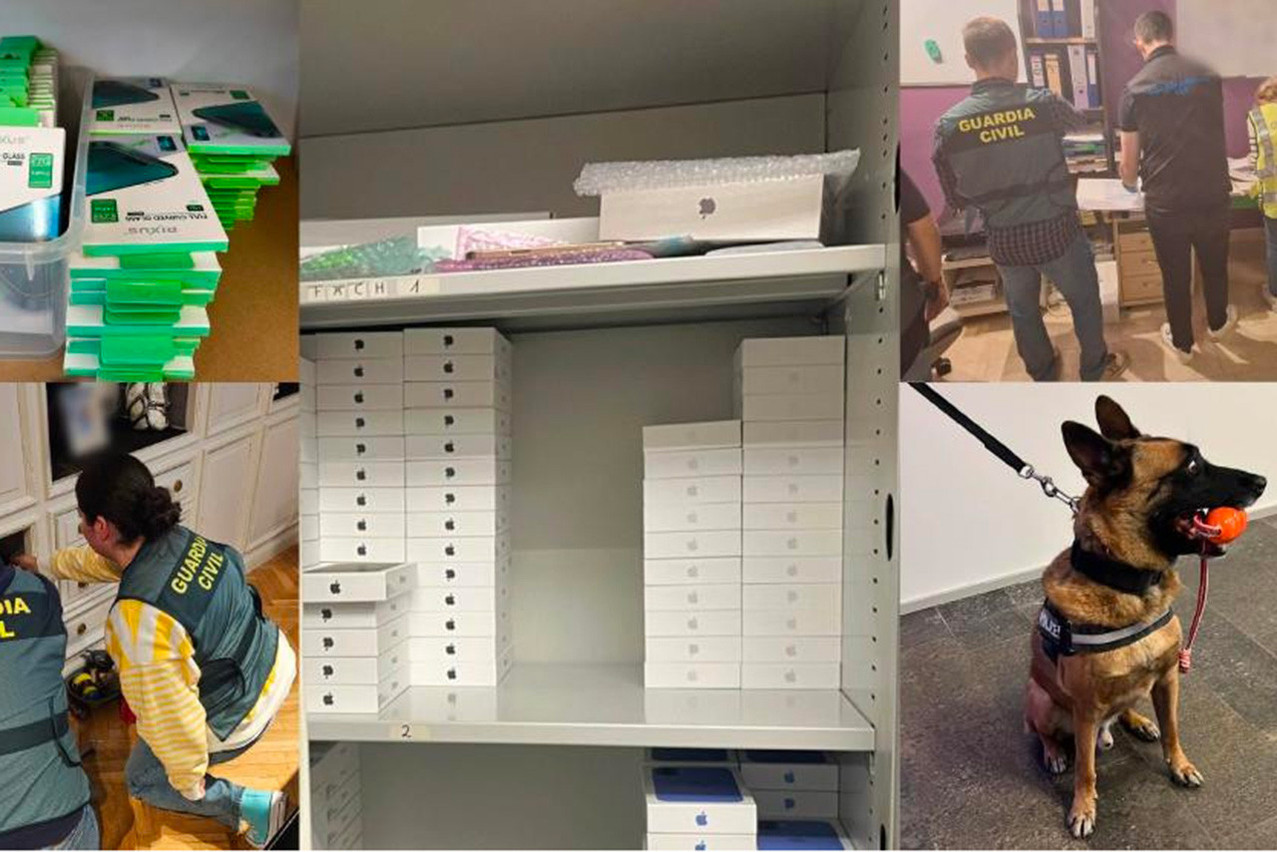
The European Public Prosecutor's Office (EPPO) this week coordinated more than 100 searches and the arrest of seven suspects as part of an investigation dubbed Mela into organised VAT fraud estimated at €48 million. The network allegedly used shell companies based in several EU Member States as well as the UK to divert the "margin tax" tax regime applicable to second-hand goods since 2018 in order to fraudulently sell new electronic products at a competitive price.
The searches were carried out in Germany, Spain and the Netherlands, as well as in a dozen other countries, including Luxembourg, where measures to freeze assets and collect evidence took place. More than 300 tax and police officers took part in the operation, seizing cash, jewellery, watches, cars and gold in particular, with a total value of four million euros.
The modus operandi uncovered is well known to the tax authorities: resellers bought, on paper, mobile phones and other small electronic devices that were supposedly already taxed, then resold them under the profit margin scheme, paying VAT only on the difference between the purchase price and the sale price. In reality, the products were new, and the scheme was designed to wipe out the VAT due at each stage. This system, similar to the so-called "carousel" scheme, is one of the most costly forms of fraud for European public finances.
A series of revealing cases
This case joins other spectacular investigations carried out by the European Public Prosecutor's Office in recent months. In March 2024, Operation Adamas had already uncovered VAT fraud on precious metals, with an estimated loss of 140 million euros between Italy, Germany and Luxembourg. In 2022, another cross-border investigation targeted trafficking in iPhones and microcomponents, resulting in lost tax revenue of nearly €93 million in Belgium and the Netherlands.
According to the European Public Prosecutor's 2023 annual report, more than 60% of the cases dealt with concern VAT fraud, with a total value in excess of €11 billion. These operations are based on close cooperation between Europol, national police forces and tax authorities, made possible by the creation of the European Public Prosecutor's Office in 2021. Based in Luxembourg, it will have unprecedented powers to investigate and prosecute all offences affecting the Union's financial interests.
The repetition of these cases illustrates the structural fragility of the current intra-Community VAT system, whose complexity facilitates abuse. The European Commission is working on a reform known as "VAT in the Digital Age", which is supposed to strengthen the traceability of transactions and reduce the opportunities for fraud by 2028.
In the meantime, the Mela affair is a reminder that VAT fraud remains one of the main black holes in European public finances, and that Luxembourg, home to the European Public Prosecutor's Office, is both a privileged observer and a discreet player.