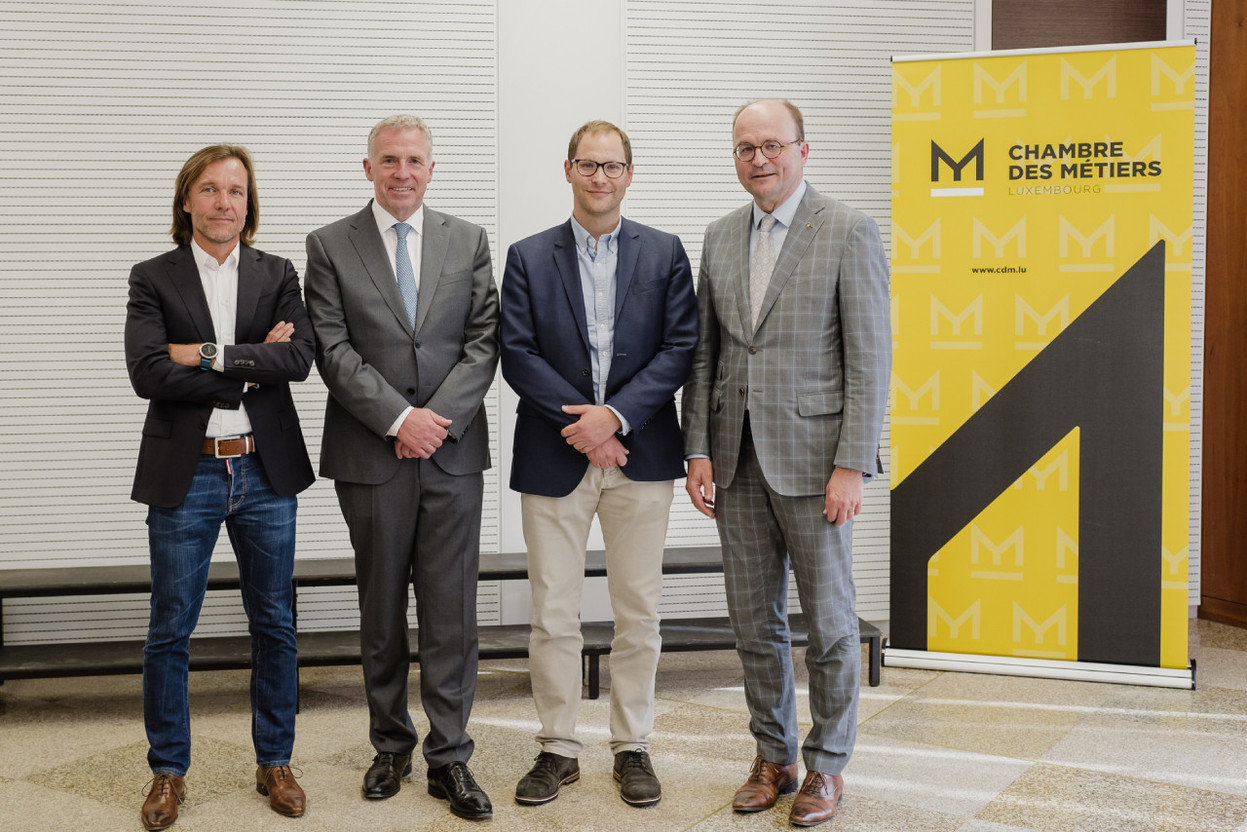
“2026 has started the way 2025 ended: grey, wet, and with a lot of fog.” From the very first lines of his speech, Tom Oberweis set the tone. The image was deliberate. “In both craftsmanship and the economy in general, we can say that we no longer see clearly through the fog of everyday life.” For the president of the Chamber of skilled trades, who was joined on stage by Luc Meyer, this lack of visibility is no longer a temporary lull, but the symptom of a situation that has become structurally unstable. One thing, however, is certain: “2026 will be a pivotal year” and, to succeed, “we must look reality straight in the eye with greater clarity and a stronger sense of responsibility”.
Speaking in front of a motionless audience composed of government members, MPs, mayors and leading figures from public life, his diagnosis was unambiguous. “Today, being an artisan in Luxembourg is like being a baker who prepares his dough without knowing whether his oven will still heat tomorrow.” Behind the metaphor, Tom Oberweis described an environment shaped by “rules that change constantly”, “costs that are exploding”, and “unclear prospects”. In such a context, “margins are almost non-existent”, “labour is lacking”, and “uncertainty dominates”, to the point of “paralysing companies and forcing them to slow down”.
[Without housing], it becomes extremely difficult for craftsmanship to attract young talent and, above all, to retain it.

Housing, a decisive factor
To these economic pressures, he added what he considers a decisive factor: housing. “Affordable housing is the alpha and omega of an attractive, dynamic and competitive economy,” he said. Without it, “it becomes extremely difficult for craftsmanship to attract young talent and, above all, to retain it”. When “young people – and especially young families – can no longer find housing or are confronted with prices that do not match their means”, Tom Oberweis believes that “this is no longer just a social issue, but has long since become a structural economic policy problem”.
In this context, he warned against responses he considers misguided. “Traditional levers no longer work,” he said, explicitly referring to the minimum wage. “The housing problem cannot be solved by another increase in the minimum wage.” Worse still, “such an increase would have the opposite effect”, pushing more people out of the labour market because “companies would no longer be able to absorb the wage costs”. In his view, “the minimum wage should not be a social policy instrument, but a fair remuneration for skilled work”.
Another warning signal, he said, is construction. “In the area of housing, I note that employment in the construction sector has fallen sharply since 2024,” he stressed, calling it an unprecedented development since reliable statistics have existed. “This is not just a statistic,” he insisted, “it is a clear sign of a sector that is shrinking dramatically, with a loss of know-how and skills.” Yet, “without a strong construction sector, there will be no new housing”, and “without new housing, the economy will weaken even further”. The vicious circle, he argued, is clearly identified, and “the measures applied so far by the government are far from sufficient to break it”.
“No future without predictability”
Tom Oberweis was equally clear about responsibilities. “Companies create prosperity,” he said, “but politics must set the framework.” That framework, however, currently lacks stability. “In these difficult times, craft businesses above all need stability” in order to “invest, hire and innovate”. “Without predictability, it is impossible to build the future,” he stated, adding that “today’s uncertainty is the greatest obstacle to entrepreneurship and the willingness to innovate”.
While acknowledging that “certain directions have been defined”, particularly in training and financial support, he remained critical of the government’s stated priorities. “When you look at the two absolute priorities – cutting bureaucracy and strengthening competitiveness – there is still a lot of air under the promises,” he said. “Solutions and progress may exist on paper, but far too rarely in the form of concrete measures on the ground.”
Craft businesses feel as though they are taking part in an obstacle course with weights attached to their feet: you move forward, but it is unnecessarily complicated and exhausting.
His criticism was particularly sharp when it came to administrative complexity. “We cannot always hide behind Brussels,” he said, arguing that “national over-transposition is an unnecessary luxury”. Too often, he added, “craft businesses feel as though they are taking part in an obstacle course with weights attached to their feet: you move forward, but it is unnecessarily complicated and exhausting”.
It was at this point that Tom Oberweis turned to a second metaphor, once again drawn directly from his professional world. “If I were to continue producing my pastries the way I did fifty years ago, without taking current tastes into account, my future would certainly not be secure.” In his view, “the same applies to politics and to our society”. Luxembourg must “rethink its model in a far more radical way” if it wants to preserve its standard of living. “Today, we are trying to solve new challenges with old recipes,” he warned.
Politics “must set the rules of the game”
Against this backdrop, he stressed that “craftsmanship is certainly not a sector of the past”. With its 130 professions, it represents, on the contrary, “the heart and the hands of the future”. But recognition must translate into action: “a coherent status for the self-employed”, “a genuine talent attraction strategy”, and a clear regulatory framework. “Politics cannot do everything,” he conceded, “but it must set the rules of the game – and then let people get on with it”.
His conclusion was a strong appeal for trust. “Too many rules do not create security,” he said. “They create insecurity and discourage artisans.” Behind every business, he reminded his audience, “there is a person who takes risks, pays wages and works long hours”. And “when the business owner becomes discouraged, no future is created or passed on”.
Finally, true to his art of metaphor, Tom Oberweis summed up his vision in the form of a simple recipe. “Success depends on the right ingredients: trust, predictability and freedom to act.” Without them, he warned, “the bread of the future will not rise”. With much of the government present in the room, the message was unmistakable: without a clear shift in direction and far more radical measures, the fog is unlikely to lift any time soon.