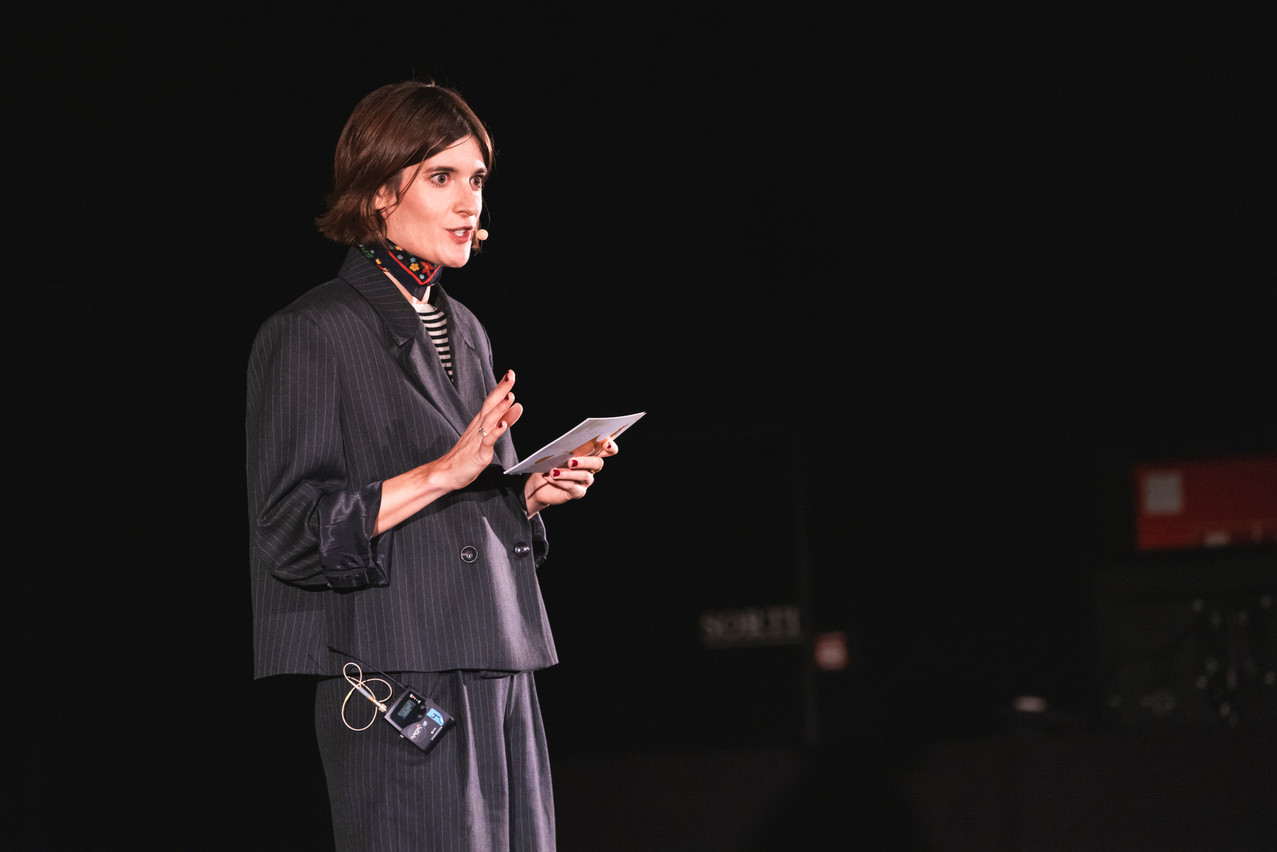
“It’s an image, but an image that says something.” Behind her, on the giant Kinepolis screen, are hens in a henhouse serving Ann Van Wetteren’s metaphorical and disruptive six minutes. “We live in a stable, wealthy, envied country. But instead of giving us wings, this wealth too often prevents us from taking off. And that, frankly, is a shame. Because let’s be clear: materially, we have everything. Creative young people, brilliant minds, original people who want to do things differently, enormous cultural diversity, an incredible, skilled workforce. In short, a fantastic playground. And yet, we put all this at the service of what? Cash.”
“The official pitch is: come to Luxembourg, you’ll make money. The unofficial pitch is: you’ll settle down in a Big Four or a bank, end up with seven people in an expensive flat-share in Bonnevoie and measure your happiness in tax kilometres. Mind you, finance is not the problem. The problem is that it has swallowed everything. It has become a state of mind. It has become the horizon. And the horizon, for us, is a line of account,” she continues.
“We know the American dream. We’ve invented the Luxembourg dream, but the premium dove version. Because yes, the country is rich, but that wealth doesn’t translate into quality of life for everyone. In 2010, you could still dream of buying a flat. Today, it’s more than €12,000 a square metre in Luxembourg City. The result: we’re selling a promise and delivering a gilded cage. And in that cage, the hen may blossom, but she’ll end up bored,” says the speaker, the audience nodding in agreement. “The financial sector accounts for 25% of GDP and half of corporate profits, with over 120 banks and 14,000 investment funds. And if everything revolves around that, hardware becomes a way of thinking. So it’s best not to disturb too much, not to change too much, not to go too far outside the box, because the state keeps a close eye on its henhouse. As a result, ideas are nipped in the bud. Not out of malice, no, but out of fear, comfort and adaptation.”
The evening was organised to mark the launch of Paperjam magazine and dedicated to the necessary intergenerational dialogue. After Van Wetteren gathered everyone into… the barnyard, she hit us with: “The real question is: can’t we imagine something better than this? Couldn’t making money also mean creating, inventing, at least alongside finance? Because all you have to do is talk to these people--locals or those from elsewhere: artists, architects, craftsmen, shopkeepers, creative people. They don’t all come here just to make money. Some come for love, others for safety, cleanliness, peace and quiet. But all too often, they come up against a bureaucracy that’s uptight, timid and obsessed with its forms. As soon as you want to do something, you’re told: “We’ve never done it like that.” Or, in the Luxembourgish version, “Mir hunn dat nach ni esou gemaach.”
“But look elsewhere: Rotterdam, Berlin, Zurich, Copenhagen!” she urged the silent audience. “These are not utopias, these are cities that dare, that test, where young people can try, make mistakes, start again. Where money is reinvested to make the city more liveable, forward-looking and creative. Cities where we can breathe. Berlin invests €100m a year to support independent craftspeople. Rotterdam subsidises rents for young designers. Zurich launched public design incubators in the 2000s. And here, we tend to breathe conformism. Here, risk is a threat, not an opportunity. And yet half the population is foreign, over 180 nationalities. And the result? Bright young people who end up working for the big companies or for the chains in the city centres--who merely survive, because the rents for living or doing business there have simply become untenable. What if, instead of going round in circles in the henhouse, we imagined something different? A Luxembourg that dares, that experiments, and that stops saying “never been done” and starts saying “cool… why not?”
“Because, yes, it’s a brilliant, creative, rich country. But at the moment, it’s a little too sure of itself to change. The solution is not to throw away everything we have, it’s to use it differently. Of course, I’m a Luxembourger, and proud of it, but I also want to remain curious, courageous, independent, experimental, and to take advantage of all the benefits our country has to offer without ever taking them for granted. That’s the heart of the story,” concluded the anthropologist. “It’s a fable, but a very real one. Less bureaucracy, less cautious mentality and, please, more space--especially for those who want to try something different. Because chickens are not stupid, they have wings. And I know enough people around me who flap their wings. So do I.”
And in case you hadn’t noticed, I never made the connection with her famous mum, Christianne Wickler, or even the Pall Center. Because on Tuesday evening, Ann Van Wetteren existed in her own right, a Luxembourger who went to breathe elsewhere, Germany in particular, to better sketch an acid and tender portrait of this small country at the heart of everything. And we could have done with a dozen minutes.
This article was originally published in French.
