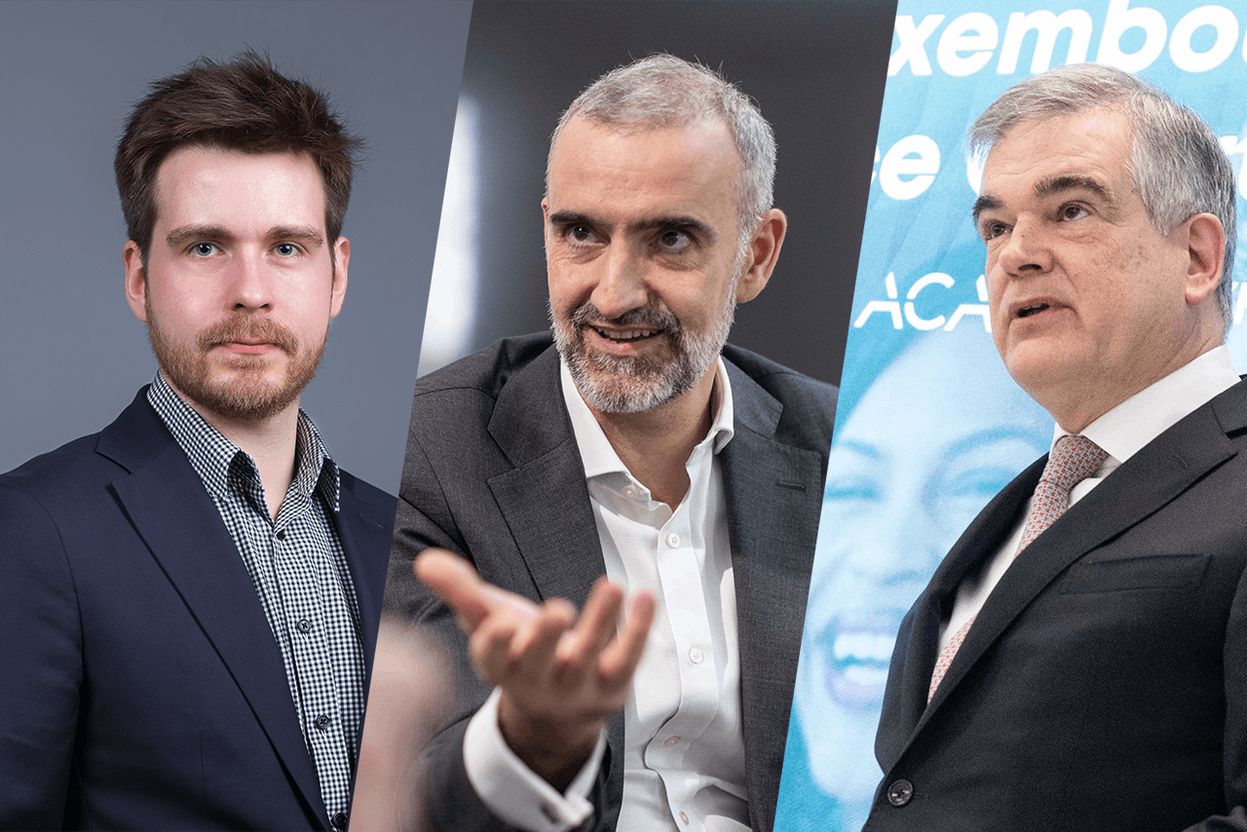
First, to fully understand the ecosystem that is the Financial Centre, a quick look back is in order. It was neither funds nor banks that marked the early days of the financial centre, but the capital markets, in the 1960s, when the Luxembourg stock exchange listed the first euro bond, with an Italian issuer, under English law, in dollars. In this ecosystem, private banking developed in the 1980s, already with a cross-border dimension.
Thanks to UCITS, the fund sector is gaining in importance. Luxembourg was the only country with the potential for a product that could be sold in several markets. Then insurance developed, firstly life insurance, then reinsurance and non-life. 
How is Luxembourg positioned in the financial landscape?
Tom Théobald. —“Luxembourg is seen as a marketplace that offers cutting-edge expertise, particularly in cross-border transactions. This international expertise is a strength, a common thread that runs through the various segments in which we are active. The financial centre is also renowned for its stability, which gives players predictability, and for its regulatory rigour and supervision, which are its hallmarks for investors, but also for financial companies. While it is recognised as serious and strict, the regulator is also recognised for its openness to dialogue and innovation.
Any weaknesses?
“The critical point that comes up regularly is the difficulty of doing business in Europe because of the often more complex regulatory framework. But its market offers a huge advantage, such as passporting, which enables us to serve 27 countries from a single jurisdiction. We are optimistic that a real awareness at the European level will lead to a reduction in regulatory complexity. It’s not about deregulation but simplification to really enable players to develop and the financial sector to play its role: that of financing the economy.
We have some great cards to play [in the area of tokenisation] thanks to our regulatory framework and our fund ecosystem, which is there.

What opportunity should the Financial Centre seize?
“In addition to private assets, which continue to enjoy strong momentum and for which Luxembourg is now the undisputed centre for alternative funds in Europe, another opportunity is emerging with active ETFs. When you buy funds on a platform via your smartphone, in 90% of cases they are ETF funds, most often passive because they simply replicate a stock market index.
Now there are active ETFs, with real active management behind them. They are not yet very developed in Europe. As Luxembourg is the European hub for active management, it would be obvious to develop them here. If you already have a successful product such as a fund and you add an ETF asset class to that fund, you create an additional distribution channel for a customer base to which you may not have had visibility.
A development to watch?
“Tokenisation, i.e. creating tokenised funds. We could also see in the near future a completely new way of buying or accessing securities or funds; almost immediately, in real time, with the possibility of buying fractional securities for example, as with the tokenisation of real estate assets. You can then create tranches that any investor can easily buy. Here, we have some great cards to play thanks to our regulatory framework and our fund ecosystem, which is there.
Luxembourg must remain at the forefront of innovation. We can’t wait [for it] to come from outside.
What challenges lie ahead?
“Access to talent. The other challenge for Luxembourg is cost: in particular the cost of housing. The government is fully committed to addressing these issues and has already put in place measures, including a particularly attractive tax regime for expatriates as well as schemes to support young working people with their housing costs. Another difficulty is the creation of new activities as a result of the European framework. Luxembourg is committed and must continue to be committed to a European framework that is conducive to the financial sector and its development.
The turning point not to be missed?
“The digitalisation of finance. Tokenisation is just one example. Luxembourg must remain at the forefront of innovation. We can’t wait for innovation to come from outside. I believe that AI can obviously be extremely transformative, but we have to be smart in its application. We can be very targeted and use these technologies to make our various sectors more competitive, more efficient, and reduce costs too.”
This article was written for the December 2025 issue of Paperjam magazine, published on 19 November. The content is produced exclusively for the magazine. It is published on the site to contribute to the full Paperjam archive. Click this link to subscribe to the magazine.
Is your company a member of Club Paperjam? You can request a subscription in your name. Let us know via club@paperjam.lu.