The financial sector is the “cornerstone” of the economy. It played a key role in absorbing the shock of the decline of the steel industry in the 1970s. Since then, its importance has never diminished.
1. The weight of the financial centre in the economy: blessing or curse?
The figures. The financial sector accounts for 15% of salaried employment (73,272 people, including 26,284 in the banking sector alone) and 30% of gross value added, i.e. 17.3 billion.
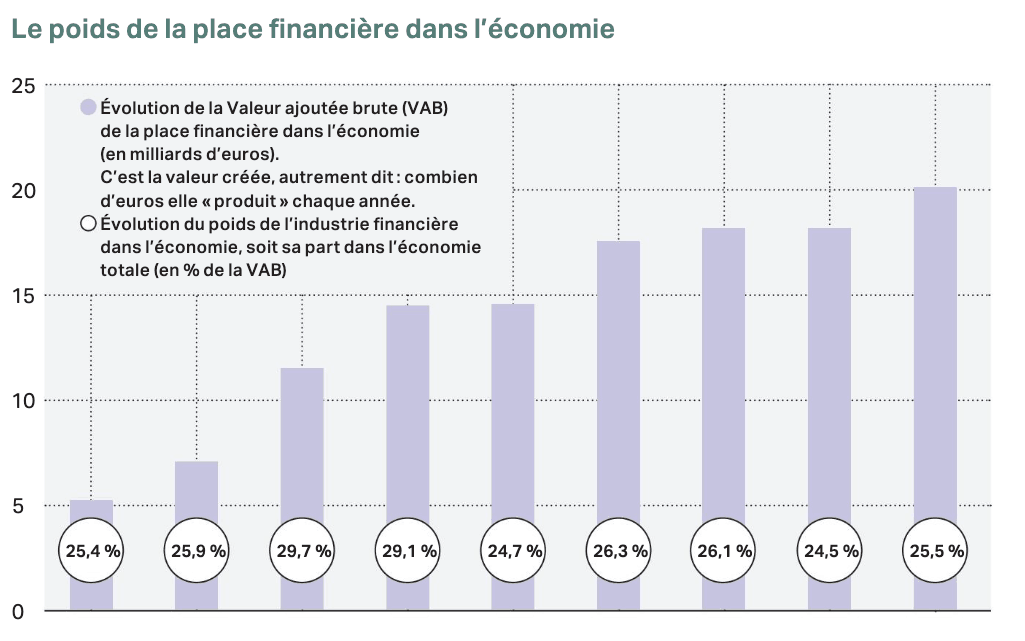
The weight of the financial centre in the economy. (Infography: Paperjam; source: Statec, Administration des contributions directes)
As far as assets are concerned, those of the banking sector rose by 30% between 2014 and 2024 to 957.8 billion. Steady growth too for the investment fund industry, which manages €7,400 billion, €4,800 billion in Ucits and €2,600 billion in hedge funds.
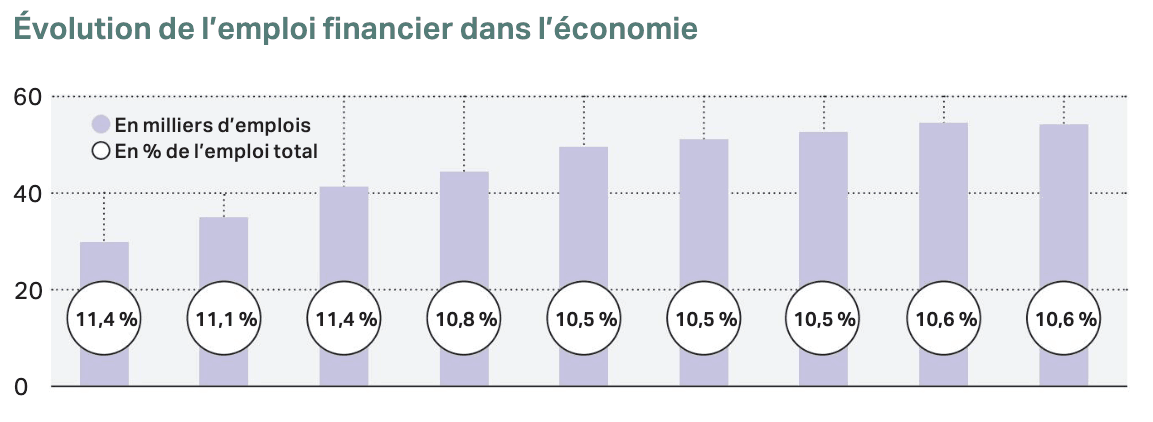
Evolution of financial employment in the economy. (Graph: Paperjam; source: Statec, Administration des contributions directes)
Despite political criticism and attempts at economic diversification by various governments over the last 20 years, its importance remains constant. This poses a challenge in terms of risk management. “The future is prepared first and foremost by managing the existing situation well,” insists Finance Minister 
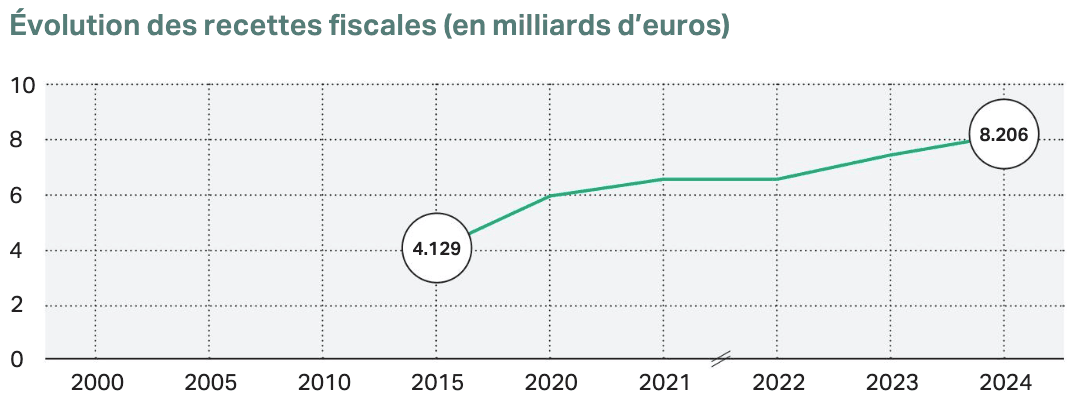
Changes in tax revenues (in billions of euros). (Infography: Paperjam; source: Statec, Administration des contributions directes)
236.400
Each employee in the financial sector generated €236,400 of added value in 2024, according to figures from Luxembourg for Finance. This is 2.4 times the national average in the rest of the economy.
2. What stage has the government reached in adopting its programme for the financial centre?
Competitiveness and attractiveness: the watchwords. In the coalition agreement, the government undertook to actively support the development, diversification and promotion of Luxembourg’s financial centre in all its dimensions and to maintain the primary objective of moving up the value chain in its various fields of activity (banking, insurance, fund industry, capital markets). Innovation, connectivity, stability, sustainability and added value: these are the foundations of the financial centre detailed last March at the Global Asset Management Conference of the Association luxembourgeoise des Fonds d’Investissement (Alfi) on 25 March by Gilles Roth.
The programme is full. And much has already been achieved.
—Community Income Tax (CIT) by one percentage point has been reduced by 1 percentage point. And Gilles Roth hinted when presenting the 2026 budget that he is prepared to go even further.
—ETFs—understood as Exchange Traded Funds—are now entirely exempt from the subscription tax, a flat-rate registration fee based on the net assets of investment funds. ETFs, also known as passive funds because they seek to replicate the performance of a stock market index, are proving extremely popular with savers.
—The modernisation of the impatriate regime under which the first 400.000 of annual income are exempted at a rate of 50%.
—The modernisation of the participatory bonus.
—Bill 8526 aimed at changing the regime for investments in start-ups in general and fintechs in particular is currently being examined by MPs.
—Bill 8590 reforming the taxation of carried interest—a very strong demand from the hedge fund sector—was tabled on 24 July. The Conseil d’État has issued formal objections. Gilles Roth has confirmed that the criticisms will be heard and that the draft will be amended rapidly.
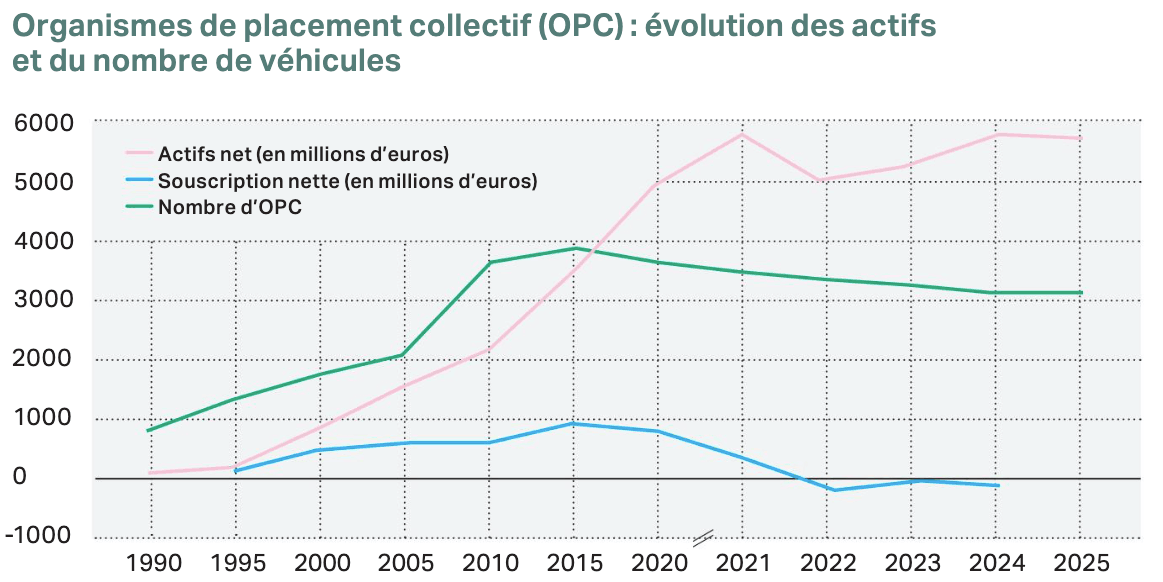
Units for collective investment (UCIs): changes in assets and the number of vehicles. (Infography: Paperjam; source: Statec, Administration des contributions directes)
1,375 billion
That is what the subscription tax is expected to raise in the 2026 budget. Or 1.2% compared to the 2025 budget. And this despite the disappearance of this tax for all ETF funds.
3. Diversifying the financial centre: what are the preferred avenues?
Bitcoin, fundtech, blockchain, Blue Economy: the Financial Centre 2.0. The government wants to make digital transformation a competitive lever for the financial centre. The latest draft budget gives pride of place to the digitalisation of the financial sector. Several initiatives have been announced:
—the creation of a FundTech Accelerator, designed to support start-ups specialising in fund management technologies,
—the establishment of an AI Experience Center, a collaborative platform between public institutions, banks and fintechs to experiment with the uses of artificial intelligence in finance,
—a strategic partnership with Mistral AI to develop sovereign European AI solutions.
The budget also provides for €424 million in public investment between now and 2029 in AI, cloud and data, including €57 million from 2026 to support the MeluxinaAI supercomputer and the Luxembourg AI Factory.
Other major innovations include Luxembourg becoming the first European state to issue a digital treasury certificate on blockchain in 2026. At the same time, the Intergenerational Sovereign Wealth Fund will be able to invest 1% of its assets—or eight million euros—in bitcoin. Another state first in the eurozone. This is less a matter of speculation than of demonstrating the government’s commitment to productivity in these areas. In fact, these announcements have had a strong impact abroad, assures Gilles Roth.
Announcements that will serve to promote the financial centre around the world. A budget of €14.5 million (+22%) has been earmarked to finance seven international economic missions in 2026, with a focus on emerging markets and financial centres complementary to that of the Grand Duchy.
The Minister also wants players in the financial centre to invest more in cybersecurity and the Blue Economy, in other words everything to do with water. A complementary sector to green finance in which he sees strong potential.
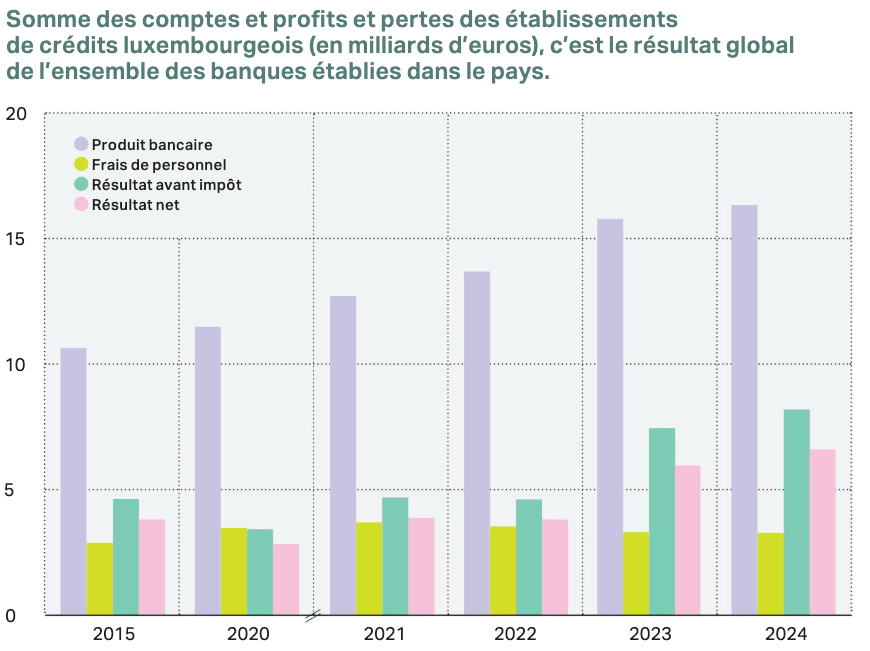
Summary of the profit and loss accounts of Luxembourg credit institutions, in billions of euros (total result of all banks established in the country). (Infography: Paperjam; source: Statec)
8 million
That is the amount earmarked in the draft 2026 budget for the development of the financial centre. This amount includes the State’s contribution to Luxembourg for Finance and the Luxembourg House of Financial Technology (Lhoft). The budget also includes 4.5 million to support the development of sustainable finance.
Human resources: does Luxembourg have the human resources to match its ambitions?
The challenge of training and human resources. The gap between the needs of the marketplace in terms of human resources and the training potential of the University of Luxembourg (Uni) is a cause for concern: 600 students are enrolled in the bachelor’s programmes in business administration and economics. On the other hand, employment in the sector has grown by 3.1% a year over the past ten years, despite the context of multiple crises. In 2024, according to Luxembourg for Finance (LFF), the Luxembourg financial centre employed 73,272 people. On a business-as-usual basis, if we apply a simple rule of three, it should need around 2,198 extra people. Even if, according to Uni figures, 75% of graduates stay in Luxembourg to start their careers, the numbers are not there.
82% of employees in the financial sector are of foreign nationality according to LFF, compared with 78.7% in 2014. The proportion of non-EU nationals has tripled to 10.2%, with average annual growth of 15.7%. Can this growth continue indefinitely at a time when the attractiveness of the region, at least for cross-border commuters, is currently raising many questions? To support competitiveness and attract new talent, the Government has introduced a package of measures (the Entlaaschtungs-Pak) since July 2024, strengthening the participatory bonus scheme the one applicable to impatriates.
For its part, the Uni is playing on the relevance of the programmes established following broad consultation with companies in the financial center in order to roll out specialised streams for the Luxembourg labour market.
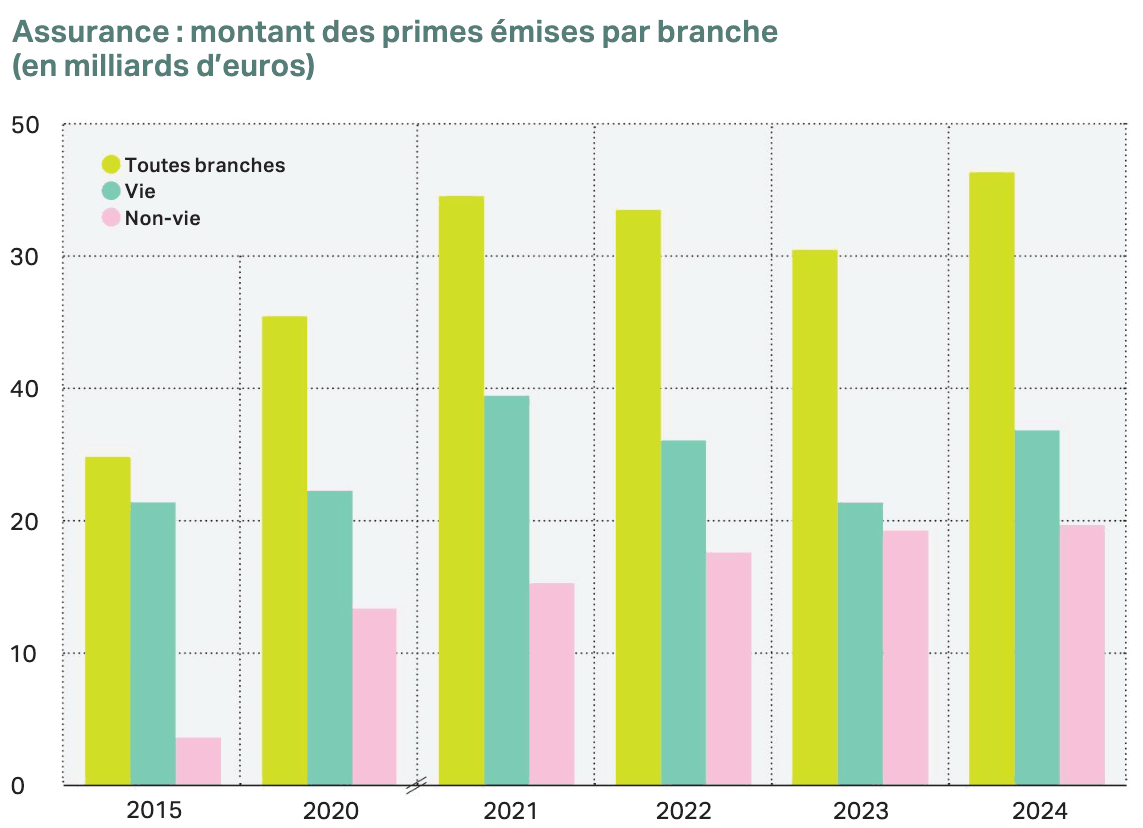
Insurance: amount of written premiums by branch (in billions of euros). (Infography: Paperjam; source: Statec, Aca)
146.655
In 2024, 146,655 jobs were directly or indirectly linked to the financial centre according to the Statec.
This article was written for the December 2025 Paperjam magazine, published on 19 November. The content is produced exclusively for the magazine. It is published on the site to contribute to Paperjam’s comprehensive archive. Click this link to subscribe to the magazine.
Is your company a member of Club Paperjam? You can request a subscription in your name. Let us know via club@paperjam.lu.