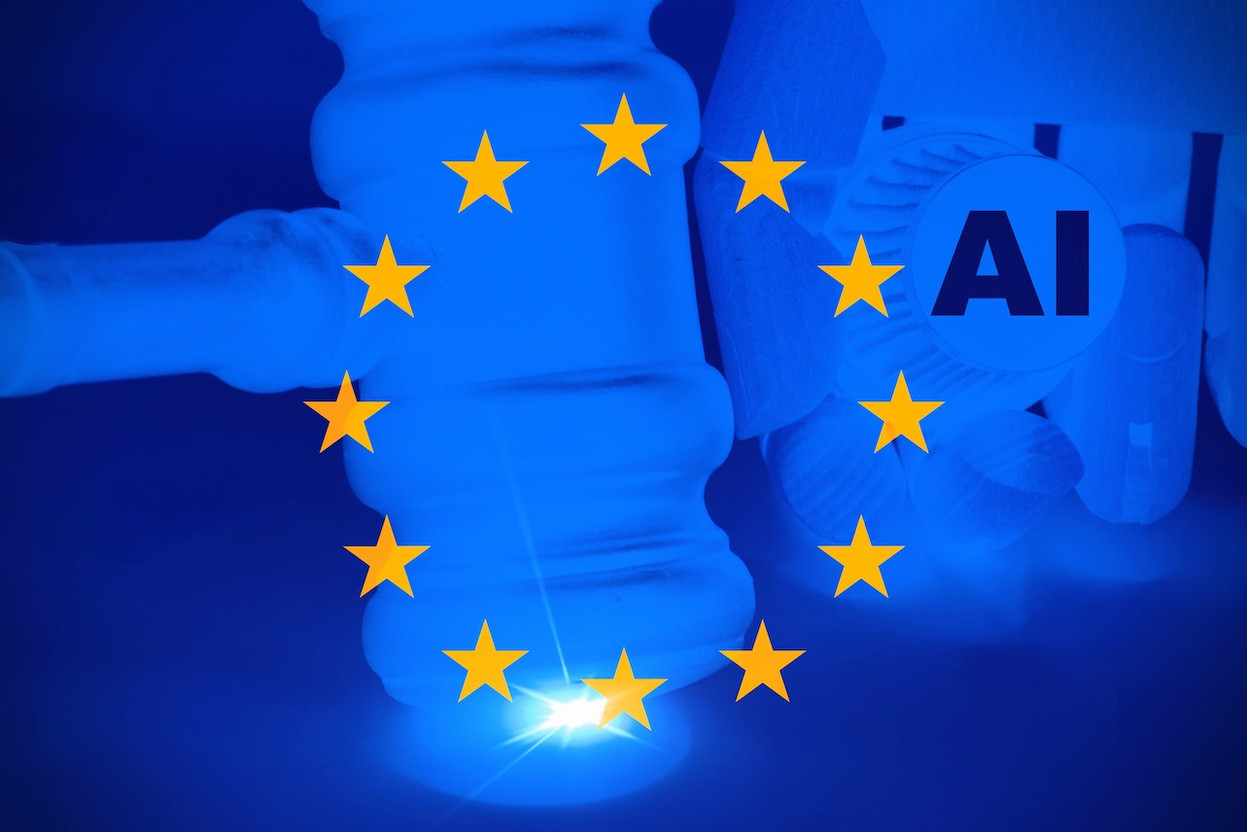
It's a rare moment in European administrative history: we hadn't even finished printing the regulations when we were already planning to put them away in a drawer. The Artificial Intelligence Act, the 458-page legislative monument that is supposed to make Europe the global benchmark for "ethical AI", is in danger of living a schizophrenic existence: in force, but suspended. Since early November, rumours have been swirling that the European Commission is considering "adjusting the timetable for implementation". In Brussels parlance, that means "we panicked".
According to The Guardian, diplomatic pressure from the US and European industry may have persuaded the EU to back off. Washington fears for its Silicon Valley champions, while the heads of 46 major European groups - Airbus, Siemens, Mercedes, ASML and BNP Paribas - fear being grounded even before take-off. They have signed an open letter calling for a two-year "clock stop". The term is elegant, as it avoids 'pause', which is too dramatic, and 'freeze', which is too political. Two years is both a nod to regulatory relativity and a sufficiently vague deadline that no one knows when to restart the clock.
The paradox is delicious: for four years, the EU has slowed down its AI ecosystem in the name of caution, the better to prepare a "predictable, safe and balanced" text. Now that it has it, it is considering postponing it. Companies, for their part, had stopped innovating while waiting for this framework. We call this quantum regulation: as long as we don't apply it, it both exists and doesn't exist.
Preventing a brain and capital drain
It has to be said that the text is no piece of cake. The AI Act classifies artificial intelligence systems according to their level of risk: "unacceptable", "high", "limited" or "minimal". An AI that monitors pupils' emotions? Not allowed. An AI that steers a train? Strictly regulated. An AI that recommends pasta recipes? Autonomous, but subject to conditions. On paper, everything is calibrated. In reality, almost no-one has yet figured out how to apply these levels to general-purpose models such as GPT-4 or Mistral 7B.
And that's where the machinery breaks down. The national authorities supposed to oversee AI do not yet exist, the code of conduct promised for the end of 2025 has not begun, and European developers are watching the Americans publish models every 15 days while they calculate the size of the fonts on their compliance forms.
Defenders of the postponement cite "competitiveness". They argue that one more year would prevent a brain drain and capital flight. Sceptics see it more as a symptom of an old European reflex: we draft texts to reassure ourselves, then suspend them so as not to upset anyone. In the meantime, innovation is moving elsewhere. While Brussels consults, Washington experiments: there, regulation is done by press release; here, it is done by the monitoring committee of the group of experts in charge of subsection B. Result: the engineers move to San Francisco, and the lawyers stay in Brussels.
"Neither a renunciation nor a moratorium"
Supreme irony: it was The Guardian that revealed that the European Commission is "considering a one-year grace period" for AI providers already on the market. Translation: those who have taken the lead will be rewarded, those who have waited for the law to take effect will be punished. When it comes to encouraging innovation, it could hardly be more absurd. Especially as the backtracking by Sam Altmann, CEO of OpenAI, the publisher of ChatGPT, sheds light on the issues...
In the corridors of the European Commission, however, they swear that this is "neither a renunciation nor a moratorium", but "a reflection on the gradual implementation". It's like being in a Raymond Devos sketch with the administration: "I haven't gone backwards, I've just gone forwards at a slower pace in the other direction."
Meanwhile, the Digital Services Act, its big brother focused on platforms, continues its course: fines, audits, transparency obligations. At least this one is making progress. And ministries are already whispering that if the AI Act stumbles, this is the one that will be brandished to say: "Look, Europe remains at the forefront of digital regulation! But regulating before innovating is a bit like putting up "slow down" signs before building the road. And every time Brussels corrects the text, the world moves on by three versions of ChatGPT.
History may remember that the EU succeeded in inventing a new political temporality: one where we legislate first and then postpone, where we frame before we understand, and where the future is negotiated by amendment. In the meantime, AI continues to turn. At least it's not waiting for implementing regulations.