
While, in 2024, the resident population in employment in Luxembourg (40.4 years old) remains younger than that of its neighbours (Germany 42.4 years old, France 41.7 years old), an analysis of the salaried workforce as a whole (residents and cross-border commuters) reveals a clear trend towards ageing.
Over the last 16 years (2009-2025), the number of employees aged 55 to 64 has almost tripled, rising from 22,480 to 66,320. During this time, the under-30 workforce has only increased by 18%.
This development is reflected in a critical indicator of the health of the labour market: the ratio of young employees (25-34) to senior employees (55-64) has collapsed at global level.
According to the Idea economist who wrote this report, Ioana Pop: “Renewal [of the wage workforce] is in free fall, since at global level it has fallen from 4.28 in 2009 to 1.95 in 2025 - in other words, for every senior, the relative share of young people in the wage workforce is falling.”
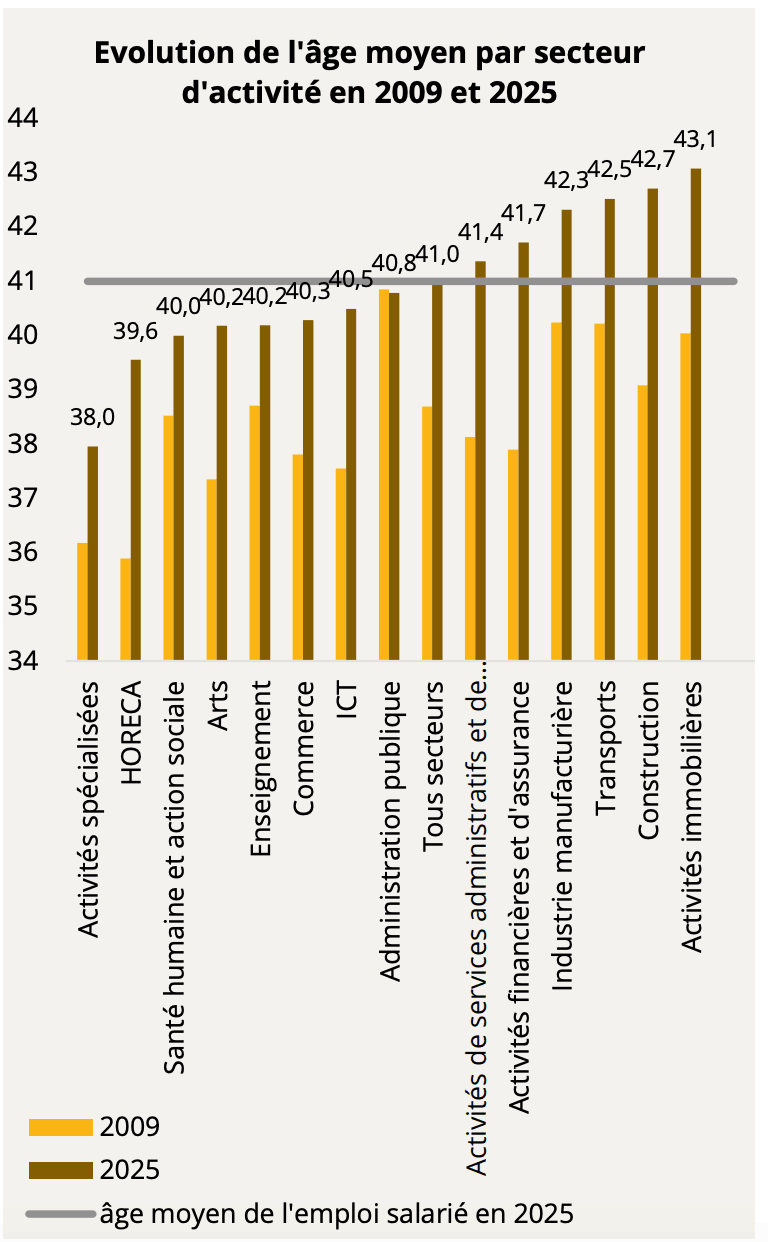
Only public administration is doing well in terms of the change in the average age of its employees. (Graph: Fondation Idea)
Sectors under pressure
Aging affects all sectors, with the exception of public administration where the average age of employees has remained stable. However, some professions are more affected than others:
- Finance and insurance: +3.8 years (reaching 41.7 years in 2025)
- Horeca: +3.7 years (reaching 39.6 years in 2025)
- Construction: +3.6 years (reaching 42.7 years in 2025)
Inversely, sectors that have seen strong growth in salaried employment, such as human health and social work (employment +103.6%) or specialised, scientific and technical activities (employment +99.8%), show a more moderate increase in average age (+1.5 years and +1.8 years respectively). Moreover, specialised activities remain the youngest sector, with an average age of 38.0 in 2025.
The analysis thus demonstrates an inverse relationship: sectors with low employment dynamics (such as finance or construction) are those that age the fastest.
Border commuters are accelerating the trend
Border commuter status is now a key factor in ageing. Whereas in 2009, residents were on average older than cross-border commuters, the trend has been reversed in 2025.
The average age of cross-border commuters has increased by 3 years between 2009 and 2025 (reaching 41.1 years), compared with just +1.6 years for residents (40.8 years). The ageing process is therefore twice as fast for non-residents, particularly those from Germany, Belgium and France.
This situation can be explained by the high concentration of cross-border commuters in the sectors that have aged the most. For example, construction (60.9% cross-border commuters) and financial and insurance activities (46% cross-border commuters) are among those that have seen the average age of their employees rise by 3 to 4 years.
The use of cross-border commuters (who account for 46% of salaried employment) has thus become a factor that accelerates the ageing of the working population. This development highlights a major challenge for the future. Ioana Pop’s analysis states, “If there are fewer and fewer young cross-border commuters entering the labour market in Luxembourg, then there is the possible problem of renewing the salaried workforce in the (near?) future.”
The ageing of the salaried workforce, whether linked to a better retention of older workers, a low attractiveness for young workers in the Greater Region or the effect of the Public Administration as a “stabiliser”, now calls for strategic thinking on the renewal of the country’s workforce.
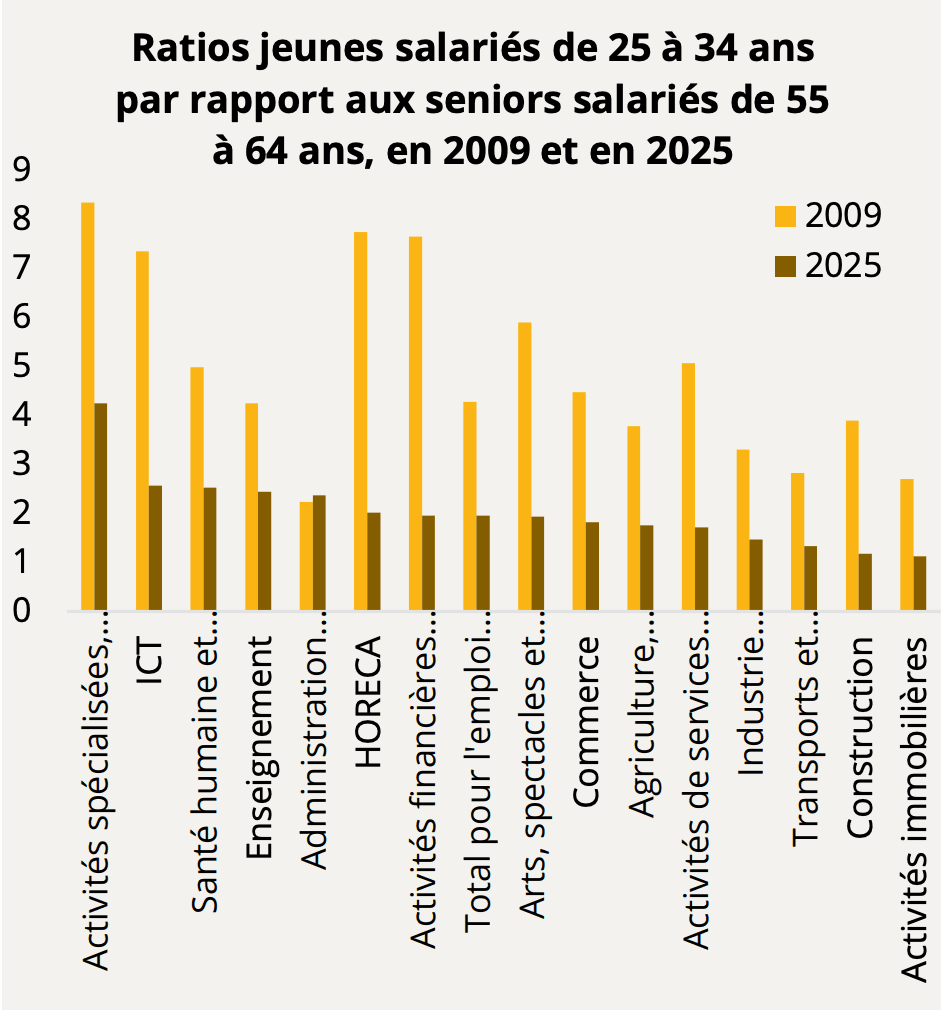
The ratio has fallen in all sectors without exception. (Graph: Fondation Idea)

