
In Luxembourg, we could say that the country is approaching almost total digital inclusion. However, certain disparities remain, and a small proportion of the population is still vulnerable to the challenges associated with using the internet. According to the Luxembourg Institute of Socio-Economic Research's annual report, based on Statec data and presented at the 5th Digital Inclusion Forum, in 2023 only 0.4% of residents have never used the internet. This figure represents a significant improvement on 2020, when it was still 1.5%. This progress demonstrates significant progress, but also highlights the need to continue to reduce digital inequalities in order to achieve full inclusion.
To better measure the phenomenon, Liser has defined three groups of users based on a statistical analysis of Internet usage, rather than relying solely on frequency of use. “Intermediate” users are the most numerous (39.4%). The report also identified 33.2% of heavy users. Low users accounted for 27.5% of the population. "We are therefore seeing a decrease in the proportion of low users and an increase in the proportion of heavy users", Liser pointed out in the report. Progress, then.
But some difficulties remain. 11% of internet users considered that the internet makes their lives more complicated. 12% experience a high level of stress when they use the internet. In its report, the Liser also mentioned "vulnerability factors" such as age, level of education and professional situation, which influence the perception of difficulties linked to the Internet.
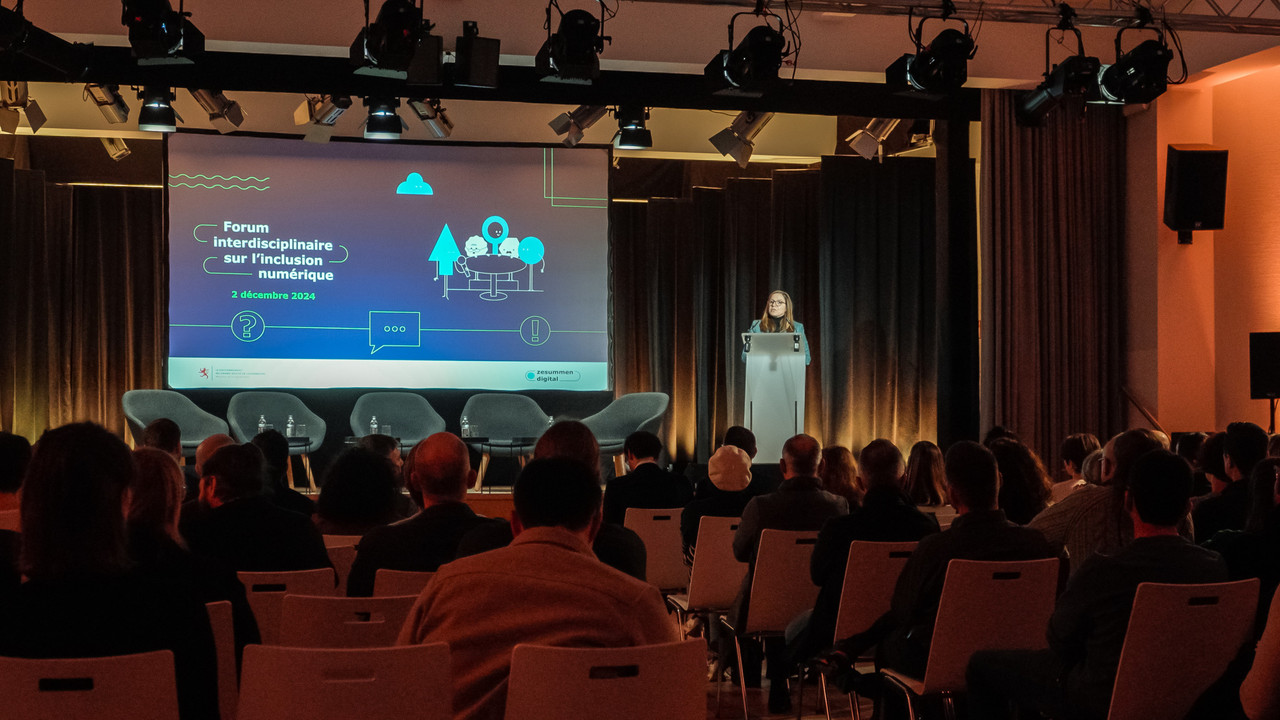
The minister for digitalisation, Stéphanie Obertin (DP), announced the launch of the ministry's 2025 call for projects to fund projects promoting digital inclusion, 2 December 2024. Over the years 2022, 2023 and 2024, the ministry financially supported 18 such projects. Photo: MinDigital
The report stated: “When we analyse the link between individual characteristics and difficulties linked to internet use (stress, more complicated life), we can mention the following highlights: being male is negatively linked to the likelihood of feeling stress when using the internet; compared to individuals aged under 30, being aged 50 and over is positively linked to the likelihood of feeling stress when using the internet and to the likelihood of finding life more complicated because of the internet. Having a qualification higher than lower or lower secondary education is positively associated with the probability of feeling stress, but is negatively associated with the probability of finding life more complicated because of the internet. Having a job is negatively associated with these two difficulties; finally, belonging to the sub-group of low internet users is positively associated with the probability of feeling stress and also with the probability of finding life more complicated because of the internet.”
Read also
Between the lines, the report put forward a number of recommendations and elements to be taken into account in the fight against the digital divide: i.e. people's computer skills beyond simple usage, the assistance received when using the internet, the level of skill required compared with the level of skill needed to use the internet as the individual wishes. According to Liser, it could also “be interesting to measure the acceptability of technological changes/mutations. Do individuals consider these changes to be too rapid?”
Revised digital inclusion plan
Drawn up in 2021, the National Action Plan for Digital Inclusion will be revised in 2026 to take account of recent developments in digital technologies. In its current version, it defines five main priorities: facilitating access to digital tools, encouraging the development of digital skills, counteracting regional differences in digital offerings, raising awareness of security and online information management, and motivating people to use tools.
Technological developments are adding their own set of challenges. The gap between those who have access to new technologies - and those who have mastered them - is widening still further as tools evolve rapidly. These developments also require ongoing training, which can exclude certain groups who are far removed from employment and/or digital technology. What's more, threats are multiplying and knowing how to guard against them is becoming increasingly complex. In its report on crime figures for 2023, the Luxembourg police reported a trend towards "an increase in criminal acts committed mainly via the computer", with a 31% rise in online fraud, a 13% rise in theft and a 21% rise in threats and insults.
Read also
The need to protect people who are far removed from digital technology from risks was discussed at length at the forum. The Bee Secure initiative is designed to do just that. It is run by the National Youth Service (SNJ) , in conjunction with the Luxembourg House of Cybersecurity, the police and the Luxembourg Public Prosecutor's Office.
On the ground, a number of associations are also working on a daily basis to further improve digital inclusion, including Goldenme, Digital Inclusion, Astrolabio’s Bénévol@ project and the Luxembourg Tech School. At the forum, the minister for digitalisation, 
Read the original French-language version of this news report here / lire en français