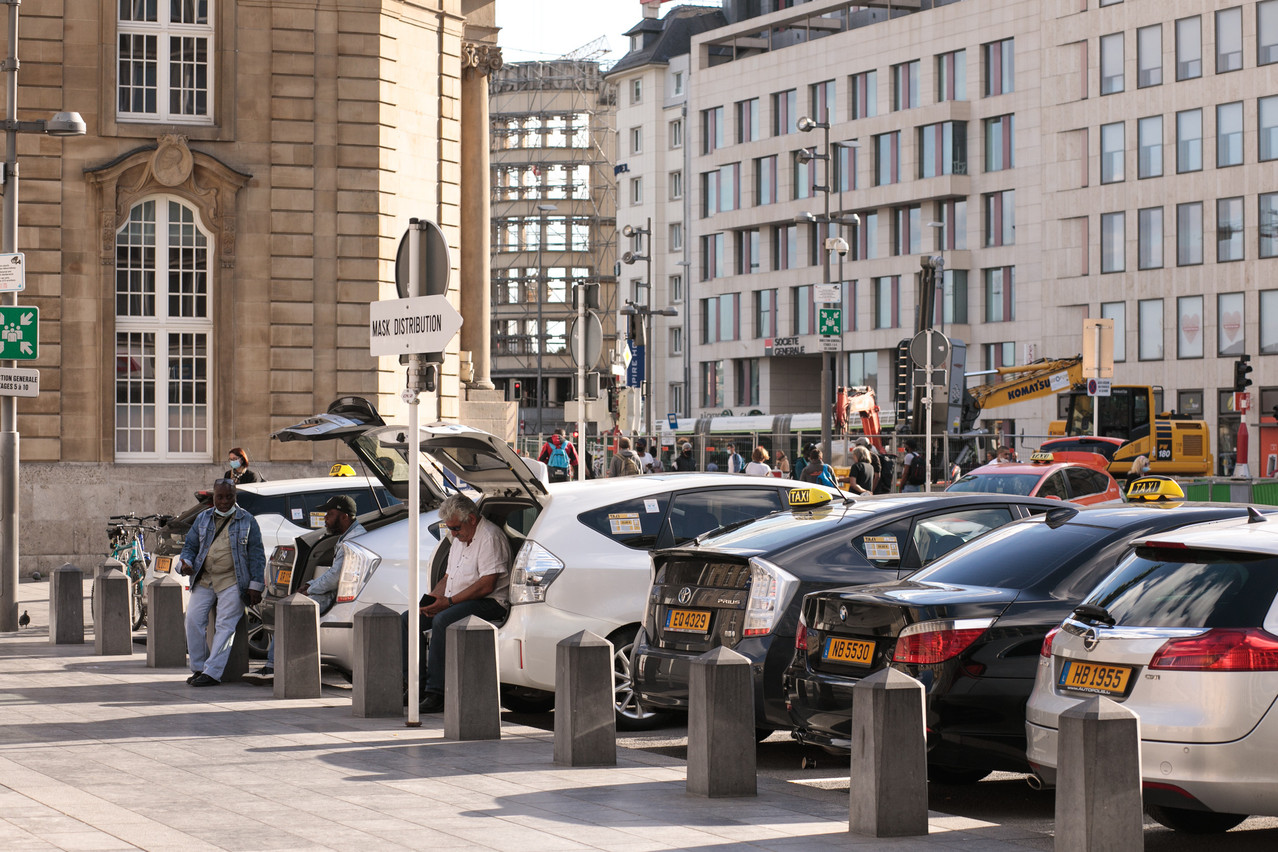
The absence of corporate customers is weighing on the taxi sector, which has just renewed a job retention plan until 30 June. “The planes are empty, as are the trains and hotels. People are not moving at the moment. Add to that the price of fuel, which is rising to unprecedented levels. The situation is very difficult to bear,” says Olivier Gallé, CEO of Colux.
The only good news is that the 11pm closing time for bars and restaurants has been lifted, which means that taxis are likely to see a return of night-time customers. “It’s still a bit early to see a trend, but last weekend we saw a lot of people again at night. Previously, with the obligation to close at 11pm in the hotel and catering industry, we had no more night drivers. We hope to recover some activity thanks to the people who go out for a drink and start going out again,” says Paulo Leitão, president of the federation of taxis, hire cars and ambulances. But the industry’s professionals are unanimous: night-time customers will not save the sector.
10-hour wait for a ride
With or without the Luxembourg nightlife, corporate customers have not yet returned to Luxembourg. The question is whether they will ever come back, with teleworking, video-conferencing, digital events and a still slow airline sector, all of this does not favour the return of these customers. “This situation will last for a long time before we get back to the levels of activity we saw in 2019. In any case, it won’t be in 2022,” says Paulo Leitão, who is also the CEO of World Taxi.
Before the health crisis, a driver would wait between ten minutes at peak airport times and an hour to get a ride at the airport.
Currently, to get a fare at Findel, “you have to wait between four and five hours. This is better than before, when it took 10 hours,” sighs Leitão. Before the health crisis, “a driver would wait between ten minutes or so at peak airport times and an hour to get a ride to the airport.”
The soaring fuel prices are not helping the already complicated situation for the sector. “Some companies have decided to increase the price per kilometre, while others are thinking about other solutions, such as electric cars, knowing that electricity has also increased and that the range of electric vehicles is not sufficient for our activity. We are trying to reduce costs as much as possible by training our drivers to drive efficiently. The cold weather does not help, as the car also has to be heated when the driver is waiting for a ride,” says the president of the taxi federation.
The Federation is currently approaching petroleum product suppliers to see if it is possible to negotiate a tariff for the entire sector. “It’s a recent idea, and we don’t know if it’s possible or to what extent,” Leitão said.
Between 100 and 150 active drivers
These difficulties have discouraged many drivers. As in the hotel and catering industry, several drivers have decided to leave the profession. “It’s a reality, there have been many departures. Imagine being in a car for hours on end without a customer, while the costs continue to rise,” says Gallé. “Companies have closed down, others have gone bankrupt. Some have simply given up the business. Working 12 hours to earn a good salary and a margin to keep the business going is worth it. But being in a car for 12 hours for minimum wage is not worth it,” confirms Leitão.
In 2021, the sector had 148 taxi companies for 1,200 to 1,300 drivers with a permit and a licence. “But at the moment there are, at most, between 100 and 150 active drivers in the country, no more,” says Paulo Leitão before explaining that “there is still a lot of partial unemployment in the sector.”
This also poses problems in terms of taxi maintenance. The cars are used to driving and spending a long period of time immobile can damage the mechanics. “We have seen large groups and small companies sell their cars and reduce their fleet. A vehicle that is stationary still needs to have a minimum of insurance to be able to be on the street,” says the president of the taxi federation, which has cut its own fleet in half.
I don't think this is the right time to launch a reform, as the financial situation is so difficult.
Waiting for taxi reform
The last difficulty is that the companies are waiting for the reform of the sector announced by transport minister François Bausch (Déi Gréng). Leitão speaks of an uncertain situation for managers who do not know when this reform will take place, and especially what it will bring. “We think it will happen again this year. We don’t have much information on the subject, we don’t know if the reform will open the market completely or if it will keep the same number of licences and zones. So we don’t know whether we will have to invest or disinvest. We have had meetings and discussions, and we are now waiting for the final bill. We are waiting, not knowing if we will have to turn left or right,” says Leitão.
“Yes, we are waiting. But I don’t think it’s the right time to launch a reform, as the financial situation is so difficult,” says Gallé. The latter is more in favour to wait and see. “There is a lack of dedicated spaces for taxis. The Cloche d’Or is being developed, but there is not a single parking space for taxis. The same goes for the new stadium and the major tram stops. In Clausen, there is a small hidden and poorly signposted space. It’s a detail, but I think that the City of Luxembourg and the ministry could have found solutions or been a little more attentive to our sector to improve the current situation,” Gallé.
This story was first published in French on Paperjam. It has been translated and edited for Delano.